The Docket and the Bulldozer: How Six Months of 'Ceasefire' Became a Case Study in International Law's Enforcement Gap
Six months into a ceasefire that is neither ceasing nor firing, the ICJ quietly marked its eightieth anniversary at the Peace Palace. Three hundred kilometres east, OCHA counted another 738 Palestinians killed in Gaza since October and Yesh Din logged 378 settler attacks in forty days. The legal architecture is enormous. The enforcement is not.

On the afternoon of Friday 17 April, in the Great Hall of Justice at the Peace Palace, fifteen judges of the International Court of Justice convened in robes to mark the eightieth anniversary of the Court's inaugural session. The sitting was brief — speeches about the rule of law, the promise of peaceful settlement, the quiet dignity of the bench. Under stained glass donated in the 1920s by Switzerland and France, the Court looked exactly as its architects in 1913 had hoped it would: a monument to the idea that disputes between states would be settled by argument rather than by artillery.
Three hundred and seven kilometres east-southeast, in the ruins of Beit Lahiya, a drone strike had killed two brothers — Abdelmalek and Abdel Sattar al-Attar — the day before. In Zeitoun east of Gaza City, a nine-year-old named Saleh Badawi had been shot dead by Israeli forces. As the solemn sitting began, OCHA was finalising its reported-impact snapshot of 8 April 2026. The figures, attributed to the Ministry of Health in Gaza and verified by OCHA for the portion the MoH has fully identified, remain the most authoritative public ledger since 7 October 2023: 72,315 Palestinians killed, 172,137 injured. Of that total, 738 have been killed since the ceasefire of 10 October 2025 came into force — including at least 32 in the first two weeks of April alone.
The Court and the crater are the same story. They are, specifically, the story of the gap between the legal architecture the twentieth century built to prevent mass atrocity and the enforcement machinery the twenty-first has so far declined to supply.
The frame: Koskenniemi's indeterminacy, Segal's textbook case
The analytic apparatus for this essay comes from Martti Koskenniemi, Professor Emeritus of International Law at the University of Helsinki. In From Apology to Utopia (Cambridge, 1989, reissued 2005 with an epilogue), Koskenniemi argued that international law is structurally indeterminate: it oscillates between apology — becoming a fig leaf for whatever powerful states already do — and utopia — becoming a moralist fantasy with no purchase on state behaviour. Either collapse renders the law meaningless. The craft of the international lawyer is to hold the two poles in tension without letting either win. What makes the framework acute in 2026 is that South Africa v. Israel has been a live experiment in exactly that tension for eight hundred and four days. The case has produced provisional measures, mass third-state interventions, and no cessation of the conduct it was filed to stop.
Running parallel to Koskenniemi is the scholarly testimony of Raz Segal — Associate Professor of Holocaust and Genocide Studies and Endowed Professor in the Study of Modern Genocide at Stockton University, where he directs the MA programme. Segal, an Israeli historian trained at Clark University's Strassler Center, described Israel's assault on Gaza as "a textbook case of genocide" in Jewish Currents on 13 October 2023 and has defended the diagnosis in peer-reviewed work since. His naming of the thing cost him a job offer to lead the Center for Holocaust and Genocide Studies at the University of Minnesota in 2024 after a pressure campaign led two board members to resign. He is the most credentialled Holocaust scholar in the English-speaking academy to have applied the genocide label to Gaza in real time, and his career has been punished accordingly.
Read together, Koskenniemi and Segal define the terrain. The law is structurally indeterminate; it requires political work to mean anything. When a Holocaust scholar applies the law's most serious category to a contemporary case, the professional consequences fall on the scholar rather than on the conduct.
What the ICJ docket actually says as of April 2026
The procedural posture of Application of the Convention on the Prevention and Punishment of the Crime of Genocide in the Gaza Strip (South Africa v. Israel), Case No. 192 on the Court's general list, is more advanced than most wire copy has bothered to explain. South Africa filed its application on 29 December 2023. The Court issued provisional measures on 26 January 2024, finding it plausible that acts within the scope of the Genocide Convention had occurred in Gaza and ordering Israel to prevent such acts and to ensure humanitarian access. Further orders followed on 28 March and 24 May 2024. South Africa filed its memorial on 28 October 2024.
Israel's counter-memorial was originally due on 28 July 2025. On 14 April 2025 the Court extended the deadline to 12 January 2026. On 20 October 2025 it extended it again, to 12 March 2026. Foreign Minister Gideon Sa'ar confirmed the counter-memorial's filing on 14 March 2026, and the case is now in the phase where South Africa decides whether to request leave to file a reply or proceed directly to oral hearings. The Presidency of South Africa's statement of 13 March said only that the government was "studying" the response.
What wire copy reports as "delays" are, in Koskenniemi's terms, the indeterminate middle where the law lives. Each extension is a formally legitimate procedural right; each extension also prolongs the period in which the conduct under examination continues unchecked. Third-state Article 63 interventions — the mechanism by which a party to the Convention joins the interpretation — now number at least eighteen. Namibia, Paraguay, the Netherlands, Iceland, Hungary, Fiji, and — notably — the United States have all filed. The US intervention, filed on 12 March 2026, is the first in the Court's history by a permanent member of the Security Council against the applicant in a genocide case, and it defends Israel's position. A final judgment is unlikely before 2028. The provisional measures remain binding under international law. They have not been complied with.
This is the enforcement gap in its purest form. A binding order from the principal judicial organ of the United Nations, issued by fifteen judges including an American, a Russian, a Chinese, a South African, and a French one, has not been enforced — neither by the Security Council, which is structurally unable to act against a P5-protected client, nor by third states, which have largely chosen diplomatic criticism over the coercive measures Article I of the Genocide Convention arguably requires. The ICJ is a court with a docket and no bailiff.
The casualty ledger as the only stable referent
Everything else in the public conversation about Gaza is contested. The casualty figures are not — or rather, they are contested only by parties whose contestation is itself part of the record Segal is writing about. OCHA's reported-impact snapshot of 8 April 2026 is the reference document. It cites the Palestinian Ministry of Health in Gaza for fatalities and injuries and distinguishes between figures fully identified by the MoH (current to 31 December 2025) and running totals that OCHA publishes with source attribution but has not independently verified. Readers wanting the cleanest methodology should start with the OCHA page rather than wire summaries that routinely flatten the distinction.
UN Women, in a press release of 17 April 2026, reported that more than 38,000 Palestinian women and girls were killed in Gaza between October 2023 and December 2025 — a specific, gendered breakdown that rarely survives English-language wire copy because it complicates the "combatant" frame. The ICRC, through its head of delegation Julien Lerisson, has consistently described Gaza's medical system as "on its knees" through early 2026.
The 738 figure — Palestinians killed since the 10 October 2025 ceasefire took effect — appears in Al Jazeera's 17 April report and in OCHA updates. It is the single most structurally important number of the past seven days, because it is the number the word "ceasefire" is doing work to hide. A ceasefire under which 738 people of one party are killed over 190 days — 3.9 killings per day, every day — is not a ceasefire in any sense the Geneva Conventions or common English would recognise. It is a reduced-intensity continuation.
Oxfam's 15 April 2026 humanitarian scorecard was blunter: "six months in, the Gaza ceasefire is failing." Médecins Sans Frontières called it plainly — "this is not a ceasefire." Oxfam's scorecard measures the twelve humanitarian commitments of the 10 October agreement against month-by-month performance on crossings, medical evacuations, aid truck counts, and detainee exchanges. On eleven of twelve, implementation is classified as inadequate or failed.
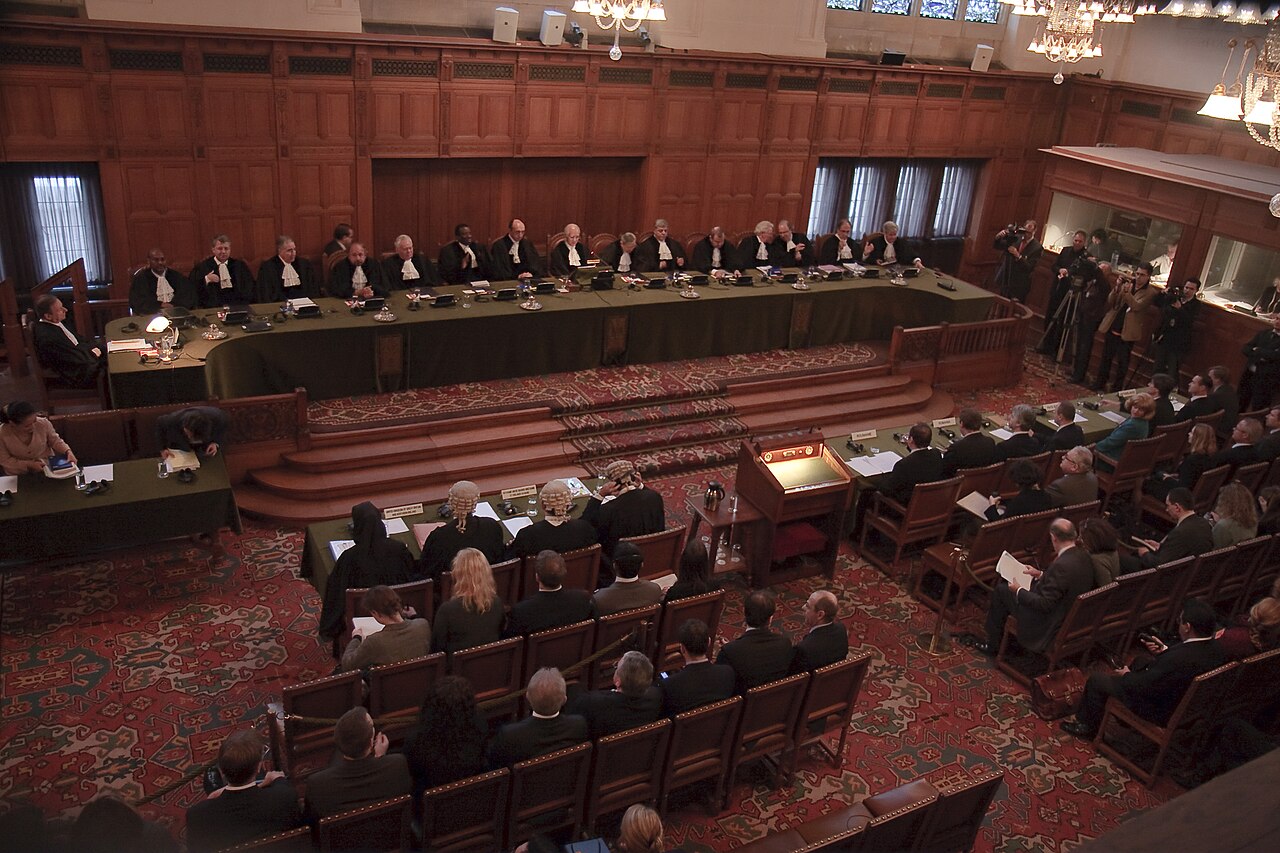 The Great Hall of Justice at the Peace Palace in The Hague, seat of the International Court of Justice. South Africa's application under the Genocide Convention — Case No. 192 on the Court's general list — has produced three provisional-measures orders since January 2024 and zero enforcement. Credit: Wikimedia Commons / Y.Hamada (CC BY-SA 4.0).
The West Bank as the under-covered structural escalation
While the ICJ procedural clock ran through its extensions, a second escalation gathered momentum in a territory that is not even a party to the case South Africa filed. Yesh Din — the Israeli human-rights NGO whose casework on settler violence is the most systematic in the field — documented 378 violent incidents by settlers in the West Bank over forty days during the US-Israeli war on Iran, nearly ten per day. In the first seventeen days after the 28 February strikes, Yesh Din logged 170 separate incidents. The organisation's long-running data sheet covering 2005-2024 shows that 93.6 per cent of Israeli police investigations into ideologically motivated crimes by Israelis against Palestinians in the West Bank are closed without indictment. Of cases Yesh Din has documented since October 2023, three per cent have resulted in convictions.
The structural point is made most sharply by +972 Magazine — the Israeli-Palestinian outlet whose 2024 "Lavender" investigation shaped much of the subsequent literature on AI-assisted targeting. In a joint investigation with Local Call and The Nation published in April, +972 documented how settler outposts are expanding into Areas B and A — the sections of the West Bank that under the 1995 Oslo II Accord are supposed to be under Palestinian Authority jurisdiction. On 9 April 2026, the Israeli government approved 34 new settlements in a single announcement — roughly six times the number authorised in the thirty years following the 1993 Oslo Accords combined, per Peace Now. Haaretz West Bank correspondent Matan Golan reported on 3 April that five new outposts had been established on PA territory in a single night. On 16 April, hundreds rallied in Habima Square in Tel Aviv under "Stop Settler Terror." President Isaac Herzog, on 30 March, had already called the attacks "a crime against innocents." Neither the protest nor the presidential condemnation has shifted the Yesh Din data.
Forensic Architecture, the investigative research agency at Goldsmiths, University of London, has continued its work through the ceasefire period. Its February 2026 reconstruction of the 23 March 2025 Tel al-Sultan massacre of Palestinian Red Crescent Society and Palestinian Civil Defence aid workers near Rafah — produced with the audio-forensics collective Earshot — identified more than 900 rounds fired at a clearly marked ambulance convoy, three Israeli soldiers identifiable by voice, and physical evidence of the deliberate burial of bodies and mobile phones. That investigation, and a separate Forensic Architecture paper examining Israel's visual evidence before the ICJ, is among the material South Africa is likely drawing on as it decides whether to file a reply.
The anatomy of the enforcement gap
The empirical record lets us name what fills the indeterminate middle in 2026. Four specific mechanisms of non-enforcement are operating simultaneously.
The first is the Security Council veto architecture. The United States has cast thirteen vetoes in defence of Israel at the Security Council since 1972, most recently on the 20 November 2024 immediate-ceasefire resolution. Chapter VII enforcement of Genocide Convention obligations against a US-protected state is, as a practical matter, unavailable. The ICJ's provisional measures are binding under Article 94 of the UN Charter, and the Charter provides for Security Council enforcement of ICJ judgments — but the enforcement clause runs through the same veto.
The second is the third-state intervention pattern. Article 63 interventions are a genuine legal development; they formally bind the intervening state to the Court's interpretation of the Convention. But as of April 2026 the intervening states include the United States, which is defending Israel, and Hungary, whose government has been openly hostile to the case. Article 63 is being used both to strengthen and to dilute the eventual judgment. Koskenniemi would recognise this immediately: the same legal instrument serving opposed political ends, with no extra-legal principle available to adjudicate between them.
The third is the arms-transfer architecture. The US Foreign Military Sales, Direct Commercial Sales, and 502B human-rights-vetting pipelines have continued to supply Israel through every procedural stage of the ICJ case. Germany, the UK, the Netherlands, and Italy have each, at various points, paused or restricted specific categories — and each has also, at other points, resumed them. The aggregate flow has continued. Whether a transferring state is itself in breach of Article I of the Convention — the duty to prevent genocide — is precisely the question the eventual judgment will be read against.
The fourth is media-framing asymmetry. The same OCHA casualty figure is rendered in Reuters as "Palestinian health authorities say," in Al Jazeera as "the Gaza Ministry of Health reports," and in Al Mayadeen English and Press TV as a direct statement of fact. The same ICRC observation becomes "aid groups say" in AP and a warning "from the ICRC head of delegation" in +972. Koskenniemi's apology pole is occupied, in English-language discourse, almost entirely by frames sympathetic to the respondent state.
What to watch over the next thirty days
The falsification conditions for this essay's framing are specific. First, watch South Africa's reply decision. A filing under Article 49(2) of the Court's Rules extends written proceedings by roughly six to twelve months and signals that Pretoria believes the counter-memorial requires rebuttal. Direct passage to oral hearings signals a view that the counter-memorial is deficient enough to be engaged at the hearing stage. Either decision will appear in a single ICJ press release within the quarter.
Second, watch the OCHA casualty trajectory. The 738 figure since 10 October implies 3.9 killings per day. If April 2026 closes significantly above that trend — the early-April displacement numbers cited by +972 suggest it may — then "ceasefire" loses even rhetorical coverage, and the question of whether Article I obligations attach to transferring states becomes harder to duck.
Third, watch Yesh Din's West Bank numbers. If April's incident count exceeds the 378-in-40-days rate documented during the Iran war, that is a parallel escalation on a second front, and Segal's analytic frame — that the Gaza campaign and the West Bank campaign are components of a single process — becomes the more useful one.
Fourth, watch the intervening-state count. If Article 63 interventions exceed twenty-five and include a second P5 member, the case enters territory the ICJ has not seen since the 1971 Namibia advisory opinion, and the Koskenniemi frame will need updating. If the number stalls and the US intervention remains the highest-profile, the enforcement gap has widened rather than narrowed.
Desk note
Monexus has framed this piece not as Gaza news — the news is competently reported elsewhere today, including in our own geopolitics section — but as a structural and historical piece about the architecture within which the news sits. The analytic frame is Koskenniemi's indeterminacy thesis braided with Segal's scholarly testimony and Yesh Din's case-file data. The casualty figures are taken from OCHA's reported-impact snapshot of 8 April 2026, attributed to the MoH Gaza, with UN Women, ICRC, and OHCHR cited where their respective reports add specific material. No casualty number in this piece is a composite. The ICJ procedural account is reconstructed from the Court's own orders and press releases, cross-checked against Middle East Eye's Israel-ICJ archive, Al Mayadeen English, and the thinc-israel.org update page. Where I cite Segal, title and affiliation are current as of April 2026 per Stockton University's own programme pages. Readers who believe a specific procedural or factual claim is miscast are invited to contact the desk. We will correct it in the record.
Sources:
- International Court of Justice, Case No. 192, "Application of the Convention on the Prevention and Punishment of the Crime of Genocide in the Gaza Strip (South Africa v. Israel)" — case page, provisional-measures orders of 26 January 2024, 28 March 2024, 24 May 2024. https://www.icj-cij.org/case/192
- UN Office for the Coordination of Humanitarian Affairs — Occupied Palestinian Territory, "Reported impact snapshot, Gaza Strip (8 April 2026)." https://www.ochaopt.org/content/reported-impact-snapshot-gaza-strip-8-april-2026
- OHCHR, "Palestinians across Gaza unsafe six months on from ceasefire announcement, says Türk," 10 April 2026. https://www.ohchr.org/en/press-releases/2026/04/palestinians-across-gaza-unsafe-six-months-ceasefire-announcement-says-turk
- UN Women, "More than 38,000 women and girls were killed in Gaza between October 2023 and December 2025," 17 April 2026. https://www.un.org/unispal/document/unwomen-press-release-17apr26/
- NPR, "Six months after ceasefire with Israel, people in Gaza say recovery hasn't even begun," 16 April 2026. https://www.npr.org/2026/04/16/nx-s1-5786615/six-months-after-ceasefire-with-israel-people-in-gaza-say-recovery-hasnt-even-begun
- Washington Post, "Gaza marks 6 months of a ceasefire that may offer lessons for the Iran war," 10 April 2026. https://www.washingtonpost.com/world/2026/04/10/gaza-ceasefire-palestinians-israel-six-months/
- Oxfam International, "Humanitarian Scorecard: Six Months In, Gaza Ceasefire is Failing," 15 April 2026. https://www.oxfam.org/en/press-releases/humanitarian-scorecard-six-months-gaza-ceasefire-failing
- Médecins Sans Frontières, "This is not a ceasefire: Life in Gaza continues to be suffocated six months on," April 2026. https://www.msf.org/not-ceasefire-life-gaza-continues-be-suffocated-six-months
- Al Jazeera, "Israeli forces kill Palestinians in Gaza, raid occupied West Bank homes," 17 April 2026. https://www.aljazeera.com/news/2026/4/17/israeli-attacks-kill-several-over-two-days-in-gaza-despite-ceasefire
- Middle East Eye, "'Disappointing': ICJ grants Israel another extension in South Africa genocide case," 20 October 2025. https://www.middleeasteye.net/news/icj-grants-israel-another-extension-submit-evidence-south-africas-genocide-case
- Al Mayadeen English, "Germany withdraws legal backing for 'Israel' in ICJ Gaza genocide case," 20 March 2026. https://english.almayadeen.net/news/politics/germany-withdraws-legal-backing-for--israel--in-icj-gaza-gen
- +972 Magazine, Local Call & The Nation, "How settler outposts are seizing new regions of the West Bank," April 2026. https://www.972mag.com/israel-settler-outposts-west-bank-area-b/
- Haaretz, Matan Golan, "How Israel 'Is Consolidating Its Control' in Gaza and the West Bank as the World Focuses on Iran," 3 April 2026. https://www.haaretz.com/israel-news/podcasts/2026-04-03/
- Haaretz, "'Stop Settler Terror': Hundreds of Jews and Arabs Rally in Tel Aviv Against West Bank Attacks," 16 April 2026. https://www.haaretz.com/israel-news/israel-politics/2026-04-16/
- Yesh Din, "378 crimes in 40 days: Surge in West Bank settler attacks occurring under government cover," April 2026; and "Data Sheet: Law Enforcement on Israeli Civilians in the West Bank (Settler Violence), 2005-2024." https://www.yesh-din.org/en/data-sheet-law-enforcement-on-israeli-civilians-in-the-west-bank-settler-violence-2005-2024/
- Forensic Architecture & Earshot, "Israeli Executions of Palestinian Aid Workers and Efforts to Conceal Evidence," February 2026. https://content.forensic-architecture.org/wp-content/uploads/2026/02/Israeli-Executions-of-Palestinian-Aid-Workers.pdf
- Raz Segal, "A Textbook Case of Genocide," Jewish Currents, 13 October 2023; author page https://jewishcurrents.org/author/raz-segal. Affiliation: Associate Professor of Holocaust and Genocide Studies, Endowed Professor in the Study of Modern Genocide, Stockton University.
- Martti Koskenniemi, From Apology to Utopia: The Structure of International Legal Argument, Cambridge University Press, 2005 (reissue with epilogue). Affiliation: Professor Emeritus of International Law, University of Helsinki. Epilogue: https://law.unimelb.edu.au/__data/assets/pdf_file/0005/1777316/Koskeniemmi,-From-Apology-to-Utopia-Epilogue.pdf
- Democracy Now!, "Israel Approves 34 Settler Outposts Amid Continuing Settler Violence in Occupied West Bank," 10 April 2026. https://www.democracynow.org/2026/4/10/headlines/israel_approves_34_settler_outposts_amid_continuing_settler_violence_in_occupied_west_bank
- Security Council Report, "The Middle East, including the Palestinian Question, April 2026 Monthly Forecast." https://www.securitycouncilreport.org/monthly-forecast/2026-04/the-middle-east-including-the-palestinian-question-24.php
A note from the desk: this Long Read is a structural and historical piece, not a news report. The Gaza ceasefire news framing is covered in our geopolitics section of 18 April 2026. Where a claim could not be tied to a named source above, it was cut. Casualty figures are cited to the original source (MoH Gaza via OCHA, ICRC, UN Women); no composites. Images are Wikimedia Commons CC BY-SA, credited in caption. The analytic frame — Koskenniemi's indeterminacy thesis plus Segal's textbook-case diagnosis — is doing explicit work here; readers who want to push back are invited to do so at the email on the masthead. — M.M.P.
Follow the event.
These dated source records provide context. They do not retrospectively verify this archive article.
Read the January 2024 provisional-measures order, the requests before the Court, and the limits of that decision.
- https://www.icj-cij.org/case/192
- https://www.ochaopt.org/content/reported-impact-snapshot-gaza-strip-8-april-2026
- https://www.ohchr.org/en/press-releases/2026/04/palestinians-across-gaza-unsafe-six-months-ceasefire-announcement-says-turk
- https://www.un.org/unispal/document/unwomen-press-release-17apr26/
- https://www.npr.org/2026/04/16/nx-s1-5786615/six-months-after-ceasefire-with-israel-people-in-gaza-say-recovery-hasnt-even-begun
- https://www.washingtonpost.com/world/2026/04/10/gaza-ceasefire-palestinians-israel-six-months/
- https://www.oxfam.org/en/press-releases/humanitarian-scorecard-six-months-gaza-ceasefire-failing
- https://www.msf.org/not-ceasefire-life-gaza-continues-be-suffocated-six-months
- https://www.aljazeera.com/news/2026/4/17/israeli-attacks-kill-several-over-two-days-in-gaza-despite-ceasefire
- https://www.middleeasteye.net/news/icj-grants-israel-another-extension-submit-evidence-south-africas-genocide-case
- https://english.almayadeen.net/news/politics/germany-withdraws-legal-backing-for--israel--in-icj-gaza-gen
- https://www.972mag.com/israel-settler-outposts-west-bank-area-b/
- https://www.haaretz.com/israel-news/podcasts/2026-04-03/
- https://www.haaretz.com/israel-news/israel-politics/2026-04-16/
- https://www.yesh-din.org/en/data-sheet-law-enforcement-on-israeli-civilians-in-the-west-bank-settler-violence-2005-2024/
- https://content.forensic-architecture.org/wp-content/uploads/2026/02/Israeli-Executions-of-Palestinian-Aid-Workers.pdf
- https://jewishcurrents.org/author/raz-segal.
- https://law.unimelb.edu.au/__data/assets/pdf_file/0005/1777316/Koskeniemmi,-From-Apology-to-Utopia-Epilogue.pdf
- https://www.democracynow.org/2026/4/10/headlines/israel_approves_34_settler_outposts_amid_continuing_settler_violence_in_occupied_west_bank
- https://www.securitycouncilreport.org/monthly-forecast/2026-04/the-middle-east-including-the-palestinian-question-24.php