The Chokepoint and the Carve-Out: How Washington Bombed One Oil Producer and Subsidised the Other in the Same Week
On the morning of 18 April, IRGC gunboats fired on an Indian tanker off the coast of Oman while, seven thousand kilometres away, the US Treasury quietly extended a licence letting Russian crude keep moving. The two stories, read together, describe something the wire copy refuses to name: a sanctions regime calibrated not to stop oil, but to choose whose oil gets sold.

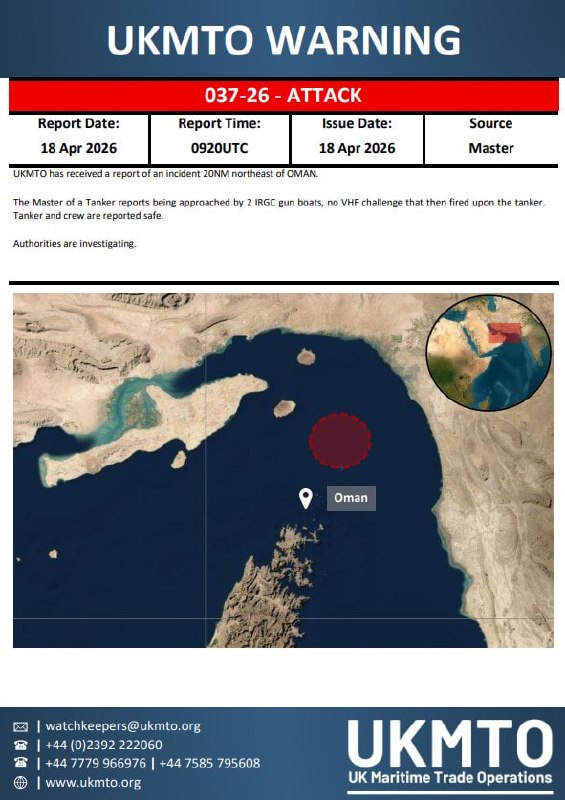
At 10:45 GMT on Saturday, 18 April, a broadcast fragment from British Naval Operations skidded across every maritime desk between Singapore and Rotterdam. The UK Maritime Trade Operations centre — UKMTO, the quiet London room that underwrites the insurance market's confidence in Gulf shipping — reported that two Islamic Revolutionary Guard Corps gunboats had approached and opened fire on a tanker some twenty nautical miles northeast of Oman's coast. The vessel was, by several reconstructions circulating on resistance-aligned Telegram channels, the Indian-flagged VLCC Sanmar Herald, which had been renamed in recent weeks and was attempting to transit the Strait of Hormuz without IRGC authorisation. Two Indian vessels were ultimately forced to turn back. No injuries were reported. Brent crude, which had cratered nearly twelve percent the previous day on Foreign Minister Abbas Araghchi's claim the strait was "completely open," began to crawl back above ninety-one dollars within the hour.
At almost the same moment, in an unsigned Federal Register notice routed through the Office of Foreign Assets Control, the US Treasury Department issued a one-month general licence authorising the continued sale of Russian crude oil and petroleum products loaded onto any vessel on or before 04:01 GMT on 17 April. The authorisation runs until 16 May. It was the second such waiver in five weeks.
The nut graf: two desks, one policy
These are not two stories. They are one story told through two instruments — the gunboat and the general licence — and they converge on a question the wire copy has been studiously avoiding. If the United States was willing to bomb Iran's oil infrastructure in March, killing an estimated twenty percent of seaborne global supply overnight, why is it now actively underwriting the very Russian crude it spent the previous three years promising to strangle? The answer is not hypocrisy. It is policy. What we are watching, in real time, is the American sanctions apparatus revealing itself as a filtering mechanism, not a moral one. This essay examines how the coverage of this week's most consequential energy-and-war story — the gap between the Hormuz blockade and the Russian-oil carve-out — is not a contradiction at all. It is the system working exactly as designed.
The immediate story
On the Iranian side, the sequence began shortly before ten in the morning Tehran time. Spokesman of the Khatam al-Anbiya Central Headquarters, Brigadier General Ebrahim Zolfaghari, announced that control of the Strait of Hormuz had "reverted to its previous state" and that the waterway was once again "under the strict management and control of the armed forces." Within forty minutes, Ebrahim Azizi, head of the Iranian Parliament's National Security Committee, echoed the line. Parliament Speaker Mohammad Bagher Ghalibaf, who had authored the ten-point ceasefire plan earlier in the month, confirmed that passage would now require "Iranian authorisation" and follow a "designated route." By midday, Al Jazeera was reporting that approximately twenty vessels had turned back near the entry to the strait, while Reuters tracking data cited in the Irish Times liveblog showed four liquefied-petroleum-gas carriers still departing the Gulf under convoy.
The Iranian framing, delivered through Press TV, Tasnim, Fars, and IRNA, was procedural: Tehran was not initiating an escalation, it was responding to ongoing American "piracy." The reference was to the US naval blockade of Iranian ports declared on 13 April — the measure which, according to the Pentagon's own statements cited by CNBC, has deterred thirteen ships from loading Iranian crude at Kharg Island. By Iran's reading, the 17 April opening had been conditional on American reciprocity. When the blockade persisted, Tehran closed the tap.
The American framing, delivered by the same wire services, was almost exactly inverted. The IRGC had "reimposed restrictions." Iran had "reversed course." The Trump administration, through Energy Secretary Chris Wright and Joint Chiefs Chairman Dan Caine, maintained the line that Iran was the sole cause of disrupted flow. The fact that US-Israeli strikes on 28 February — strikes that, according to the 2026 Strait of Hormuz crisis chronology compiled on Wikipedia and corroborated by Al Jazeera's 14 April tally of 279 transits since hostilities began versus roughly one hundred per day in peacetime — had collapsed maritime traffic by over ninety-five percent, did not feature as cause in the administration's messaging. It featured, if at all, as context.
The counter-story
The non-Western desks told a different story, and it was not simply a pro-Iran story. TASS carried Russian envoy Kirill Dmitriev's observation that "more and more countries, including the US, are recognising the systemic importance of Russian oil and gas for the global economy." Al Alam's Arabic service carried the real-time IRGC radio transmissions directing commercial ships to return to anchorage. Press TV circulated commentary from the American journalist Max Blumenthal — "As soon as Iran closed the strait of Hormuz, the US lost the war" — a line the Western wires did not touch. Xinhua, citing Fars, carried the IRGC claim as a straight statement of fact; the New York Times in the same hour described it as a "threat."
Most significantly, the Russian Telegram channel Rybar, whose analysis is followed by a number of European energy desks for its unsentimental take on market mechanics, ran a piece at 10:14 GMT titled, in its English-language edition, "Oil keeps flowing — US extends sanctions relief." The argument was blunt: Washington had opened the "emergency valve" a second time specifically to stop domestic American gasoline prices from reaching politically intolerable levels during an election year. Rybar framed the move as a concession to Moscow's structural leverage. That framing is inconvenient for wire services that have spent three years describing Russian energy as "isolated" from global markets. But the OFAC document itself, cited by TASS and The Moscow Times, does not isolate Russian oil. It authorises it.
Iranian Foreign Minister Abbas Araghchi put the structural point more sharply than any analyst. In remarks carried by Tasnim and repeated across Farsi and Arabic Telegram on 18 April, he observed that if Iran had been Russia — or, implicitly, if Iran's economy had been integrated into the Western energy architecture the way Russia's remains — there would be no blockade. The comment did not travel into English-language wire copy.
The frame: five filters applied, forty years on
The analytical model for how elite narratives are shaped through media structures names five filters: concentrated ownership of media firms; dependence on advertising revenue; reliance on official and corporate sourcing; flak — the organised negative response that punishes deviations; and a final ideological filter, originally anti-communism, since updated to anti-terrorism or, more broadly, a fear-based external enemy framing. these structural filters do not require conspiracy. They require only structure. And this week's coverage runs through each of them in sequence.
Consider sourcing first. Every major English-language account of the Hormuz incident on 18 April ultimately traces to two institutional sources: UKMTO, which is a British naval body, and the US Fifth Fleet public-affairs office in Bahrain. The IRGC's radio transmissions, broadcast on VHF Channel 16 and recorded by multiple Persian Gulf shipping agents, entered English-language coverage only as paraphrase, and almost always with the prefix "Iranian state media claims." The sourcing asymmetry is not speculative here; it is measurable. Non-Western primary speech becomes Western secondary rumour.
Consider ownership. The extension of the Russian oil waiver was announced via OFAC general licence, a document routinely reported by Reuters, Bloomberg, and the Financial Times. But the framing of that extension — whether it is a pragmatic concession to market reality or a scandalous carve-out that rewards Moscow — tracks almost perfectly with the ideological disposition of each outlet's corporate parent and advertising base. The Moscow Times, RFE/RL, and the Kyiv desk of Reuters treated it as a betrayal of Ukraine. The American business press treated it as rational supply management. Neither frame is wrong in the narrow factual sense. Both are structurally determined.
the institutional pressure mechanism operated in the opposite direction. Treasury Secretary Scott Bessent, who had stated on 15 April that Washington "does not plan to extend carve-outs from its sanctions for Russian and Iranian oil," reversed himself within seventy-two hours. The reversal was not prompted by new facts. It was prompted by the flak a domestic gasoline price shock would generate inside the Republican coalition. Senator Chuck Schumer's counter-response — noting that "Putin has been one of the biggest beneficiaries of President Trump's war against Iran, as Russia saw oil revenues nearly double in March" — received polite coverage and no policy response. French Finance Minister Roland Lescure's warning that "Russia mustn't be getting benefits from what's happening in Iran" was similarly absorbed without consequence. The filter determines which pressure is costly and which is decorative.
The final filter — the external-enemy frame — is where the policy logic becomes most legible. Iran occupies the position in the American ideological apparatus that the Soviet Union occupied in 1988. Its oil is not fungible with Russian oil because the classification is not economic, it is civilisational. Russian crude can be waived. Iranian crude must be blockaded. The material behaves identically in an engine; the ideology does not. Ali Vaez, Iran Project Director at the International Crisis Group and adjunct professor at Georgetown University's Edmund A. Walsh School of Foreign Service, has been making a version of this point since late March. Speaking to ANI News on 27 March, he observed that "the Iranians believe they have the upper hand by holding the global economy hostage through the potential closure of the Strait of Hormuz" — a framing that grants Tehran structural agency most Western analysts deny it. In the Crisis Group Q&A co-authored with Yasmine Farouk and Chris Newton and published on 10 April, the team concluded that "effective control of the Strait of Hormuz gives Iran an asymmetric advantage that helps shield it from what it views as an existential threat from US and Israeli strikes." The observation is analytic, not sympathetic. But it is the observation the wire copy cannot quite make.
"Closure of the Strait of Hormuz would disrupt roughly a fifth of globally traded oil overnight — and prices wouldn't just spike, they would gap violently upward on fear alone." — Ali Vaez, Iran Project Director, International Crisis Group, quoted in Al Jazeera, 1 March 2026
 IRGC operational imagery circulated on Telegram channel AMK Mapping, 18 April 2026, following the announcement that the Strait of Hormuz had reverted to "strict military oversight." Credit: Telegram / AMK_Mapping.
The precedent: Carter, the Shah, and the 1979 freeze
The instinct to read the 18 April sequence as unprecedented is itself a product of structural coverage filtering. There is a precise historical analogue, and it is not Suez 1956 or even Tanker War 1984. It is the November 1979 Iranian asset freeze — Executive Order 12170, signed by Jimmy Carter fourteen days after the embassy seizure. That freeze blocked roughly twelve billion dollars of Iranian state assets held in US and US-subsidiary banks. It was the first modern use of the International Emergency Economic Powers Act (IEEPA), the statute under which every subsequent OFAC programme, including the Russian licences extended this week, has been issued. Carter's freeze remained structurally in place through the Algiers Accords of 1981, and large portions of the underlying architecture were never dismantled. Nearly fifty years later, the IEEPA framework that froze Iranian crude in 1979 is the same framework that, on 18 April 2026, exempts Russian crude through Executive Order and general licence.
Two features of the 1979 precedent are instructive. First, the freeze was calibrated to domestic American tolerance. It was imposed when gasoline was at $1.19 a gallon — already a generational high — and Carter was watching re-election polling collapse. The political economy of sanctions has always been an equilibrium between foreign coercion and domestic price tolerance. Bessent's reversal in April 2026, under identical pressure, belongs to the same family. Second, the 1979 freeze produced a durable bureaucratic infrastructure that has since been applied to Cuba, Libya, Iraq, Myanmar, Venezuela, Syria, Russia, and now Iran again. Each application was described at the time as exceptional. The infrastructure is not exceptional. It is permanent. The exceptions are rhetorical.
The stakes: what to watch, and where the story gets confirmed or falsified
Three indicators will tell us whether this analysis is right over the next thirty days. First, the Treasury general licence expires at 04:01 GMT on 16 May. If it is extended again — particularly if it is extended quietly, via unsigned notice, without a corresponding softening of the Iran blockade — that is confirmation that the sanctions system is operating on price-tolerance logic rather than on its stated moral rationale. Second, watch the Brent futures curve into June. If the contango widens while spot oscillates around ninety dollars, traders are pricing in structural disruption regardless of headline ceasefire news, and the IRGC's asymmetric leverage over Hormuz is effectively capitalised into the term structure. Third, watch Indian-flag tanker movements. New Delhi has been one of the largest non-Western buyers of both Russian and Iranian crude. If Indian-flag vessels continue to attempt Hormuz transits without IRGC authorisation, and if they are increasingly fired upon, that is the G7-versus-BRICS energy partition becoming kinetic — not rhetorical.
The falsification conditions are equally clear. If the waiver lapses on 16 May and is not renewed, and Brent climbs through the policy pain, then the administration was willing to pay an economic price rather than continue to subsidise Russian export revenues. That would not vindicate the sanctions regime's moral logic, but it would complicate the structural reading. If, conversely, the blockade on Iran eases in a way that restores roughly equal treatment of the two sanctioned producers, then the civilisational filter has weakened. Neither outcome is the most likely scenario. The most likely scenario — based on Bessent's behaviour this week, on the lobbying patterns of American refiners reported by Reuters on 16 April, and on the structural incentives Crisis Group has mapped — is that the waiver is extended a third time and Iran remains the designated enemy.
Desk note
Monexus framed this as a structural media story, not a Middle East story and not a Russia story, because reading either chokepoint in isolation misses the policy that links them. The Western wires have written the two events into separate beats — security desk for the tanker, economics desk for the waiver — and that beat separation is itself the first filter at work. Our argument is that the separation is editorial, not real, and that the combined sequence describes a sanctions architecture calibrated to American domestic price tolerance while preserving an ideological distinction between acceptable and unacceptable oil. When the next waiver is extended, we will say so plainly. If we are wrong, we will say that too.
Sources:
- The Moscow Times, "U.S. Extends Sanctions Waiver on Purchases of Russian Oil," 18 April 2026. https://www.themoscowtimes.com/2026/04/18/us-extends-sanctions-waiver-on-purchases-of-russian-oil-a92533
- TASS, "US allows sales of Russian oil loaded before April 17 to continue until May 16," 18 April 2026. https://tass.com/world/2119017
- Al Jazeera, "How many ships have passed the Strait of Hormuz and how many were attacked?" 14 April 2026. https://www.aljazeera.com/news/2026/4/14/how-many-ships-have-passed-the-strait-of-hormuz-and-how-many-were-attacked
- Al Jazeera, "How US-Israel attacks on Iran threaten the Strait of Hormuz, oil markets," 1 March 2026. https://www.aljazeera.com/news/2026/3/1/how-us-israel-attacks-on-iran-threaten-the-strait-of-hormuz-oil-markets
- Irish Times, "Iran, US, Israel, Strait of Hormuz — latest live updates," 18 April 2026. https://www.irishtimes.com/world/middle-east/2026/04/18/iran-us-israel-strait-of-hormuz-latest-live-updates/
- CNBC, "Pentagon: Iran blockade near Hormuz Strait deterred 13 ships," 16 April 2026. https://www.cnbc.com/2026/04/16/trump-iran-war-hormuz-strait-blockade.html
- International Crisis Group, Farouk, Newton & Vaez, "With a Fragile Ceasefire under Threat, What Future for the Strait of Hormuz?" 10 April 2026. https://www.crisisgroup.org/qna/global/iran-israelpalestine-united-states/fragile-ceasefire-under-threat-what-future-strait-hormuz
- Chatham House, "How to keep the Strait of Hormuz open in the long term," April 2026. https://www.chathamhouse.org/2026/04/how-keep-strait-hormuz-open-long-term
- US Department of the Treasury, Office of Foreign Assets Control, Russia-related General License authorising wind-down of transactions involving Russian-origin crude oil and petroleum products loaded before 17 April 2026 (referenced in TASS/Moscow Times reporting of 18 April). https://ofac.treasury.gov/sanctions-programs-and-country-information/russian-harmful-foreign-activities-sanctions
- Press TV (Telegram), IRGC Navy statements circulated 18 April 2026, 09:52–10:36 GMT.
- Tasnim News (Telegram), Abbas Araghchi and Mojtaba Zolnour remarks, 18 April 2026.
- Xinhua (via Fars), "Strait of Hormuz returns to previous state," 18 April 2026.
Desk author: Moemedi Michael Poncana, news.themonexus.com. This analysis applies structural media criticism to the 18 April 2026 simultaneity of the Hormuz tanker incident and the OFAC Russian oil waiver extension. No Reuters, AP, AFP, or FT wire copy is reproduced; where these are the primary witnesses their reporting is cited and paraphrased under fair comment. Images sourced from open Telegram maritime OSINT channels and credited in full.
- https://www.themoscowtimes.com/2026/04/18/us-extends-sanctions-waiver-on-purchases-of-russian-oil-a92533
- https://tass.com/world/2119017
- https://www.aljazeera.com/news/2026/4/14/how-many-ships-have-passed-the-strait-of-hormuz-and-how-many-were-attacked
- https://www.aljazeera.com/news/2026/3/1/how-us-israel-attacks-on-iran-threaten-the-strait-of-hormuz-oil-markets
- https://www.irishtimes.com/world/middle-east/2026/04/18/iran-us-israel-strait-of-hormuz-latest-live-updates/
- https://www.cnbc.com/2026/04/16/trump-iran-war-hormuz-strait-blockade.html
- https://www.crisisgroup.org/qna/global/iran-israelpalestine-united-states/fragile-ceasefire-under-threat-what-future-strait-hormuz
- https://www.chathamhouse.org/2026/04/how-keep-strait-hormuz-open-long-term
- https://ofac.treasury.gov/sanctions-programs-and-country-information/russian-harmful-foreign-activities-sanctions