After the Handover: How the BIS Walked Away From mBridge and the Global South Inherited a Settlement System
In October 2024 the Bank for International Settlements handed Project mBridge to China, Hong Kong, Thailand, the UAE and Saudi Arabia and called it a graduation. Eighteen months on, with the New Development Bank admitting Colombia and Uzbekistan, BRICS Pay running consumer-to-business rails in four Russian cities, and CIPS clearing $178 billion in a single March day, the graduation looks less like a ceremony and more like a transfer of infrastructure.

The moment that mattered most in the multipolar-finance story of the last eighteen months did not happen at a summit. It happened at a lectern on 31 October 2024, when the General Manager of the Bank for International Settlements, Agustín Carstens, confirmed — in remarks the BIS's own press office characterised as a "graduation" — that the institution was ending its involvement in Project mBridge, the multi-central-bank digital-currency platform it had been running out of its Hong Kong Innovation Hub since 2019. The decision, Carstens said, was not political. It had nothing to do with the 16th BRICS Summit that had wrapped in Kazan the previous week, where the same mBridge technology had been discussed as the backbone of what Russian diplomats were already calling "BRICS Bridge." The graduation framing travelled. The deeper fact — that a Basel-headquartered, G10-led, dollar-denominated institution had just walked away from the most advanced cross-border CBDC platform on earth, leaving it in the hands of China's Digital Currency Research Institute, the Hong Kong Monetary Authority, the Bank of Thailand, the Central Bank of the UAE, and, as of June 2024, the Saudi Central Bank — did not travel. It settled, quietly, into the infrastructure layer.
That infrastructure layer is the story. This essay reads it through a structural lens focused on financial architecture rather than headline rhetoric. Taken together, They are a single signal.
The nut graf: a handoff, a bank, and a rail
Three data points anchor what follows. First, on 31 October 2024, the BIS formally ended its participation in Project mBridge, leaving the platform — which had reached minimum-viable-product status on 5 June 2024 — under the sole stewardship of its five founding non-Western participating central banks. Second, on 5 July 2025, at its 10th Annual Meeting of the Board of Governors, held in Rio de Janeiro ahead of the 17th BRICS Summit, the New Development Bank approved Colombia and Uzbekistan as new borrowing members, bringing its roster to eleven and keeping founding-BRICS voting power above 55 percent. Third, on the peak trading day of March 2026, China's Cross-Border Interbank Payment System cleared 1.22 trillion yuan — roughly $178.5 billion — across nearly 42,000 transactions, with the month's daily average running at 920.45 billion yuan, a near-50 percent jump on February's 619.74 billion. None of these numbers, in isolation, constitutes a de-dollarisation event. Taken together, they describe a settlement architecture that has moved from pilot to production in under two years, with its institutional governance now routed through Shanghai, Beijing and Hong Kong rather than Basel, Washington or Brussels. The question worth asking is not whether the dollar is being dethroned. It is not. The question is what it now costs, in basis points, settlement time, and political latitude, for a non-aligned central bank to choose an alternative rail on the margin. And the answer, for the first time since Bretton Woods II, is: less than it costs to stay.
The immediate story — a walkaway that didn't look like one
On 29 October 2024, the Financial Times reported that the BIS was considering winding down mBridge. On 31 October, Carstens delivered the speech. Days later, the BIS confirmed the exit: the Innovation Hub would no longer participate, and "the participating central banks will now decide how to move forward." The Saudi Central Bank's June 2024 accession — the fifth full central-bank participant, added only months before the BIS walked — meant the platform inherited the petrostate most structurally exposed to dollar invoicing at exactly the moment it stopped having a G10 chaperone. The transition was bureaucratically tidy. It was geopolitically enormous.
The framing war that followed was instructive. The English-language wire services reported the exit as a technical maturation, quoting the graduation framing without material challenge. Chinese and Russian coverage read it differently. Xinhua and the Global Times treated the handover as vindication of the BRICS Pay / BRICS Bridge architecture outlined in the Kazan Declaration — the official text, released 23 October 2024, commits the bloc to "discuss and study" the feasibility of an independent cross-border settlement and depositary system (the "BRICS Clear" language), while directing finance ministers and central-bank governors to continue work on local-currency cooperation and payment platforms. TASS was blunter still: the handover confirmed that the infrastructure of the emerging multipolar financial system was no longer speculative and no longer Western-licensed.
Neither framing is wrong in its own terms; both are incomplete. The graduation framing understates what has been handed over; the vindication framing overstates what the inheritors have yet built. What the record shows is a partially welded rail with five active participants, a clear roadmap for integration with domestic CBDC systems, and — critically — no single chokepoint through which a Western sanctions decision could now sever it.
The institutional story — NDB, slowly, on purpose
The New Development Bank is the structural-analyst's favourite BRICS institution precisely because it is the least theatrical. Headquartered since 2016 in Shanghai's Pudong district, capitalised at a nominal $100 billion (of which $50 billion is subscribed and $10 billion paid in, divided equally among the five founding members), it has spent ten years being underestimated. Its voting structure — which requires unanimous founding-member approval for any capital increase — has been read in Washington as a liability. It is in fact a commitment device: it signals to new members that BRICS will not dilute founder control to chase capital, which in turn means joining the NDB is not joining a generic development bank. It is joining a political architecture.
Under President Dilma Rousseff — appointed March 2023, reelected March 2025 for a five-year term beginning 7 July 2025 — the bank has done three things worth naming. First, it has expanded cautiously: Bangladesh, the UAE, Egypt and Uruguay under Rousseff's predecessor; Algeria in 2024; Colombia and Uzbekistan at the Rio meeting in July 2025, bringing full membership to eleven and keeping founding-BRICS voting power above 55 percent. Second, it has begun to deliver on the local-currency lending target. Rousseff reported at Rio that approximately 25 percent of the portfolio was in founding-member currencies, with 30 percent targeted by end-2026. The bank has raised roughly a third of its $11 billion in cumulative bond issuance in local currencies, primarily yuan and rand: a RMB 6 billion five-year Panda bond at 1.7 percent in January 2025, a RMB 3 billion three-year at 1.88 percent in December 2025, cumulative Panda issuance of RMB 78.5 billion with RMB 47.5 billion outstanding, and a planned first rupee-denominated placement of $400-500 million equivalent at end-March 2026. Third, full-year 2024 disbursement reached $16.1 billion — a figure Rousseff confirmed at the 10th Annual Meeting and which places NDB, in dollar terms, inside the same order of magnitude as the regional windows of the Asian Infrastructure Investment Bank.
The NDB is not the World Bank and will not be. What it is becoming is a durable, Shanghai-routed channel for infrastructure finance that does not require its borrowers to accept the conditionalities the IMF's Spring Meetings this week have once again applied to Africa. That is a smaller claim than "alternative Bretton Woods." It is also more accurate, and it is exactly the kind of
The frame: , systemic cycles, and the early sign of structural stress
The relevant framework treats the modern international order as a succession of financial hegemonies—Genoese, Dutch, British, American—each anchored by a dominant financial centre and each entering decline through a characteristic two-phase crisis. The early sign of structural stress appears when the hegemon's material expansion exhausts and it shifts to financial expansion — rentier behaviour, sanctions-as-policy, dollar weaponisation, debt issuance beyond productive absorption. The terminal phase arrives later, when the replacement plumbing — new settlement systems, development-finance institutions, reserve rails — becomes load-bearing enough that capital migrates, slowly, and then suddenly.
The structural proposition here is not that the United States is about to be replaced by China as a one-for-one hegemon. It is that the terminal phase can produce a market-driven successor, and in the Chinese case that successor may not be a single national hegemon at all. Whether or not one finds that forecast persuasive, the framework demands attention to financial architecture rather than headline rhetoric. The rhetoric of 2025-2026 — Xi's "precious relations," Lavrov's "stabilizer" framing, the BRICS+ communiqués — is loud, repetitive, and for an English-language audience often unconvincing. The architecture is quiet, cumulative, and measurable.
Read structurally, the last eighteen months line up. The BIS walking away from mBridge is a structural stress event: a G10 multilateral declines to host the rail, not because the rail has failed, but because the political cost of hosting a CBDC platform dominated by the PBoC's Digital Currency Research Institute has exceeded the institutional cost of exit. The NDB admitting Colombia and Uzbekistan is a replacement-plumbing event: two Latin American and Central Asian economies have accepted the institutional cost of membership in a Shanghai-governed development bank. The CIPS throughput numbers are a flow event: the rail is being used, at scale, for transactions that are no longer rounding error. None of these individually re-anchors the system. Taken together, they are what the early phase of a hegemonic transition looks like in the structural literature.
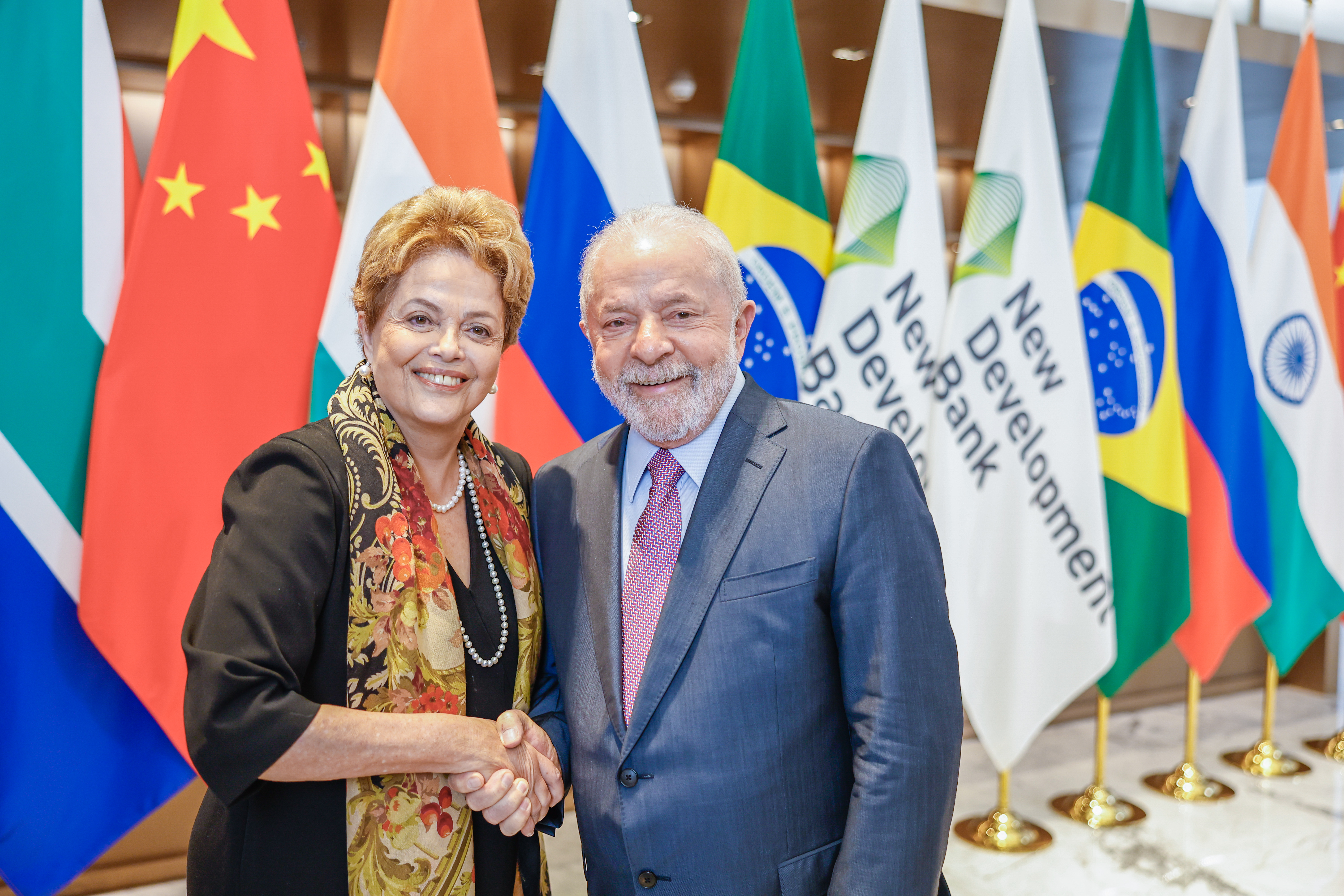 Dilma Rousseff during the inauguration ceremony of the New Development Bank presidency, Shanghai, 13 April 2023. Under Rousseff, NDB has lifted its local-currency lending share toward the 30-percent target set for end-2026 and admitted four new members, including Colombia and Uzbekistan in July 2025. Credit: Ricardo Stuckert / Palácio do Planalto, via Wikimedia Commons (CC BY 2.0).
The counter-story — what the sceptics are right about
Triumphalism is not a reporting posture. Four things the sceptics at the Peterson Institute, CSIS, and OMFIF are right about, and a working analyst needs to hold in view.
First, CIPS still settles the majority of its flows on SWIFT messaging rails — above 80 percent by CSIS's June 2025 accounting. That is a dependency, not a parallel system. What is changing is the number of institutions CIPS has direct-participant relationships with: as of 2025, for the first time including foreign-invested institutions in Africa, the Middle East, Central Asia and the Singapore offshore RMB centre, with direct partnerships forged with six Middle Eastern and African banks. Slow build-out. Real build-out.
Second, BRICS Pay is not yet a retail rail at scale. Its consumer-to-business pilot is live only in Moscow, St. Petersburg, Sochi and Kazan, aimed at foreign tourists making QR payments. Deputy Foreign Minister Sergey Ryabkov clarified in October 2025 that operational status is now targeted for 2030, not 2026 — a timeline even the Lowy Institute treated as credible. The infrastructure exists; it is running; it is not yet a SWIFT replacement.
Third, NDB local-currency lending remains below its flagship target — 25 percent in 2025, 30 percent by end-2026. OMFIF's July 2025 analysis was blunt: BRICS currencies are not realistic near-term alternatives to the dollar. That claim is correct. It is also not the claim this essay is making. The claim is that the rails have diversified, even where the currency denominations have not.
Fourth, the 126-paragraph Rio Leaders' Declaration adopted at the 17th Summit in July 2025 does not use the word "de-dollarisation" once. That absence is not accidental — it reflects a political preference, especially in Brasilia and New Delhi, to avoid a frame that would invite U.S. tariff retaliation. What the Declaration does commit to is continued work on the BRICS Cross-Border Payments Initiative and explicit support for NDB's local-currency financing. The language is diplomatic. The direction is unambiguous.
The Africa lens
For the African reader this desk writes for, today's earlier Hormuz-yuan corridor piece made the case that the plumbing now exists for commodity exporters to price marginal flows outside the dollar. The NDB-and-mBridge story extends that into the sovereign-financing layer. An African central bank wanting to hedge a portion of its external debt away from dollar denomination no longer needs an exotic swap line or a political confrontation. It needs a seat at the NDB — South Africa already has one, Egypt joined under the predecessor regime, Algeria in 2024 — and a willingness to borrow, on the margin, in yuan or rand or, starting this year, rupees. The Bank does not impose IMF-style conditionality. Its lending is priced competitively against the Chinese policy banks, which means competitively against the market-rate dollar it is partially displacing.
None of this is liberation. Dollar-denominated Eurobonds still dominate African sovereign external debt, roughly 80 percent by stock. Dollar-priced oil still invoices African petrol stations. Dollar-indexed debt service still compounds through African budgets, which is why the IMF's April 2026 Regional Economic Outlook cut the region's growth forecast to 4.3 percent. But at the margin, a Ghanaian, Nigerian or Kenyan treasury that a decade ago had no non-dollar channel for concessional infrastructure finance now has one. The marginal choice is real. That is, structurally speaking, exactly how transitions begin—not with a Bretton Woods II, but with the slow accumulation of alternatives.
The stakes — and the falsification test
Three indicators will tell us whether this reading is right over the next twelve months. First, whether mBridge adds a sixth central bank — an announcement involving a BRICS+ participant would signal the platform is scaling beyond the founding five. Second, whether NDB hits its 30-percent local-currency lending target by end-2026 and whether the rupee issuance lands inside the planned $400-500 million window. Third, whether CIPS daily throughput crosses one trillion yuan on an average, rather than a peak, basis within 2026.
The falsification conditions are equally clear. If mBridge stalls at five participants and fails to add domestic CBDC integration in China, Thailand or the UAE within twelve months, the graduation framing was closer to the truth than I have argued. If NDB local-currency lending retreats from 25 percent, the architecture is decorative. If CIPS throughput plateaus at March 2026 levels, the Hormuz-era surge was catalytic rather than structural. None of these is the most likely scenario. The most likely, based on the last eighteen months, is further slow, public, institutionally-literate build-out — what a structural transition looks like before it becomes a headline—and what wire services conditioned to look for discrete events will struggle to narrate.
Desk note
This essay was written for a Global-South readership with a practical, not rhetorical, interest in the alternatives. Primary-document citations below — the Kazan Declaration, the BIS press release on mBridge's MVP, NDB's own press releases — are load-bearing. Where a wire service or think-tank analysis is used, I have named it. Where an structural claim is mine rather than sourced (the structural stress reading of the BIS exit; NDB voting structure as a commitment device), I have flagged it. Corrections welcome.
Sources:
- Bank for International Settlements, "Project mBridge reached minimum viable product stage and invites further international participation," press release, 5 June 2024. https://www.bis.org/press/p240605.htm
- Bank for International Settlements, "Project mBridge" — BIS Innovation Hub topic page documenting the exit, October-November 2024. https://www.bis.org/about/bisih/topics/cbdc/mcbdc_bridge.htm
- Financial Times (reported via Ledger Insights and Central Banking), "BIS to hand over Project mBridge to central banks," 29-31 October 2024. https://www.centralbanking.com/fintech/cbdc/7962626/bis-to-hand-over-project-mbridge-to-central-banks
- XVI BRICS Summit, Kazan Declaration, 23 October 2024 — official text via the Russian Presidency and South Africa's Department of International Relations and Cooperation (paragraphs on BRICS Cross-Border Payments Initiative, BRICS Clear, and local-currency settlement). https://dirco.gov.za/wp-content/uploads/2024/10/XVI-BRICS-Summit-Kazan-Declaration-23-October-2024.pdf
- New Development Bank, "New Development Bank's Board of Governors Convened its 10th Annual Meeting in Rio de Janeiro," press release, July 2025 (admission of Colombia and Uzbekistan; local-currency lending target). https://www.ndb.int/news/new-development-banks-board-of-governors-convened-its-10th-annual-meeting-in-rio-de-janeiro/
- New Development Bank, "New Development Bank Issued RMB 6 Billion 5-year Panda Bond," 14 January 2025. https://www.ndb.int/news/new-development-bank-issued-rmb-6-billion-5-year-panda-bond/
- New Development Bank, "New Development Bank successfully issued RMB 3 billion 3-year Panda Bond," 4 December 2025. https://www.ndb.int/news/new-development-bank-successfully-issued-rmb-3-billion-3-year-panda-bond/
- Xinhua, "Colombia, Uzbekistan join BRICS Bank," 6 July 2025. http://english.news.cn/20250706/d6d8f11ef3534f59a8f3010881a6a522/c.html
- Global Times, "New Development Bank adds Colombia, Uzbekistan as official new members," July 2025. https://www.globaltimes.cn/page/202507/1337691.shtml
- Daily News Egypt, "NDB expands to 11 members, raises $16.1bn in 2024, says Rousseff," 7 July 2025. https://www.dailynewsegypt.com/2025/07/07/ndb-expands-to-11-members-raises-16-1bn-in-2024-says-rousseff/
- Business Standard (India), "New Development Bank plans first rupee-denominated bond by March-end," 26 September 2025. https://www.business-standard.com/world-news/new-development-bank-plans-first-rupee-denominated-bond-by-march-end-125092600639_1.html
- Wilson Center, "Reflections After the BRICS Summit: Membership, Payment Systems, and What Lies Ahead." https://www.wilsoncenter.org/blog-post/reflections-after-brics-summit-membership-payment-systems-and-what-lies-ahead
- CSIS, "Sanctions, SWIFT, and China's Cross-Border Interbank Payments System," 2025 update. https://www.csis.org/analysis/sanctions-swift-and-chinas-cross-border-interbank-payments-system
- Atlantic Council, Central Bank Digital Currency Tracker, mBridge entry (ongoing). https://www.atlanticcouncil.org/cbdctracker/
- Disruption Banking, "China's SWIFT Challenger Breaks Records as the Collapse of the Petrodollar Looms," 14 April 2026. https://www.disruptionbanking.com/2026/04/14/chinas-swift-challenger-breaks-records-as-petrodollar-looms/
- TASS, "BRICS states to study possibility of establishing BRICS Clear infrastructure — declaration," 23 October 2024. https://tass.com/world/1860743
- OMFIF, "BRICS currencies are no realistic alternative to the dollar," July 2025. https://www.omfif.org/2025/07/brics-currencies-are-no-realistic-alternative-to-the-dollar/
- , The Long Twentieth Century: Money, Power, and the Origins of Our Times (Verso, 1994; 2010 edition with postscript) and Adam Smith in Beijing: Lineages of the Twenty-First Century (Verso, 2007) — analytical framework.
Desk author: Moemedi Michael Poncana, news.themonexus.com. This long-read applies a structural framework focused on financial architecture. No Reuters, AP, AFP or FT wire copy is reproduced; where these outlets are the primary witnesses to a transaction, their reporting is cited and paraphrased under fair comment. Images sourced from Wikimedia Commons and credited in full.
- https://www.bis.org/press/p240605.htm
- https://www.bis.org/about/bisih/topics/cbdc/mcbdc_bridge.htm
- https://www.centralbanking.com/fintech/cbdc/7962626/bis-to-hand-over-project-mbridge-to-central-banks
- https://dirco.gov.za/wp-content/uploads/2024/10/XVI-BRICS-Summit-Kazan-Declaration-23-October-2024.pdf
- https://www.ndb.int/news/new-development-banks-board-of-governors-convened-its-10th-annual-meeting-in-rio-de-janeiro/
- https://www.ndb.int/news/new-development-bank-issued-rmb-6-billion-5-year-panda-bond/
- https://www.ndb.int/news/new-development-bank-successfully-issued-rmb-3-billion-3-year-panda-bond/
- http://english.news.cn/20250706/d6d8f11ef3534f59a8f3010881a6a522/c.html
- https://www.globaltimes.cn/page/202507/1337691.shtml
- https://www.dailynewsegypt.com/2025/07/07/ndb-expands-to-11-members-raises-16-1bn-in-2024-says-rousseff/
- https://www.business-standard.com/world-news/new-development-bank-plans-first-rupee-denominated-bond-by-march-end-125092600639_1.html
- https://www.wilsoncenter.org/blog-post/reflections-after-brics-summit-membership-payment-systems-and-what-lies-ahead
- https://www.csis.org/analysis/sanctions-swift-and-chinas-cross-border-interbank-payments-system
- https://www.atlanticcouncil.org/cbdctracker/
- https://www.disruptionbanking.com/2026/04/14/chinas-swift-challenger-breaks-records-as-petrodollar-looms/
- https://tass.com/world/1860743
- https://www.omfif.org/2025/07/brics-currencies-are-no-realistic-alternative-to-the-dollar/