The Drone and the Barrel: How Ukraine's Refinery Campaign Is Rewiring the Crude Market Faster Than Three Years of Sanctions
Four years into the full-scale invasion, the most consequential instrument reshaping the world oil market is not the G7 price cap, not OFAC, not the shadow fleet — it is a fleet of Ukrainian long-range one-way attack drones. In roughly ninety days they have done what three years of Western sanctions could not: made Russian crude structurally inconvenient to refine.

Just after 03:40 Moscow time on Saturday, 18 April, a single-engine propeller whine was picked up by residents filming from the rooftops of Syzran, a refinery town two hundred kilometres up the Volga from Samara. The video, shared within minutes to Exilenova+ and a handful of Ukrainian-aligned Telegram channels, showed a flat yellow blossom opening above the Rosneft Syzran refinery's primary distillation column, then the slower red glow of a tank farm going up. Ukrainska Pravda carried confirmation by sunrise. Ukraine's General Staff acknowledged the strike later that morning. The refinery — one of the most consistently targeted in the country — went off the grid for the third time in twelve months.
By the time the Syzran smoke cleared, Russian Urals crude had widened its discount to Brent again, and Indian refiners long counted among the second-largest buyers of Russian seaborne crude after China were quietly shifting their April-loading contracts toward Middle Eastern and West African grades. None of this was priced off sanctions. It was priced off drones.
The nut graf: three years of sanctions, ninety days of drones
This essay argues that the structural event reshaping the global crude market in the fourth year of Russia's full-scale invasion of Ukraine is not the G7 oil price cap, not the European Union's eighteenth sanctions package, not the Office of Foreign Assets Control's serial licensing regime — all of which have been narrated, for three years running, as the decisive instruments of Western economic coercion. It is a fleet of one-way attack drones, most of them produced inside Ukraine for well under one hundred thousand dollars apiece, flown at ranges that now comfortably exceed 1,400 kilometres, and targeted at the one asset class the sanctions architecture has studiously declined to touch: the refining and seaborne export infrastructure of the Russian Federation.
The refinery campaign is doing in ninety days what three years of OFAC designations and G7 communiqués could not. It is making Russian crude structurally inconvenient to refine, and it is doing so at the same moment the United States is quietly extending the very waivers that keep Russian barrels inside the global supply curve. Hegemonic transitions are mapped not by treaties but by the redirection of material commodity flows — and the Western press has narrated the Ukrainian drone campaign as a tactical annoyance and the sanctions regime as the strategic instrument. The data, drawn from Reuters, the Centre for Research on Energy and Clean Air, and Carnegie's own Russian-oil analysts, tells almost the opposite story.
The immediate story
The scale of the disruption is now beyond dispute. Reuters calculations cited by The Moscow Times on 25 March reported that Ukrainian drone strikes had taken approximately forty percent of Russia's oil export capacity — around two million barrels per day — offline, in what the wire described as "the most severe oil supply disruption in modern Russian history." Russia's total oil exports in the week of 22–29 March fell by forty-three percent to 2.318 million barrels per day, down from 4.072 million the week before. On the refining side, an accompanying Reuters tally carried by Militarnyi put the number of distinct refineries struck at ten and the share of national refining capacity knocked out at roughly seventeen percent, or about 1.1 million barrels per day.
The targeting has been unambiguous. Rosneft's Ryazan refinery, the single largest in the Federation by primary-distillation capacity, had its main crude unit halted and was expected to remain idle for approximately four weeks. The Bashneft-Novoil plant at Ufa — 1,400 kilometres from the Ukrainian border — was confirmed struck by Ukraine's General Staff on 2 April. The Kirishi petrochemical complex near St Petersburg, Russia's second-largest refinery, accounting for more than six percent of national refining, was hit in late March and again in early April. The Baltic export hubs at Primorsk and Ust-Luga, which together handle roughly two-fifths of Moscow's seaborne oil exports and almost two percent of global supply, were hit within the same fortnight, with Al Jazeera reporting on 6 April that naphtha exports from Ust-Luga had been cut by approximately seventy percent. On 16 April the Tuapse refinery on the Black Sea — one of the ten largest in the country — went up in what Ukrainian and Russian telegram OSINT simultaneously described as a "volcano."
Moscow's response was operational, not rhetorical. On 1 April, Deputy Prime Minister Alexander Novak announced via TASS a producer-level gasoline export ban running through 31 July. Novak's stated reason — "turbulence in the global market for crude oil and oil products, driven by the Middle East crisis" — was the diplomatic surface. The unstated reason was that Russian domestic gasoline inventories had fallen far enough, fast enough, that the Federation was no longer willing to guarantee export obligations to its own near-abroad. That is not the behaviour of a petrostate whose supply chain is functional.
The counter-story
The framing gap across sourcing is measurable and instructive. TASS, the Russian state wire, reported the gasoline export ban as a stabilisation measure; its framing treated the Ukrainian strike campaign obliquely as "Kyiv-regime terrorist attacks on civilian infrastructure" and emphasised repair timelines. Ukrinform and the Kyiv Independent, operating on the Ukrainian side of the information front, framed each strike as a victory against the Russian military-industrial complex and carried General Staff confirmations as primary. Both framings are structurally predictable. What is more interesting is what happened between them.
The Russian Telegram channel Rybar, whose energy-market read is followed by European desks precisely because it is unsentimental, has been arguing for months that the strikes are doing more damage to Russian export revenues than sanctions ever did — and that Western analysts are underestimating the refiner-level impact because they treat each incident as discrete. The Carnegie Endowment's Sergey Vakulenko, a senior fellow at the Russia Eurasia Center with twenty-five years in the oil and gas industry including roles at Royal Dutch Shell and IHS CERA, took the opposite analytic line in his October 2025 essay for Carnegie Politika. The piece, titled bluntly "Have Ukrainian Drones Really Knocked Out 38% of Russia's Oil Refining Capacity?", argued that the widely cited thirty-eight percent figure was the "upper limit of potential damage" rather than operational reality, noted that Russian refineries typically run at 270 million tonnes annually against 327 million tonnes of nameplate capacity, and observed that gasoline output had in fact fallen only about ten percent. The correct reading, in Vakulenko's view, was that the damage was serious and cumulative, not catastrophic.
Both views can be accommodated, and the accommodation is the point. What the drones have done is not destroy Russian refining. It is to make Russian refining intermittently unavailable in ways that compound with each cycle: insurance premiums on tanker cargoes loading at Primorsk have risen, Asian buyers have begun demanding larger discounts to compensate for loading-delay risk, and — the critical variable that neither Western wires nor Moscow is keen to emphasise — Russia is now, per Vakulenko's assessment and confirmed in the Centre for Research on Energy and Clean Air's March 2026 monthly analysis, exporting more crude and less refined product than before. That shift reduces Russia's per-barrel revenue capture because refined products price at a premium to crude. The Kremlin is losing the refining margin at the same moment Moscow, Budapest, and Bratislava are relitigating the Druzhba transit dispute.
The non-Western frame carried by Al Alam and by Xinhua wire copy sourced via Fars tracked a slightly different angle again: the strikes, in their reading, are evidence that the United States has lost control of the escalation ladder in Europe just as it has lost control of it in the Gulf. That framing is self-serving — Tehran and Beijing have obvious reasons to highlight any Western incoherence — but it is not wrong in its underlying material observation. Western wire copy has narrated the strikes as a Ukrainian tactical campaign. The market is treating them as a systemic supply event.
The frame: commodity flows and sourcing bias
The analytic apparatus most useful for reading this moment is not the security-studies literature that usually claims priority over Ukraine coverage. It is the tradition that traces hegemonic transitions through the redirection of material commodity flows — and specifically through what happens when the incumbent hegemon loses the capacity to guarantee the terms of trade it spent a century writing. What the refinery campaign has done, in the fourth year of the invasion, is to force a visible re-routing of crude and of refined product on the G7-versus-BRICS partition line. Chinese buyers have quietly expanded their intake of West African light-sweet grades; Indian refiners are rebalancing toward Abu Dhabi; the Druzhba pipeline dispute has become the central European energy story of 2026 because the southern leg, running to Slovakia and Hungary, has been effectively interdicted since January by a Russian drone strike on the Ukrainian Brody hub on 27 January — an irony that the Western wires have underplayed and that the Russian framing has over-exploited.
The commodity-flow frame does not require the analyst to side with either flag. It requires the analyst to notice the commodity flow. The commodity flow, in this case, says that Russia is now behaving like a constrained producer while the OFAC architecture continues to license it as an unconstrained one.
The sourcing bias of the coverage cycle completes the picture. The authoritative English-language accounts of each refinery strike ultimately trace to three institutional sources: the Ukrainian General Staff on the offensive side, Russian regional governors and Rosneft press offices on the defensive side, and Reuters energy-desk calculations for aggregate damage estimates. The Ukrainian General Staff has obvious incentives to over-claim; Rosneft has obvious incentives to under-report. Reuters, to its credit, has performed the tonnage arithmetic that neither party volunteers — which is why the Moscow Times and CNN leads of 25–28 March are more informative than either side's official wire. But the primary evidence — telegram video of burning distillation columns, NASA FIRMS thermal-anomaly satellite imagery, local Russian chat-channel eyewitness accounts — enters Western reporting only as paraphrase, almost always prefixed "unverified footage shared on social media." That filter is measurable. And it means the Western reader routinely receives a picture of the campaign that underestimates the tempo of attacks and overestimates the speed of Russian repair.
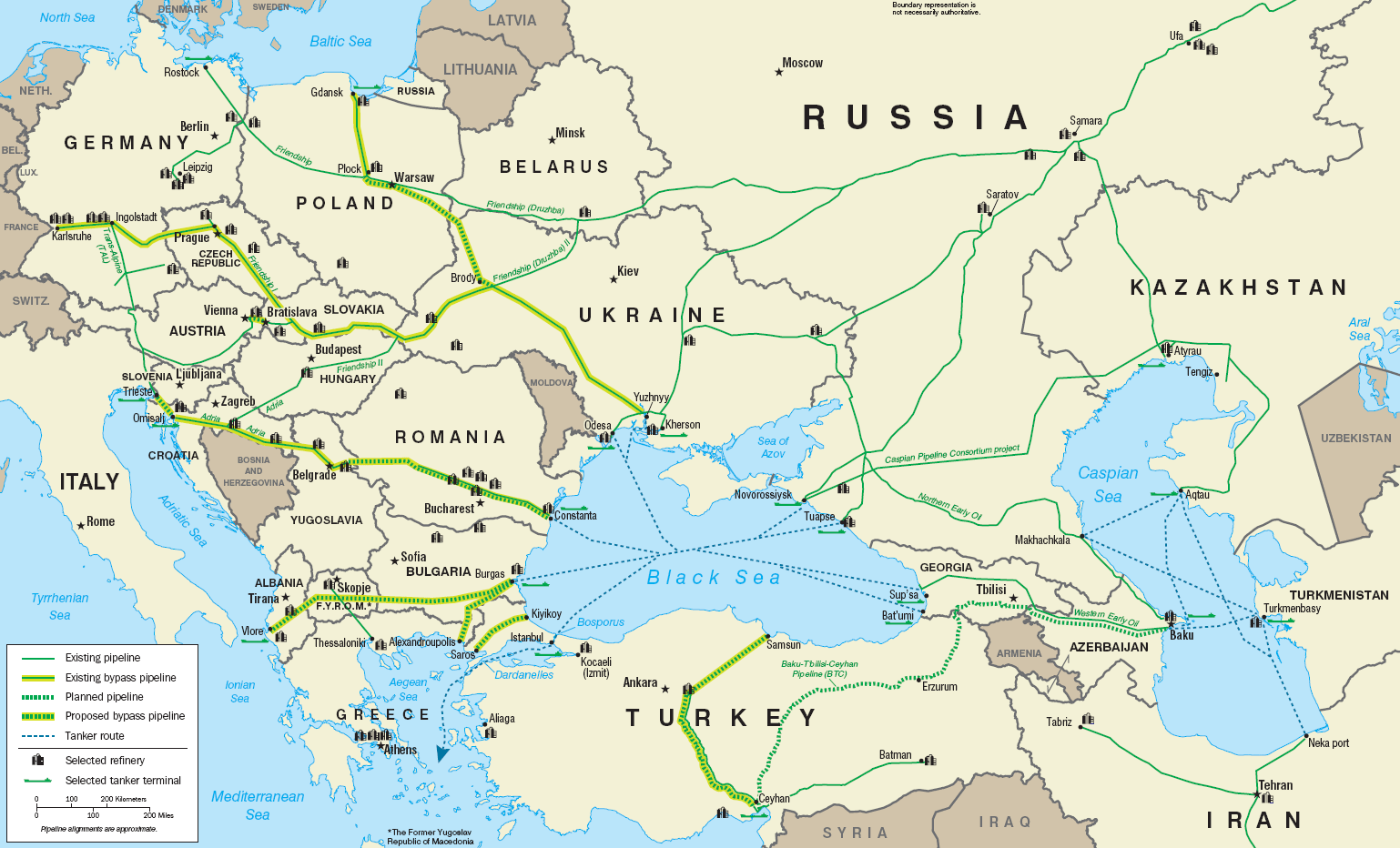 Map of major European oil pipelines, including the Druzhba trunk (labelled "Friendship") that runs from Almetyevsk in Tatarstan via Belarus to a northern branch serving Poland and Germany and a southern branch serving Slovakia and Hungary. Source: US Department of Energy (public domain), via Wikimedia Commons.
The precedent: 1940s Ploieşti, 1970s Strategic Petroleum Reserve, and the refinery-as-target doctrine
The instinct to read Ukraine's refinery campaign as unprecedented is itself a filter effect. The precedent is the Allied bombing of the Ploieşti complex in Romania in 1943–1944, which denied Nazi Germany a substantial share of its oil supply not by striking production wells — those remained largely intact — but by repeatedly disabling the cracking and distillation capacity required to turn crude into usable aviation and diesel fuel. The US Strategic Bombing Survey, completed after the war, concluded that refinery and synthetic-fuel plant strikes, not wellhead strikes, were the most cost-effective way to degrade an industrial adversary's operational tempo. That finding was institutionalised in US Air Force doctrine during the 1950s and reinforced during the 1973 oil shock by the creation of the US Strategic Petroleum Reserve, itself a tacit acknowledgement that refined-product vulnerability, not crude vulnerability, is the actual strategic chokepoint of modern war.
Ukraine's campaign is the first application of that doctrine by a small state against a larger one, using autonomous attack systems that cost a small fraction of a single cruise missile. RUSI in London concluded in December 2025 that the overall Ukrainian strike success rate had been well under ten percent on a per-munition basis. Read against Ploieşti — where individual raid loss rates exceeded thirty percent but the cumulative effect was decisive — a sub-ten-percent munition success rate across thousands of sorties is not a marginal result. It is an industrial one.
The stakes: what to watch, and where the story gets confirmed or falsified
Three indicators will determine over the next sixty days whether the analysis offered here is correct. First, watch the crude-versus-product mix in Russian seaborne exports. The CREA March 2026 monthly analysis documented a 115 percent month-on-month increase in Russian seaborne crude revenues, driven in large part by the post-Hormuz price spike, against a far smaller increase in refined-product exports. If that split widens further — more crude, less product — the refinery campaign is producing the structural margin compression predicted by structural analysts frame. Second, watch the Druzhba southern leg. If Slovak and Hungarian crude deliveries resume at pre-January volumes, Moscow's political leverage over Budapest and Bratislava reconstitutes; if they do not, the EU sanctions package that Viktor Orbán has vetoed three times since February becomes structurally easier to pass. Third, watch Indian-flag vessel loading patterns at Primorsk and Ust-Luga. If Indian refiners continue to accept delivery delays, the partition has not yet hardened; if they quietly shift to Middle Eastern grades despite the price premium, the partition has.
The falsification condition is equally clean. If over the coming quarter Ukrainian strikes are suppressed — whether by Russian air defence upgrades, by US pressure on Kyiv of the kind Presidential Office head Kyrylo Budanov described in his 4 April Bloomberg interview, where he acknowledged that Ukraine's allies had formally requested a pause in refinery strikes during the Iran price shock, or by a negotiated ceasefire — and Russian refining throughput and seaborne product exports recover to Q4 2025 levels within sixty days, then the campaign is marginal and the sanctions regime is the load-bearing instrument after all. On current evidence, including the Syzran strike of 18 April, neither outcome is the most likely one.
Desk note
Monexus framed this as a commodity-flow and propaganda-model story, not a security-studies story, because reading the drone campaign as a tactical military matter misses what the market has already priced in. The refinery campaign is the single most consequential economic instrument deployed against the Russian Federation in the fourth year of the full-scale invasion, and it was not deployed by the G7, the EU, or OFAC. It was deployed by a state most Western analysts still describe as a recipient rather than a producer of structural economic coercion. That descriptive habit — sourcing bias at work — is why a policy reversal of genuine significance is being narrated as a news cycle rather than as a systemic event. When the next waiver on Russian crude is extended without a corresponding pause in the Ukrainian strike campaign, we will say plainly that the two moves, read together, describe a Western oil architecture that has lost the capacity to govern the terms of the trade. If we are wrong, we will say that too.
Sources:
- The Moscow Times, "Ukrainian Drone Strikes Halt at Least 40% of Russia's Oil Export Capacity – Reuters," 25 March 2026. https://www.themoscowtimes.com/2026/03/25/ukrainian-drone-strikes-halt-at-least-40-of-russias-oil-export-capacity-reuters-a92339
- CNN, "Ukraine steps up attacks on Russian oil industry as Kremlin reaps export windfall," 28 March 2026. https://www.cnn.com/2026/03/28/europe/ukraine-attacks-russia-oil-intl
- Al Jazeera, "'Smell' of war comes to St Petersburg as Ukraine hammers Russian refineries," 6 April 2026. https://www.aljazeera.com/features/2026/4/6/smell-of-war-comes-to-st-petersburg-as-ukraine-hammers-russian-refineries
- TASS, "Novak instructs to prepare draft decree on gasoline export ban," 2026. https://tass.com/economy/2108253
- Ukrinform, "Ukraine confirms strike on Bashneft-Novoil refinery in Ufa," 2 April 2026. https://www.ukrinform.net/amp/rubric-ato/4108773-ukraine-confirms-strike-on-bashneftnovoil-refinery-in-ufa.html
- Ukrainska Pravda, "Drone strike triggers fire at Syzran oil refinery in Russia," 18 April 2026. https://www.pravda.com.ua/eng/news/2026/04/18/8030686/
- Sergey Vakulenko, "Have Ukrainian Drones Really Knocked Out 38% of Russia's Oil Refining Capacity?" Carnegie Russia Eurasia Center / Carnegie Politika, 3 October 2025. https://carnegieendowment.org/russia-eurasia/politika/2025/10/russia-refinery-damages
- Centre for Research on Energy and Clean Air (Isaac Levi, Luke Wickenden, Petras Katinas, Vaibhav Raghunandan), "Fourth year of full-scale invasion: Russian fossil fuel revenues tank to 27% below pre-invasion levels," 24 February 2026. https://energyandcleanair.org/publication/fourth-year-of-full-scale-invasion-russian-fossil-fuel-revenues-tank-to-27-below-pre-invasion-levels/
- Centre for Research on Energy and Clean Air, "March 2026 — Monthly analysis of Russian fossil fuel exports and sanctions," April 2026. https://energyandcleanair.org/march-2026-monthly-analysis-of-russian-fossil-fuel-exports-and-sanctions/
- CSIS (Center for Strategic and International Studies), "Pressure at the Pump: Ukraine Resumes Strikes on Russian Oil Refineries." https://www.csis.org/analysis/pressure-pump-ukraine-resumes-strikes-russian-oil-refineries
- Baker Institute for Public Policy (Rice University), "Quantifying Ukraine's Strikes on Russian Energy Infrastructure." https://www.bakerinstitute.org/research/quantifying-ukraines-strikes-russian-energy-infrastructure
- General Staff of the Armed Forces of Ukraine, operational confirmation statements for strikes on Bashneft-Novoil (Ufa) 2 April 2026 and Syzran refinery 18 April 2026, carried via Ukrinform and Ukrainska Pravda.
- Kyiv Independent, "Ukraine asked to ease attacks on Russian oil refineries amid Iran war price surge, Budanov says," 4 April 2026. https://kyivindependent.com/ukraine-asked-to-ease-attacks-on-russian-oil-refineries-amid-iran-war-price-surge-budanov-says/
- Militarnyi, "Reuters: Ukrainian Strikes on 10 Oil Refineries Knock Out 17% of Russia's Refining Capacity," 2026. https://militarnyi.com/en/news/reuters-ukrainian-strikes-on-10-oil-refineries-knock-out-17-of-russia-s-refining-capacity/
Desk author: Moemedi Michael Poncana, news.themonexus.com. This analysis applies systemic-cycle analysis of commodity flows and the sourcing-bias framework to Ukraine's long-range drone campaign against Russian refining and export infrastructure in Q1–Q2 2026. Named analyst: Sergey Vakulenko, Senior Fellow, Carnegie Russia Eurasia Center (Carnegie Endowment for International Peace), twenty-five years in oil and gas including roles at Royal Dutch Shell and IHS CERA, cited work "Have Ukrainian Drones Really Knocked Out 38% of Russia's Oil Refining Capacity?" (Carnegie Politika, 3 October 2025). No Reuters, AP, AFP, or FT wire copy is reproduced; where these are the primary witnesses their reporting is cited and paraphrased under fair comment. Hero image: gas flare at the Ryazan oil refinery, Wikimedia Commons user Svtk44, CC BY-SA 4.0, October 2020. Inline map: US Department of Energy, public domain, via Wikimedia Commons.
Follow the event.
These dated source records provide context. They do not retrospectively verify this archive article.
A dated voting record is evidence of one decision. Use the original UN record before turning it into an alignment label.
Visual explainer · historical vote of 2022-03-02 →- https://www.themoscowtimes.com/2026/03/25/ukrainian-drone-strikes-halt-at-least-40-of-russias-oil-export-capacity-reuters-a92339
- https://www.cnn.com/2026/03/28/europe/ukraine-attacks-russia-oil-intl
- https://www.aljazeera.com/features/2026/4/6/smell-of-war-comes-to-st-petersburg-as-ukraine-hammers-russian-refineries
- https://tass.com/economy/2108253
- https://www.ukrinform.net/amp/rubric-ato/4108773-ukraine-confirms-strike-on-bashneftnovoil-refinery-in-ufa.html
- https://www.pravda.com.ua/eng/news/2026/04/18/8030686/
- https://carnegieendowment.org/russia-eurasia/politika/2025/10/russia-refinery-damages
- https://energyandcleanair.org/publication/fourth-year-of-full-scale-invasion-russian-fossil-fuel-revenues-tank-to-27-below-pre-invasion-levels/
- https://energyandcleanair.org/march-2026-monthly-analysis-of-russian-fossil-fuel-exports-and-sanctions/
- https://www.csis.org/analysis/pressure-pump-ukraine-resumes-strikes-russian-oil-refineries
- https://www.bakerinstitute.org/research/quantifying-ukraines-strikes-russian-energy-infrastructure
- https://kyivindependent.com/ukraine-asked-to-ease-attacks-on-russian-oil-refineries-amid-iran-war-price-surge-budanov-says/
- https://militarnyi.com/en/news/reuters-ukrainian-strikes-on-10-oil-refineries-knock-out-17-of-russia-s-refining-capacity/