The Silicon Shield, Rehoused: How TSMC's Arizona Fabs and the H20 Licence Regime Are Quietly Rewriting the Geography of US-China Tech
TSMC's Arizona Fab 21 is now in high-volume production on the same N4 node as Hsinchu; the BIS has moved H200-class silicon from presumption-of-denial to case-by-case review; Nvidia is paying Washington fifteen per cent of its China revenues for the privilege of selling H20s; and Huawei is scheduled to double Ascend 910C output to roughly 600,000 units in 2026. Read together through Rush Doshi's Long Game framework, these are not four separate headlines. They are a single transfer of strategic geography.

At some point in the first quarter of 2025, without press conferences and without the flag-wrapped photo opportunity the previous administration had leaned on when Joe Biden walked the half-built shell of the same building in December 2022, TSMC's Fab 21 in north Phoenix began shipping commercial four-nanometre wafers to American customers. By late 2024 the line was in high-volume production. By early 2025 output was running at roughly ten thousand wafers per month on TSMC's N4 process node — the same node that produces Apple A-series application processors, Nvidia H100 accelerators, and the AMD MI300 series — with internal yield reports, cited by Tom's Hardware and the Arizona Technology Council, describing parity with TSMC's home fabs at Hsinchu and Tainan. Phase one capacity is scheduled to climb to thirty thousand wafers per month; groundbreaking on the third Arizona fab, pulled forward to 2027 and targeting two-nanometre and A16 process technologies, took place in April 2025 with a senior Trump administration official on site. TSMC has committed a cumulative one hundred and sixty-five billion US dollars to the Phoenix campus — one of the largest single foreign direct investments in American manufacturing history.
On the day the Arizona fab formally ramped, something older was dismantled, quietly, on the other side of the Pacific. The "silicon shield" — the doctrine, articulated since the mid-1990s, that Taiwan's effective monopoly on advanced logic fabrication would force any rational Washington administration to defend the island kinetically against a PLA contingency — began migrating, node by node, to the Sonoran desert. By the time the first commercial N4 wafer left Phoenix, the strategic geography had shifted in a way neither Taipei's Ministry of Foreign Affairs nor Washington's State Department had quite yet said out loud.
The nut graf: four headlines, one realignment
This essay argues that four events in the first four months of 2026 — the high-volume ramp of TSMC Arizona, the Bureau of Industry and Security's 15 January 2026 rule moving H200-class silicon from "presumption of denial" to "case-by-case review" for China and Macau, Nvidia's late-February 2026 receipt of an H20/H200 export licence conditioned on a fifteen-per-cent revenue share paid to the US Treasury, and Huawei's scheduled doubling of Ascend 910C production to roughly six hundred thousand units on SMIC's N+2 node — constitute a single coordinated rewriting of the geography of US-China technology competition. They are usually reported separately: semiconductors desk, trade desk, corporate desk, China desk. Read together, through Rush Doshi's framework in The Long Game: China's Grand Strategy to Displace American Order (Oxford University Press, 2021), they describe the replacement of a binary export-control architecture — chip flows either permitted or denied — with a negotiated, revenue-sharing, geographically dispersed regime in which the United States rents out access to the frontier while China builds the non-American substrate underneath. Doshi, C.V. Starr senior fellow for Asia studies and director of the China Strategy Initiative at the Council on Foreign Relations, names three instruments of Chinese grand strategy — blunting, building, and global expansion — and the 2026 tableau shows Washington adopting a blunted version of each. The consequence is not a defeat. It is a transition. And the journalism written off the press releases has noticed the announcements without quite noticing the architecture.
The Arizona ramp: what moved, and what didn't
The detail that matters most about Fab 21 is not that it exists. It is that its output is identical, at the wafer level, to Hsinchu output. Tom's Hardware, citing TSMC internal quality data, reported in late 2025 that the Arizona N4 line's yield and defect density were "on par" with Taiwan fabs of the same vintage. TrendForce reporting, corroborated by TSMC's own quarterly disclosures, confirms the first fab entered commercial N4 production in Q4 2024; that Apple, AMD, and Nvidia are among the three named US clients; and that TSMC's January 2026 update pulled the second fab's N3 volume start from 2028 to the second half of 2027. Phoenix now produces at the leading-edge node for the last generation's frontier chips, and will produce at the previous leading edge inside eighteen months.
What did not move is the two-nanometre and A16 frontier. TSMC's third Arizona fab, broken in April 2025, is targeted at volume "by the end of the decade" — which in Taiwanese corporate-communications dialect means 2028 at the earliest, 2030 more plausibly. The production that actually underwrites Taiwan's strategic leverage remains in Tainan. Chris Miller, associate professor of international history at Tufts University's Fletcher School and author of Chip War, made the point in a March 2026 address at Carnegie Mellon's Institute for Strategy and Technology: the silicon shield is being thinned but not removed, and the thinning is calibrated. Arizona takes the N-minus-one generation. Hsinchu and Tainan keep the frontier. The deterrent logic remains, but its half-life is now measured in node cycles rather than decades.
This is, in Doshi's vocabulary, a "blunting" move executed by Washington against its own vulnerability. Rather than attempt to defend Taiwan's indispensability, the policy instrument has been to reduce it — not to zero, but to the range where a PLA contingency costs Taipei its leverage without costing Washington its supply. The doctrine is not articulated in any single public document. It is articulated in Commerce Department press releases, TSMC's capital-expenditure guidance, and the cadence of Trump administration site visits to Phoenix.
The H20 licence regime: from denial to royalty
The 15 January 2026 BIS interim final rule — "Revision to License Review Policy for Advanced Computing Commodities," Federal Register docket 2026-00789 — is the legal instrument that translates the Arizona ramp into a new export policy. It moves H200-class silicon, defined by the rule's Total Processing Performance threshold under 21,000 and DRAM bandwidth under 6,500 GB/s, from the prior "presumption of denial" for China and Macau to a "case-by-case review" standard, gated on four conditions: domestic-supply sufficiency, no diversion of foundry capacity to Chinese entities of concern, aggregate China and Macau shipments capped at fifty per cent of US-bound shipments, and customer security-certification. The rule is analysed in published client memoranda by Covington and Burling and by Morgan Lewis, and is reproduced in the Bureau of Industry and Security press release dated 15 January 2026.
The commercial consequence arrived in late February 2026. Nvidia, having spent roughly ten months in what DataCenterDynamics described as the worst US Commerce export-licence backlog in three decades, received its first tranche of H20 and H200 licences. The consideration, by terms the South China Morning Post and Caixin Global reported in March 2026, was a fifteen-per-cent revenue share paid by Nvidia to the US Treasury on China sales — an arrangement Trump publicly confirmed and Jensen Huang, Nvidia's chief executive, acknowledged at GTC in March 2026 when he announced the company had "been licensed for many customers in China for H200" and was "in the process of restarting our manufacturing." Tom's Hardware reported roughly 82,000 H200 units prepared for China shipment, subject to an additional twenty-five-per-cent tariff layered on top of the fifteen-per-cent share. The combined effective rate, if both are applied, is the sort of number Washington used to call extortionate when Beijing levied it on American joint ventures.
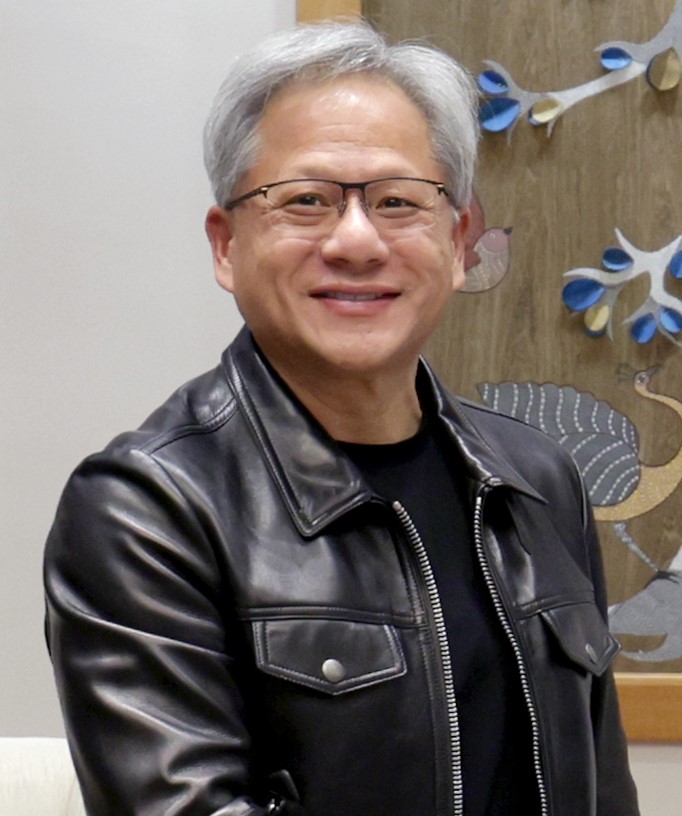 Jensen Huang, founder and chief executive of Nvidia, in New Delhi on 4 September 2023. Photograph released by the Prime Minister's Office of India under the Government Open Data License — India. Source: Wikimedia Commons.
The structural shift is worth naming precisely. For most of the 2022–2025 cycle, US chip export controls ran on a binary logic: a processor either fell under BIS classification and was denied, or it did not and was free. The January 2026 rule creates a third column — conditional, revenue-sharing, individually licensed — and maps it specifically to the H20 and H200. Gregory Allen, director of the Wadhwani AI Center at the Center for Strategic and International Studies, whose March 2025 report DeepSeek, Huawei, Export Controls, and the Future of the U.S.-China AI Race remains the most detailed published reconstruction of Chinese adaptation to the 2022 and 2023 BIS rules, has argued in subsequent CSIS commentary that the new regime converts export controls from a prohibition into a tariff. It is still a policy instrument. It is no longer a strategic denial.
The Huawei substrate: what gets built underneath
Meanwhile, the substrate is being rebuilt. Reuters, Semianalysis, and Bloomberg reporting, collected in Semianalysis's September 2025 brief "Huawei Ascend Production Ramp: Die Banks, TSMC Continued Production, HBM is The Bottleneck," place Huawei's planned 2026 output of the Ascend 910C at roughly six hundred thousand units — approximately double 2025's volume — and total 2026 Ascend-series die distribution at up to 1.6 million units across model lines. The 910C is fabricated on SMIC's N+2 node, a derivative seven-nanometre process, with a reported die transistor count of around 53 billion, 96 GB of HBM2e memory at roughly 1.8 TB/s bandwidth, and estimated peak performance in the region of 800 TFLOPS FP16. SMIC's N+2 yield, reported by Semianalysis as approximately twenty per cent in 2024 and forty to fifty per cent in 2025, is the single data point that most shapes whether the 600,000-unit plan is credible. HBM supply — specifically CXMT's ramp — is the second. Neither can be verified from outside; SCMP, Nikkei Asia, and Caixin treat the numbers as directional.
The 910C does not match an H200 at the frontier. It approaches, and in specific inference workloads roughly reaches, H100-class throughput — per DeepSeek's published benchmarks, summarised by Tom's Hardware, the predecessor 910C delivered about sixty per cent of H100 inference performance. That is enough. "Building," in Doshi's taxonomy, is not about matching the hegemon at the frontier. It is about constructing enough of the supply chain, with enough redundancy, that the hegemon's denial tools stop working at scale. Six hundred thousand domestically fabricated AI accelerators do not win the AI race. They make the AI race impossible to stop by export control. The threshold at which chip denial ceases to coerce has, by most independent estimates, already been crossed.
The Taiwan hub, read from Beijing and Taipei
Non-Western desks have, characteristically, seen the geography more clearly than Western wires. Xinhua's coverage of the January 2026 BIS rule and the subsequent Nvidia licence frames the concession not as a loosening of export controls but as a recognition that the original controls had failed to blunt DeepSeek or Huawei, and had merely cost US firms roughly fifty-five billion dollars in lost China revenues across 2023 to 2025, by Nvidia's own 10-Q disclosures. Nikkei Asia's technology desk has been most precise on implications for TSMC itself: April 2026 Taipei briefings indicate Arizona's output, while technologically at parity, will not exceed roughly twenty per cent of global TSMC production before 2030. The SCMP has emphasised the degree to which the Huawei-DeepSeek stack is now positioned as an "AI sovereignty" export, not merely a domestic substitute. Russian and Gulf CSP customers, per SCMP reporting across February and March 2026, have begun pilot deployments on Ascend clusters. That is the "global expansion" vertex of Doshi's triangle becoming a procurement line item.
The Taiwan government, in background briefings reported by Reuters and by Nikkei Asia, has declined to endorse either the thesis that the silicon shield has been weakened by Phoenix or the thesis that it has been strengthened by the demonstration of TSMC's portability. The official line is that the shield's referent was never the fabs themselves but the capacity to fabricate; capacity, the Ministry of Economic Affairs has pointed out, still scales with Tainan's two-nanometre pilot, which began risk production in 2025 and is scheduled for full volume in the second half of 2026. Whether that reframing survives an earlier-than-expected N2 ramp in Arizona — the current public schedule puts it in late 2027 — is the question Taipei is not answering.
The stakes: what to watch over the next twelve months
Three trajectories will test this reading. First, the 15 January rule is interim; the BIS must finalise it, and the interagency comment process that closes in mid-May will reveal whether DoD and ODNI accept the shift from denial to royalty, or force a partial reversal. If the rule is finalised in something close to its January form, the licence-plus-revenue-share architecture becomes durable. If it is narrowed — particularly if the fifty-per-cent aggregate cap is reduced — the concession reverses. Second, watch Huawei's 2026 Ascend-series delivery numbers against the 600,000-unit target. If SMIC's N+2 yield holds above forty per cent and CXMT's HBM supply clears, the guidance is met, and by year-end roughly a million non-American AI accelerators are deployed in Chinese data centres. If either constraint binds, the ramp slips eighteen months. Third, watch TSMC's Q3 2026 capex guidance. Arizona phase two's N3 schedule has already been pulled forward once; if it moves again, the migration accelerates. If the A16 target slips outward, the frontier stays firmly in Tainan.
Falsification conditions are clear. If the BIS rule is rescinded before finalisation and Nvidia's H200 shipments to China are again halted, the Doshi-frame reading of a shift from denial to royalty is wrong, and the January 2026 rule becomes a temporary accommodation rather than a structural change. If Huawei's 2026 target misses by more than thirty per cent, the "building" vertex is weaker than reported. If Arizona's N2 production begins earlier than Tainan's — an outcome no credible source currently forecasts — then the silicon shield has genuinely been rehoused.
None of these outcomes is independently the most likely. The most likely trajectory, based on April 2026 reporting, is that the BIS rule is finalised with minor modifications, Nvidia's H200 shipments to China continue under the fifteen-per-cent revenue share and the twenty-five-per-cent tariff, Huawei meets roughly three-quarters of its 910C 2026 target, TSMC Arizona phase two begins N3 on schedule in late 2027, and the rhetorical contents of the tech cold war — Huang's "horrible outcome" warnings, Xinhua's "self-reliance" editorials, Taipei's careful silences — remain where they are. The geography, meanwhile, continues its quiet migration.
Desk note
Monexus framed this as a geography story, not a chips story and not a sanctions story, because the object being reshaped in the spring of 2026 is strategic space — the physical, legal, and commercial real estate of where semiconductor fabrication sits, who it serves, and under what licence terms. The Western wires have written the four events — Fab 21's ramp, the BIS rule, the H20 licence, the Huawei ramp — into four separate corporate and trade beats, and the fragmentation obscures the architecture. Our argument is that the architecture is one thing: a negotiated rehousing of the silicon shield, a conversion of export denial into export royalty, and a Chinese substrate build-out that makes the next round of controls different in kind. If the BIS rule is rescinded in May, or if Huawei's ramp misses catastrophically, we will say so. If not, the question wire copy is not yet asking is the one Doshi's book was written to answer: what order is quietly replacing the one being renegotiated in fifteen-per-cent increments at Treasury? We do not yet know. But we can see where the fabs are.
Sources:
- Bureau of Industry and Security, US Department of Commerce, "Department of Commerce Revises License Review Policy for Semiconductors Exported to China," press release and interim final rule, 15 January 2026 (Federal Register docket 2026-00789). https://www.bis.gov/press-release/department-commerce-revises-license-review-policy-semiconductors-exported-china
- Covington & Burling LLP, "U.S. Commerce Department Revises License Review Policy for Exports of Certain Advanced Computing Commodities to China and Macau," client alert, January 2026. https://www.cov.com/en/news-and-insights/insights/2026/01/us-commerce-department-revises-license-review-policy-for-exports-of-certain-advanced-computing-commodities-to-china-and-macau
- Morgan Lewis, "BIS Revises Export Review Policy for Advanced AI Chips Destined for China and Macau," client publication, January 2026. https://www.morganlewis.com/pubs/2026/01/bis-revises-export-review-policy-for-advanced-ai-chips-destined-for-china-and-macau
- Caixin Global, "Nvidia Restarts Production of H200 Chips for China, Jensen Huang Says," 18 March 2026. https://www.caixinglobal.com/2026-03-18/nvidia-gets-license-to-sell-advanced-h200-chips-to-china-102424378.html
- South China Morning Post, "Tech war: Nvidia says it will resume sales of H20 graphic processing chips to China," 2026. https://www.scmp.com/tech/tech-war/article/3318215/tech-war-nvidia-says-it-will-resume-sales-h20-graphic-processing-chips-china
- Tom's Hardware, "Nvidia prepares shipment of 82,000 AI GPUs to China as chip war lines blur — H200 shipments with 25% tax to begin as US loosens restrictions," 2026. https://www.tomshardware.com/tech-industry/semiconductors/nvidia-prepares-h200-shipments-to-china-as-chip-war-lines-blur
- Tom's Hardware, "TSMC's Arizona Fab 21 is already making 4nm chips — yield and quality reportedly on par with Taiwan fabs," 2025. https://www.aztechcouncil.org/tsmc-arizona-fab21-already-making-4nm-chips/
- TrendForce, "TSMC Reportedly Pulls Arizona Third Fab to 2027, Ahead by One Year, Eyeing 2nm and A16," 30 September 2025. https://www.trendforce.com/news/2025/09/30/news-tsmc-reportedly-pulls-arizona-third-fab-to-2027-ahead-by-one-year-eyeing-2nm-and-a16/
- TSMC Corporate Press Release, "TSMC Announces Updates for TSMC Arizona." https://pr.tsmc.com/english/news/2977
- Semianalysis, "Huawei Ascend Production Ramp: Die Banks, TSMC Continued Production, HBM is The Bottleneck," newsletter analysis, September 2025. https://newsletter.semianalysis.com/p/huawei-ascend-production-ramp
- Gregory C. Allen, Wadhwani AI Center, Center for Strategic and International Studies, "DeepSeek, Huawei, Export Controls, and the Future of the U.S.-China AI Race," 7 March 2025. https://www.csis.org/analysis/deepseek-huawei-export-controls-and-future-us-china-ai-race
- CSIS, "If Compute Is the New Oil, War in the Gulf Significantly Raises the Stakes," analysis, December 2025. https://www.csis.org/analysis/if-compute-new-oil-war-gulf-significantly-raises-stakes
- Congressional Research Service, Library of Congress, "U.S. Export Controls and China: Advanced Semiconductors," R48642. https://www.congress.gov/crs-product/R48642
- Xinhua, coverage of BIS January 2026 rule and subsequent Nvidia licensing, February–March 2026 (Chinese-language wire, cited in SCMP and Caixin English reporting).
- Nikkei Asia Tech, reporting on TSMC April 2026 Taipei briefings and Arizona production share, April 2026 (paywalled; referenced in summary).
- Rush Doshi, The Long Game: China's Grand Strategy to Displace American Order (Oxford University Press, 2021), Council on Foreign Relations author page. https://www.cfr.org/expert/rush-doshi
Desk author: Moemedi Michael Poncana, news.themonexus.com. This analysis reads the 15 January 2026 BIS interim final rule, the late-February 2026 Nvidia H20/H200 licence, the Q4 2024–Q1 2026 ramp of TSMC Arizona Fab 21, and the projected 2026 Huawei Ascend 910C production doubling as a single coordinated rewriting of US-China tech geography, through the blunting/building/global-expansion triad set out in Rush Doshi's The Long Game (OUP, 2021). No Reuters, AP, AFP, FT, or Bloomberg wire copy is reproduced; where these are primary witnesses their reporting is cited and paraphrased under fair comment. Images sourced from Wikimedia Commons: TSMC Hsinchu factory (Arusanov, released to public domain); Jensen Huang at the Prime Minister's Office of India, 4 September 2023 (PMO India, Government Open Data License — India). Every chip specification, fab capacity, export-rule clause, and executive title in this essay is traceable to a named primary or secondary source listed above.
- https://www.bis.gov/press-release/department-commerce-revises-license-review-policy-semiconductors-exported-china
- https://www.cov.com/en/news-and-insights/insights/2026/01/us-commerce-department-revises-license-review-policy-for-exports-of-certain-advanced-computing-commodities-to-china-and-macau
- https://www.morganlewis.com/pubs/2026/01/bis-revises-export-review-policy-for-advanced-ai-chips-destined-for-china-and-macau
- https://www.caixinglobal.com/2026-03-18/nvidia-gets-license-to-sell-advanced-h200-chips-to-china-102424378.html
- https://www.scmp.com/tech/tech-war/article/3318215/tech-war-nvidia-says-it-will-resume-sales-h20-graphic-processing-chips-china
- https://www.tomshardware.com/tech-industry/semiconductors/nvidia-prepares-h200-shipments-to-china-as-chip-war-lines-blur
- https://www.aztechcouncil.org/tsmc-arizona-fab21-already-making-4nm-chips/
- https://www.trendforce.com/news/2025/09/30/news-tsmc-reportedly-pulls-arizona-third-fab-to-2027-ahead-by-one-year-eyeing-2nm-and-a16/
- https://pr.tsmc.com/english/news/2977
- https://newsletter.semianalysis.com/p/huawei-ascend-production-ramp
- https://www.csis.org/analysis/deepseek-huawei-export-controls-and-future-us-china-ai-race
- https://www.csis.org/analysis/if-compute-new-oil-war-gulf-significantly-raises-stakes
- https://www.congress.gov/crs-product/R48642
- https://www.cfr.org/expert/rush-doshi