Hezbollah's drone and ambush footage tests Israel's northern front narrative
Footage released on 13 June 2026 shows a Hezbollah surface-to-air kill on an Israeli Heron-1 and a separate ambush against an armoured column, sharpening a public-information contest both sides are waging in real time.
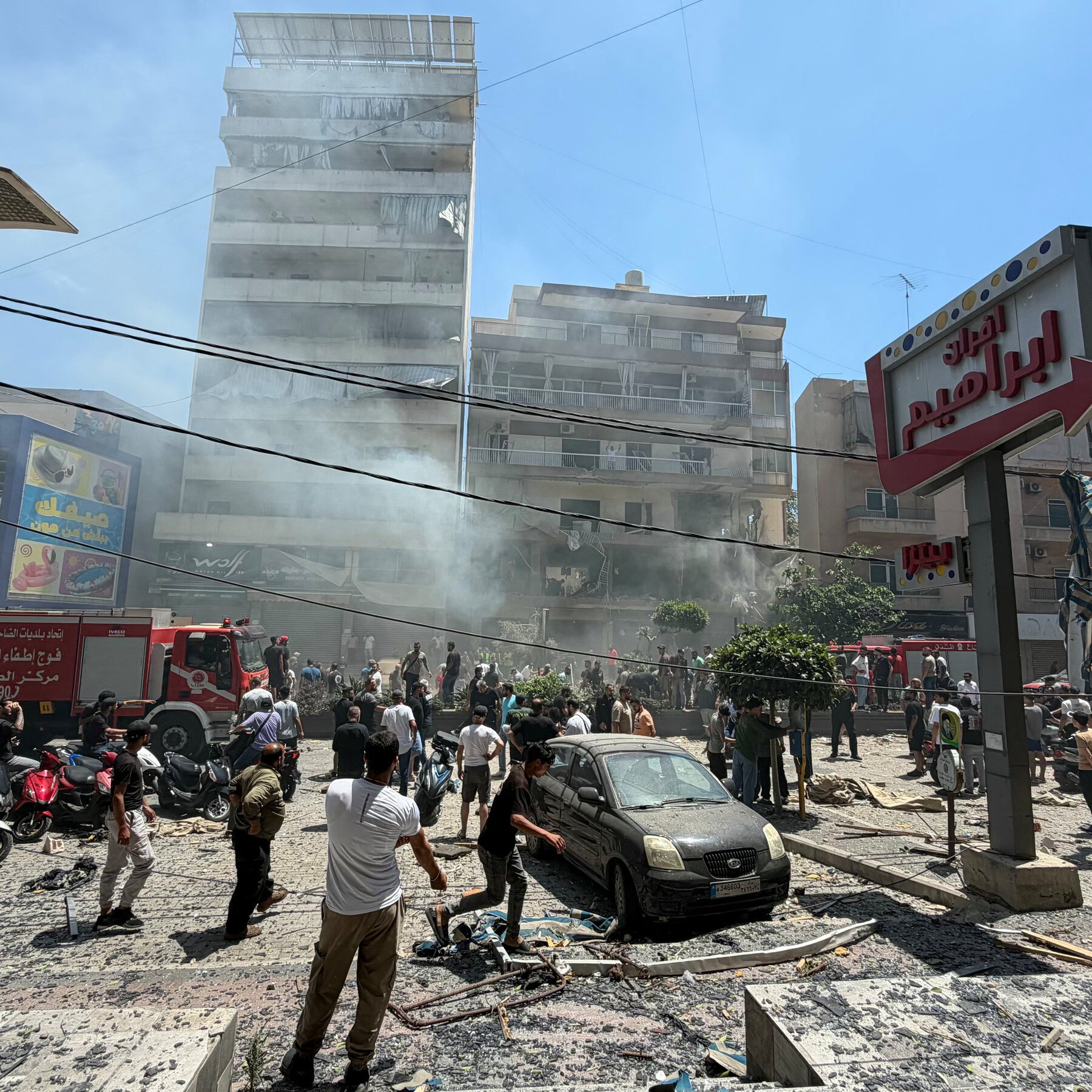
On the evening of 13 June 2026, two pieces of footage landed within roughly sixteen minutes of each other and set the terms of a new information fight along the Israel–Lebanon border. At 19:48 UTC, a clip surfaced showing an Israeli soldier sprinting for cover after a warning that a drone had crossed from Lebanese territory. At 19:53 UTC, a second clip — circulated by Middle East Spectator — claimed a Hezbollah ambush on an advancing Israeli armoured column, with at least two vehicles destroyed in an explosion visible from a distance. By 20:04 UTC, a third video had been published by Hezbollah's media arm, showing the engagement of an Israeli Aerospace Industries Heron-1 reconnaissance drone and a guided-munition-style hit on its seeker head, the kind of footage the group has historically released only when it is confident the kill is real.
The pattern matters more than any single clip. Israel and Hezbollah have spent the past year trading not just fire but narratives, and the new releases tighten the screws on the Israeli public-information line that the northern front is being held to manageable cost. Each piece of footage is small on its own; taken together, they are a counter-narrative package aimed at Israeli domestic audiences and at the Israeli defence establishment, which has warned for months that Iranian-aligned groups are deliberately producing "proof of concept" media to erode deterrence.
What the three clips actually show
The Heron-1 video is the most technically legible of the three. According to a description circulated by the open-source account sprinterpress, the footage shows the downing of an Israeli Heron-1 over Lebanese territory, with the homing head on the intercepting munition consistent with an Iranian-designed surface-to-air missile family long reported in regional arsenals. Heron-1 is a medium-altitude long-endurance unmanned platform used by the Israeli Air Force for surveillance; its loss is operationally significant because it is not a cheap system and because each downing of one shifts the cost calculus of routine overflight.
The tank ambush footage is harder to verify. The clip circulated by Middle East Spectator shows a column of armoured vehicles moving through a vegetated corridor and at least one secondary detonation on a vehicle. No claim of personnel casualties has yet been independently corroborated. The third clip — the soldier fleeing on a warning of incoming drones from Lebanon — is a short piece of body-camera-style footage whose origin and date cannot be confirmed from the public record.
The counter-narrative problem
Israel's conventional messaging in this phase of the conflict has emphasised three things: that air superiority is uncontested, that Hezbollah's precision-missile and drone stocks have been degraded, and that ground incursions into Lebanon are surgical and limited. The new footage pushes against each of those claims at once. A successful drone kill of a Heron-1 implies surface-to-air coverage that Israeli air planners had publicly downplayed. An ambush on an armoured column implies the kind of shaped-charged anti-armour capability that is not consistent with a degraded arsenal. And a soldier running for cover on drone warning is, however small, the kind of image the Israeli home front has been primed to notice.
There is a real risk of over-reading any one of these. Sprinterpress is an X account with a track record of accurate open-source work but with no editorial chain; Middle East Spectator is a Telegram aggregator whose sourcing is opaque. The footage could be old, re-cut, or selectively framed. None of that, however, is the point from Hezbollah's perspective. The point is to be first to define the day's image, and on 13 June the group did.
What this sits inside
The deeper pattern is the steady migration of the Israel–Hezbollah confrontation from a closed-air campaign — jets versus missile batteries, with journalists and the public kept at a distance — into an open-source information contest in which the first credible footage of the day tends to set the day's story. The same logic that drove Hamas's media operation after 7 October 2023 is now visible on the northern front, with shorter loops and more disciplined production. Tehran-aligned groups have learned that a clean kill, captured and posted within the hour, does political work that ten press conferences cannot.
It is also a story about what a "surgical" ground operation looks like in real time. Israeli planners have framed incursions into southern Lebanon as precision actions against launch sites and weapons stores; the ambush footage, if confirmed even partially, complicates that framing. Armoured columns move slowly, are easy to film, and are easy to ambush in terrain that Hezbollah knows in detail. The asymmetry of image — the Israeli tank is large, the Hezbollah anti-armour team is small — is itself part of the message.
What is still genuinely uncertain
The open record at the time of writing does not establish: the operational loss rate of Israeli Heron-1s in the current phase; the number of Israeli personnel killed or wounded in the reported ambush; whether the soldier footage is from the same day or an earlier engagement; and whether Iranian-supplied air defence systems have been formally transferred into Lebanese hands or are being operated by embedded personnel. Each of these is the kind of detail that a serious verification process would test, and none is settled by the clips themselves. The dominant framing — that Hezbollah is regaining a degree of air-defence competence and tactical surprise on the ground — should be read as the most plausible reading of the evidence, not as established fact.
The northern front is being argued about in twelve-second increments. That is the actual story, and it has not been honestly told by anyone, on either side, yet.
Desk note: Monexus foregrounds the open-source footage itself, with the caveats attached, rather than either the Israeli security-services line or the Hezbollah media line, both of which are incentives-loaded. Where the wire services lead, we follow; where the wire services are silent, we name the silence.
Wire provenance
This editorial synthesis draws on the following public wire/social posts:
- https://x.com/sprinterpress/status/2065884032320053248
- https://t.me/Middle_East_Spectator
- https://x.com/sprinterpress/status/2065884032320053248
- https://en.wikipedia.org/wiki/IAI_Heron
- https://en.wikipedia.org/wiki/2023_Hezbollah%E2%80%93Israel_crisis