Hezbollah's drone war returns to the border — and Israel is publishing what it shows
Hezbollah footage shows a Heron shot down over eastern Lebanon and kamikaze drones sent at an Israeli armoured brigade HQ in the south. The video war, and the air war beneath it, are running in parallel.
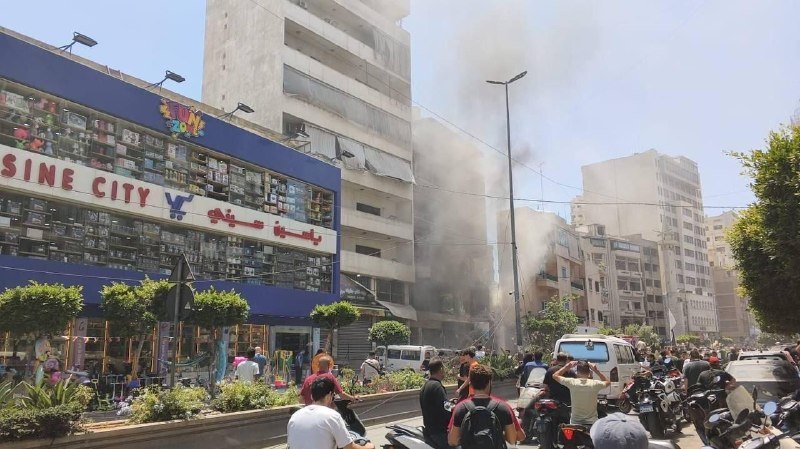
Three short clips, released inside an hour, have put the south-Lebanon front back on the airwaves. On 13 June 2026, Hezbollah-aligned channels published footage of an operation it says shot down an Israeli IAI Heron drone over the town of Nahleh in eastern Lebanon using a Misagh-3 loitering surface-to-air munition, followed by video of two kamikaze drones launched at what the group described as the newly established command-and-control centre of the Israeli 401st Armoured Brigade in Debl, in the south of the country. The releases are tactical boasts, not intelligence confirmations. They are also the clearest public signal in weeks that the drone duel along the Litani has re-opened, and that both sides now want the world to see it.
What changed on Saturday is not the existence of a Hezbollah air threat — that capability has been documented for years — but the choreography. Three separate uploads from two channels, sequenced within about an hour and a half of each other, address two different layers of the fight: a counter-UAS kill on an Israeli surveillance drone, and a deliberate strike on what the group says is a frontline armoured headquarters. The pairing is designed to communicate two things at once. The first is that Hezbollah can still deny Israel full ISR coverage of the eastern Bekaa and the southern Litani corridor. The second is that it can reach the rear of the Israeli deployment in the south, not merely the fence.
Read the footage the way the IDF would. A Heron is not a strike asset; it is a long-endurance surveillance platform. Bringing one down with a Misagh-3 — an Iranian-origin loitering SAM that homes on radar emissions — does not just remove one airframe. It is meant to push Israeli planners to assume their unmanned surveillance picture is contested, and to shift more ISR onto manned aircraft, which are costlier and easier to escalate around. The follow-on attack on the 401st Brigade's forward HQ is the more politically loaded claim. The 401st is one of the IDF's three operational armoured brigades, and a strike on a battalion-or-above headquarters, even in edited propaganda footage, is meant to signal reach rather than effect. Neither clip, on what is publicly available, has been independently verified for damage assessment. The Israeli military has not, as of writing, published a confirmation or rebuttal of either claim.
The counter-narrative matters here. Israeli security concerns along the northern border are not manufactured, and they do not start or end with a Telegram post. The 401st Brigade's deployment to the south-Lebanon sector reflects a posture that the IDF's own Northern Command has been rebuilding since the slow-burn attrition of 2024, and the renewed formation-level presence is itself a response to the kind of stand-off tactics that Hezbollah's media wing is now advertising. Drone-on-drone engagements, loitering munitions against ISR, and swarming attacks against headquarters buildings are the vocabulary the front has been speaking for the better part of a year. The Saturday releases, in that sense, are a public-resumption announcement more than they are a novel escalation. The risk is that the visual language — kamikaze drones closing on a named brigade HQ — outruns the actual tactical reality, and that domestic Israeli and Lebanese audiences, each for opposite reasons, are invited to read more into the footage than the operators on either side have yet had to fight through.
Structurally, this is what a low-intensity aerial front looks like in 2026. The dominant frame is no longer a single service-vs-service exchange; it is a layered kill chain in which a non-state actor fields loitering SAMs, kamikaze drones, and tightly edited media releases as a single integrated system. Counter-air, counter-UAS, strike, narrative — all four functions now sit in the same package. Western wire coverage has tended to treat the video releases as colour, not substance. That treatment understates the operational logic. A Hezbollah press cycle that is timed, branded, and distributed across Arabic- and English-language channels in the same hour is itself a coercive instrument, and Israel — with a military that takes hostile media penetration seriously as a force-protection problem — has a direct interest in not letting that instrument set the agenda in Tel Aviv or in the border towns.
The honest position is that we do not yet know what actually flew, what was hit, and what failed. Hezbollah-aligned channels are not neutral observers; they are participants, and their footage is curated for effect. The IDF has not corroborated or denied. The 401st's presence at Debl is consistent with Israeli public reporting on its post-war posture in the south. What the Saturday releases prove, on the available evidence, is narrower than either side's partisans will want to claim: that Hezbollah retains a loitering-munition capability against Israeli unmanned systems, and a kamikaze-drone capability aimed at rear-echelon formations inside the border zone. The wider claim — that the campaign has shifted from harassment to something more — is plausible, but the footage is not enough to carry it. The next forty-eight hours of Israeli and UNIFIL reporting, not the next forty-eight hours of Telegram uploads, will tell us whether Saturday was a punctuation mark or a turn of the page.
How Monexus framed this vs the wire: the dominant Western line is to treat Hezbollah's media releases as illustration, with the harder claims about Israeli casualties, headquarters damage, or the downing of the Heron left unverified. We have followed that standard on facts we cannot corroborate, but pushed back on the framing assumption that the video itself is not the message. In a border front that runs partly on coercive signalling, treating the choreography of the release as separate from the strike it claims to depict misses the point of why the footage was made in the first place.
Wire provenance
This editorial synthesis draws on the following public wire/social posts:
- https://t.me/AMK_Mapping/
- https://t.me/AMK_Mapping/
- https://t.me/wfwitness/