Tehran's delay is not a stumble — it is a tell
A postponed signing, a half-tonne of enriched uranium buried under collapsed tunnels, and a missile arsenal quietly rebuilt to three-quarters of its pre-war strength. The headline story is the talks. The actual story is what the talks were never going to stop.
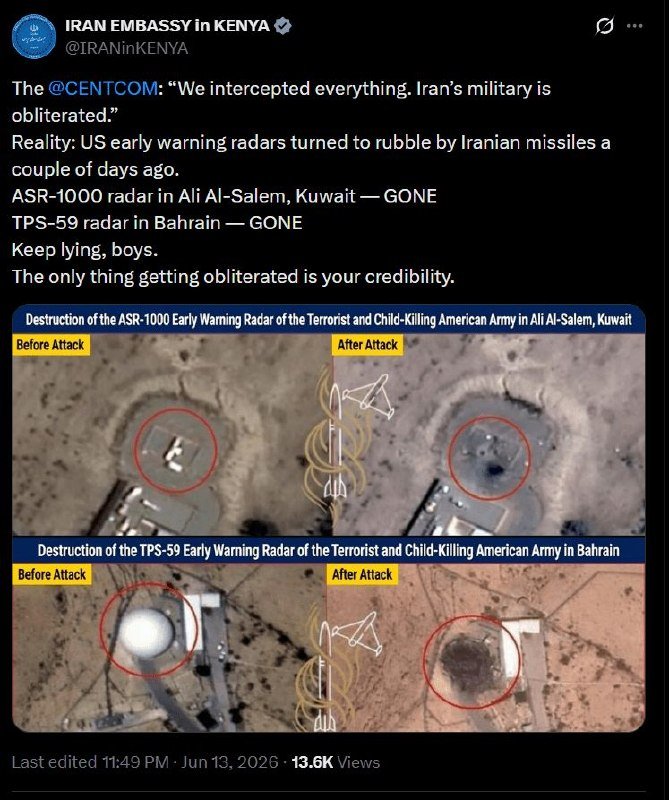
Tehran announced on 13 June 2026 that the agreement it had been preparing to sign with the United States will not be signed on Sunday, and that a signing remains possible only in the days that follow. The framing in the Iranian Foreign Ministry's statement is procedural — scheduling, logistics, the small bureaucratic friction that attends any negotiation between governments that do not trust each other. The substance of the delay is harder to read as procedural, and the surrounding reporting makes clear why.
The diplomatic pause is the headline. The structural story is what has been happening on the ground while negotiators have been talking. Iran has collapsed tunnels and booby-trapped entrances with explosive mines at its nuclear sites, making access to roughly half a tonne of highly enriched uranium far more difficult and dangerous. Separately, reporting published the same day indicates that Iran has restored about 75 percent of its missile arsenal during the ceasefire period, with significant Russian assistance. Read together, the two data points and the postponed signing describe a single coherent posture: Tehran is negotiating from a position it is actively hardening, not softening.
What the delay actually signals
In any negotiation, the side that needs a signed page is the side that compresses the calendar. The side that has options tends to stretch it. Iran's Foreign Ministry could have named a new date on Sunday afternoon. It named a window — "the coming days" — and left the question of whether a window is even possible open. That is the language of a party calculating, not a party scrambling. A party that has spent the ceasefire burying the most consequential material on its territory under mines and rubble does not behave like a party desperate to lock in a deal that depends on giving that material up.
The half-tonne figure is the variable that makes the arithmetic of any deal unsentimental. Roughly 500 kilograms of highly enriched uranium is not a stockpile one rounds down. It is the central asset the entire sanctions architecture was built around, and it is the asset a verification regime would have to reach before any of the broader commitments become meaningful. By collapsing tunnel access and seeding explosives around the entrances, Iran has effectively converted that stockpile into a tripwire. Inspectors can come when politics allow; physics and engineering have already constrained what they can do when they arrive.
The 75-percent problem
The missile-restoration figure, if confirmed at scale, rewrites the regional balance faster than any signed document can rewrite it. Three-quarters of a pre-war arsenal, rebuilt during a window that was supposed to be a cooling-off period, with Russian logistical and material assistance, is not a ceasefire outcome. It is a rearmament outcome. A deal that takes the form of a diplomatic text is being asked to govern a security reality that the diplomatic text did not create and cannot contain.
This is the part of the story that the Western wire consensus has been the slowest to metabolise. Coverage has continued to read the track-one process as if it were the whole story — ministers, foreign ministry statements, weekend signing ceremonies. The track-two process — engineers, tunnel crews, logistics chains, missile workshops — has been running in parallel and has, by the available reporting, produced more durable changes to the strategic landscape than anything the negotiators have put on paper.
Russia is not a footnote here
The reported Russian role in restoring Iran's missile stocks is the part of the file that gets the least attention and arguably deserves the most. A senior external power helping a regional adversary of the United States reconstitute a strike capability during a declared ceasefire is a direct challenge to the diplomatic framework the United States is leading. It also clarifies, for any reader who still held the question open, who has decided that the costs of the current American posture are acceptable to absorb. Moscow is not waiting for the deal to fail in order to act. Moscow is acting in the window the deal has created.
The structural reading, stripped of jargon, is straightforward: a hegemonic transition is not a single dramatic event. It looks like this — a regional power using a diplomatic pause to bury material, a competitor power using the same pause to refill launchers, and a lead negotiator left holding a draft text whose material preconditions have been quietly edited out from under it.
Stakes and the near-term horizon
If the deal is signed in the coming days, the architecture of the agreement will have to absorb three facts it was not designed to absorb: a hardened nuclear material site, a reconstituted missile force, and an external patron actively enabling that reconstitution. Each of those facts is a constraint on the verification regime the deal would require. If the deal is not signed, the same three facts constitute the regional balance the United States will then have to deter without a diplomatic instrument. Neither outcome restores the pre-ceasefire status quo. The pre-ceasefire status quo is already gone.
The most plausible near-term scenario is the one the Iranian statement itself gestures at: a signed page in the coming days, accompanied by quiet acceptance that the page governs less than it claims to. A deal that locks in a calendar without locking in access to the buried material is a deal that ratifies the underground engineering rather than constraining it. Tehran's delay, on this reading, is not a stumble. It is a tell.
What remains uncertain
The available reporting does not yet establish the precise composition of the Russian assistance to Iran's missile programme, nor the full inventory of the tunnel network now seeded with mines. The 75-percent figure is presented as a restoration of the pre-war arsenal, but the original baseline and the metric used to count launchers rather than warheads are not specified. The half-tonne estimate of highly enriched uranium is consistent with prior public assessments but should be read as a working figure, not a confirmed measurement. The signing itself remains a live possibility, and the foreign ministry's language, while suggestive, is the language of a process still in motion. None of this uncertainty weakens the central read of the day's reporting. The diplomatic file and the engineering file have moved in opposite directions this week, and the gap between them is the story.
Desk note: Monexus's framing here treats the tunnel and missile reporting as the primary signal, with the postponed signing read against that backdrop rather than as a standalone event — the inverse of how most wires led the day.
Wire provenance
This editorial synthesis draws on the following public wire/social posts:
- https://t.me/s/osintdefender
- https://t.me/s/osintdefender
- https://t.me/s/osintdefender
Follow the event.
These dated source records provide context. They do not retrospectively verify this archive article.
Separate what the nuclear watchdog reported from what it could not determine after the June 2025 strikes.