Majdal Zoun clash deepens a southern Lebanon that the ceasefire was supposed to settle
Hezbollah and Israeli forces are trading heavy fire in and around Majdal Zoun, the latest in a string of southern Lebanon engagements that underscore how little of the supposed ceasefire actually holds on the ground.
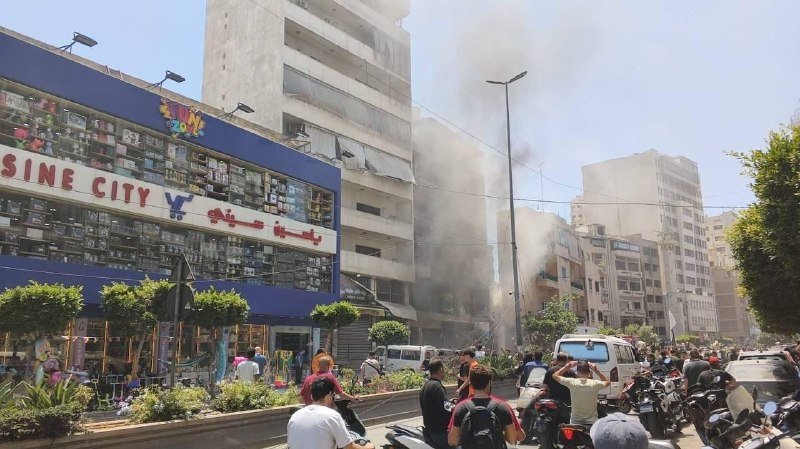
Fires were burning across Majdal Zoun on the afternoon of 13 June 2026, with two newly released photographs showing the southern Lebanese town ablaze after what field accounts described as a fresh bout of fighting between Israeli forces and Hezbollah fighters, with the engagements reported at 20:39 UTC that day [wfwitness, Telegram, 2026-06-13]. Roughly sixteen minutes earlier, the same channel logged five Israeli Merkava tanks on fire after being targeted by Hezbollah fighters in what it called a "major battle" in and around the town [telegram:megatron_ron, 20:23 UTC, 2026-06-13]. Earlier in the same hour, Iranian state-aligned Press TV published footage purporting to show Hezbollah forces striking an Israeli command-and-control vehicle with an Ababil attack drone inside southern Lebanon [telegram:presstv, 20:15 UTC, 2026-06-13].
The sequence — five tanks claimed destroyed, a drone strike on a command vehicle, a town on fire — is more than a tactical episode. It is the latest visible rupture in the ceasefire arrangement that was supposed to freeze the Israel–Hezbollah front. Monexus's reading of the day's traffic is that the southern-Lebanon theatre has effectively reverted to a low-grade, attritional war conducted under the vocabulary of "violation response," with each side claiming the other fired first. The structural question is no longer whether the ceasefire survives a given week, but whether it ever functioned as anything more than a pause between operations.
The shape of 13 June
The day's reporting clustered tightly around Majdal Zoun, a town in the Tyre district of south Lebanon close to the frontier. The two wfwitness photographs, circulated at 20:39 UTC, show fires burning inside the built-up area following clashes between "advancing Israeli forces and Hezbollah fighters" [telegram:wfwitness, 2026-06-13]. The accompanying framing does not specify whether the fires were the product of tank engagements, airstrikes, or ground combat; only that the town was burning after a contact.
Megatron's earlier post, at 20:23 UTC, supplies a more granular — and far more partisan — claim: five Israeli Merkava tanks on fire after being targeted by Hezbollah fighters in "a major battle taking place in Majdal Zoun" [telegram:megatron_ron, 2026-06-13]. The number is striking. Independent verification was not available in the materials Monexus reviewed; Hezbollah-aligned channels have, in past rounds, inflated or aggregated strike counts to maximise propaganda effect, and the figure should be read as a claim by one side of the fight rather than a confirmed battlefield outcome.
At 20:15 UTC, Press TV, the English-language outlet of Iranian state broadcasting, released footage framed as Hezbollah targeting an Israeli command-and-control vehicle with an Ababil attack drone in southern Lebanon [telegram:presstv, 2026-06-13]. The Ababil is a known Iranian-designed loitering munition family in service with Hezbollah's aerial arm; the footage is consistent with the group's documented playbook of pairing anti-tank and drone strikes against Israeli armour and headquarters elements in the frontier zone.
The "violation response" frame
What is most revealing in the day's traffic is not the kinetic detail but the rhetoric wrapping it. Across at least two wfwitness posts, Hezbollah's statements for the day were framed explicitly as a reaction to "Israeli ceasefire violations" — language repeated almost verbatim in the 20:03 UTC and 19:40 UTC dispatches covering the group's daily operational communiqués [telegram:wfwitness, 2026-06-13; telegram:wfwitness, 2026-06-13]. A separate wfwitness item at 19:57 UTC carried Hezbollah-released footage of what it said was a 8 June strike on an Israeli command-and-control vehicle on the outskirts of Yahmar al-Shaqif, also in southern Lebanon [telegram:wfwitness, 2026-06-13].
The pattern is consistent and worth naming. Hezbollah's English-language information apparatus has settled on a self-justifying template: every operation is a response to an Israeli breach, the breach is the proximate cause, and any Israeli counter-action is a fresh breach. The template is not new — it is the rhetorical architecture of late-2024 and 2025 — but its persistence six months into a formally agreed cessation suggests that "ceasefire" has become, in practice, a word that means "we get to define who started it." Israeli framing, channeled through IDF Spokesperson briefings and Israeli press, runs in the mirror image: Hezbollah rearmament and any fire across the Blue Line is the violation, and Israeli action is restoration of the arrangement.
Both narratives cannot be simultaneously true. Both are being advanced, with vigour, in real time.
Why Majdal Zoun matters
The geography is doing the talking. Majdal Zoun sits inside the band of villages that the November 2024 understanding placed under varying degrees of Israeli access and Hezbollah withdrawal. The town's name has recurred across the post-ceasefire reporting cycle whenever the frontier re-ignites; that recurrence is itself a finding. The Israeli side of the line has, by all available accounts, continued to operate inside the southern-Lebanon band — including, per the day's material, "advancing" inside Majdal Zoun itself [telegram:wfwitness, 2026-06-13]. Hezbollah's claim of destroying five Merkavas in the same locality, even discounted for propaganda inflation, implies a direct, in-village engagement rather than the cross-border fire that a functioning ceasefire would have confined.
There is a structural reading here that does not depend on the day's contested numbers. The ceasefire architecture of late 2024 was a political construct held together by a single external backer willing to enforce restraint on both clients. That backer has, across 2025 and into 2026, shown diminishing appetite for a coercive presence on the Israel–Lebanon line. When the enforcer withdraws, the underlying logic of the arrangement — that Israel will not advance into Lebanese towns and Hezbollah will not re-employ heavy anti-tank systems in them — collapses into the verbal stalemate now on display. Majdal Zoun is what the collapse looks like in practice: a small town burning, two claim-counters running, and a press architecture that converts the result into a daily bulletin of "violations."
The plausible counter-read
A defensible counter-reading is that none of this represents a strategic decision by either party to break the arrangement. Israel can argue, with some evidence, that the operations it runs inside southern Lebanon are bounded counter-terror action against an actor that did not, in its view, genuinely disarm. Hezbollah can argue, also with some evidence, that Israeli incursions into towns like Majdal Zoun are themselves the breach, and that its responses are calibrated and necessary. Under that reading, 13 June is not a strategic rupture but the steady-state cost of a permanently contested line — the friction that the diplomatic language of "calm" was always destined to produce.
The problem with that more sanguine reading is that steady-state friction, sustained, is operationally indistinguishable from a war of position. Towns do not burn at this rate as background noise. The 13 June material — five tanks claimed destroyed, an active drone strike on a headquarters vehicle, fires in a populated centre — is a level of contact incompatible with the term "ceasefire" in any ordinary sense of the word. The framing that still calls it a ceasefire is, in effect, a political claim rather than a description of the ground.
Stakes and what to watch
The human stakes are local and immediate. Civilians in Majdal Zoun and the surrounding Tyre-district villages bear the cost of an arrangement that, on the day's evidence, no longer protects them. The Israeli towns on the other side of the border carry a different but no lesser risk: the slow attrition of a deterrence framework that, in November 2024, was supposed to have bought quiet for a generation. The Lebanese state's leverage on the ground is, as it has been for two years, near zero; the Iranian, American, and French diplomatic layers all have an interest in calling the present situation by a softer name than the facts warrant.
What to watch over the coming days is whether the Majdal Zoun episode closes quickly — a contained incident, no Israeli ground advance, a return to cross-border fire — or widens. If the 20:23 UTC claim of five destroyed Merkavas holds up under independent visual verification, the political pressure inside Israel for a deeper response will rise sharply, and the diplomatic layer will be tested. If the figure compresses under scrutiny, the Hezbollah-aligned information apparatus will have burned credibility it cannot easily replace. Either way, the southern Lebanese frontier is no longer being managed so much as it is being endured.
Desk note: the wire outlets have, in this round, largely ceded the southern-Lebanon frontline to Telegram channels — Hezbollah-aligned (wfwitness, Megatron) and Iranian-state (Press TV). Monexus has reported their claims as claims, has flagged the partisan provenance of each, and has declined to inflate unverified tank-destruction counts into a confirmed battlefield outcome. The Israel–Lebanon front deserves the same sourcing rigour applied to Gaza and the north.
Wire provenance
This editorial synthesis draws on the following public wire/social posts:
- https://t.me/wfwitness/
- https://t.me/megatron_ron/
- https://t.me/presstv/
- https://t.me/wfwitness/
- https://t.me/wfwitness/
- https://t.me/wfwitness/