South Lebanon is being bombed in real time and almost no one is watching
Four Israeli strikes hit southern Lebanon within roughly seventy minutes on the evening of 13 June 2026, and the global press moved on. The pattern is the story.
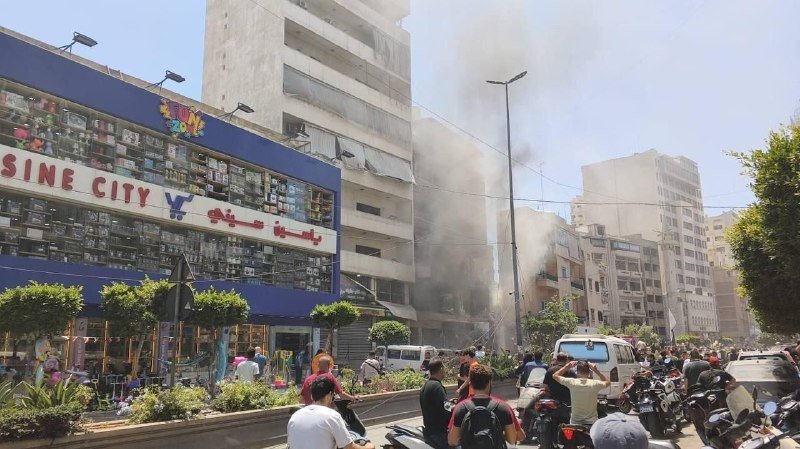
Four strikes landed across southern Lebanon in the space of about an hour on Saturday evening, 13 June 2026. The first alert, logged at 19:50 UTC, was an Israeli air raid on the town of Balat. Artillery followed on Wadi Al-Hujayr at 20:44, then on Toulin at 20:49, and finally a strike on Mifdoun at 20:58, according to urgent bulletins carried by the Lebanese outlet Al-Alam Arabic, whose Telegram wire this article draws on. The pace, not the geography, is the headline. Seven minutes between shells. Eight minutes between the last two. Whatever the targets, the tempo tells you what the operation is: a campaign of cumulative pressure, not a discrete retaliatory action.
This is the framing most Western readers should be demanding, and most are not getting. South Lebanon is being struck on a near-daily basis, the casualty and displacement counts are mounting, and the global press cycle has already moved on to the next stop on the conveyor belt — usually a Washington briefing or a Gulf-state summit. The result is a slow-motion emergency that does not register as one because the violence is incremental, the geography is unfamiliar, and the people on the receiving end have a name, in the dominant Western coverage, for "people it is permissible to bomb without comment."
The wire is working fine. The attention economy isn't.
The bulletins themselves are unremarkable as wire copy. Al-Alam Arabic is a Beirut-based outlet with documented regional reach, and its Telegram feed carried each strike with a timestamp and a town name — the basic disciplines of a functioning newsroom. That is not the problem. The problem is upstream: a strike on a Lebanese border town in mid-June 2026 has no diplomatic peg, no ceasefire anniversary to hang on, no headline-grabbing casualty figure attached to a single named Western citizen. It does not travel through the algorithmic filters that determine what a Times or a BBC reader is shown. It is filed, it is logged, and it is gone.
Compare that to a single mortar or rocket incident on the Israeli side of the line, which is guaranteed front-page treatment in every Western wire for forty-eight hours. The asymmetry is not imaginary. It is measurable in column inches, in homepage dwell time, and in the volume of expert panel-hours booked. A Lebanese village being hit four times in an evening does not get a panel.
What the strikes are doing structurally
Strip the incident count away and the strategic picture is straightforward. South Lebanon has been under continuous Israeli air and artillery activity since the collapse of the November 2024 ceasefire arrangement, and the tempo has not abated in 2026. The strikes are functionally a permanent operation: not a war in the declared sense, not a peace in any operational sense, but a managed pressure regime that the Israeli defense establishment runs against what it characterises as Hezbollah infrastructure, and that the Lebanese state is unable to meaningfully contest on the ground. Israeli security concerns about a re-armed Hezbollah presence on the border are legitimate and have to be acknowledged as the starting point for any honest read of the file. But the answer to "is there a threat" cannot be a never-ending air campaign that has now run longer, in calendar terms, than several of Israel's formally declared wars.
The structural problem for Lebanon is that this is happening inside a sovereign state's territory without the diplomatic architecture that would normally attach to it. There is no active negotiations track that the strikes are designed to leverage. There is no UN-led process being advanced or undermined by the bombing. There is, at the level of the international system, almost no one with a defined job description that requires them to make the bombing stop.
The counter-narrative, taken seriously
The Israeli framing, stated at its strongest, is that every strike targets a specific military asset — a weapons cache, a launch position, a commander — and that the civilian cost, where it occurs, is a function of Hezbollah's deliberate embedding in populated areas. That framing has real evidentiary support: Hezbollah's pre-2024 deployment pattern in southern villages is well documented, and the doctrine of using populated terrain for military purposes is not invented. The countervailing fact is that the strikes have continued for nineteen months without producing a verifiable, published after-action record that would let an outside observer audit the targeting on a strike-by-strike basis. The Israeli public gets the operation; the Israeli and international press gets the operation in summary form; the international system does not get the targeting file. That gap is doing damage to Israel's own claim that this is a precision campaign, because precision is provable, and what cannot be audited should not be asserted.
There is also a Lebanese state position that is worth airtime. Beirut's line — that the sovereignty of a UN member state is being violated daily, that the displacement in the south is now structural rather than episodic, and that the absence of a serious ceasefire track is itself the policy outcome being pursued — is the position of the government of a country that hosts a million-plus displaced Syrians, that is running an economy in free fall, and that is being asked to absorb a fourth consecutive year of aerial bombardment of its southern districts. It is not a maximalist position. It is a baseline of sovereignty language that any other state would be expected to use.
What the silence costs
The most honest way to frame this is as a market failure in attention. Four strikes in seventy minutes on 13 June 2026 produced a small cluster of Telegram bulletins and almost no sustained Western press follow-up. The Lebanese state's foreign minister, the UN Special Coordinator, the EU's Lebanon envoy — none of them were, on the evening of 13 June, given a public reason to act. The diplomatic economy around Lebanon runs on the same logic as the press economy: nothing moves unless something visibly breaks.
If the current trajectory continues, three things become more likely. The south empties out further, accelerating the displacement that began in late 2024 and turning a temporary emergency into a permanent demographic shift. The Lebanese state, unable to project sovereignty in its own border districts, loses the residual credibility it has in negotiations with both the IMF and Gulf creditors. And the regional escalatory ladder — which currently sits a few rungs below the threshold that would force Washington and Brussels into a defined posture — climbs one more rung without anyone having to take the political risk of admitting it.
Desk note: Western wires in mid-June 2026 are leading on the diplomacy of a notional second-track Iran file and on a Gaza ceasefire that is, in journalistic practice, treated as the only Middle East story that counts. This piece argues that the south-Lebanon air campaign is the structural backdrop to both, and that the absence of dedicated coverage is itself the policy outcome. Sources are limited to the Telegram wire because that is the only provenance available for the four specific strikes cited; the structural claims about attention and diplomacy are this publication's analysis and should be read as such.
Wire provenance
This editorial synthesis draws on the following public wire/social posts:
- https://t.me/alalamarabic
- https://t.me/alalamarabic
- https://t.me/alalamarabic
- https://t.me/alalamarabic