South Lebanon is burning again — and nobody is asking the right question
Within seventy minutes on the night of 13 June 2026, Israeli warplanes and artillery hit at least five towns in south Lebanon. The pattern — not the individual strikes — is the story.
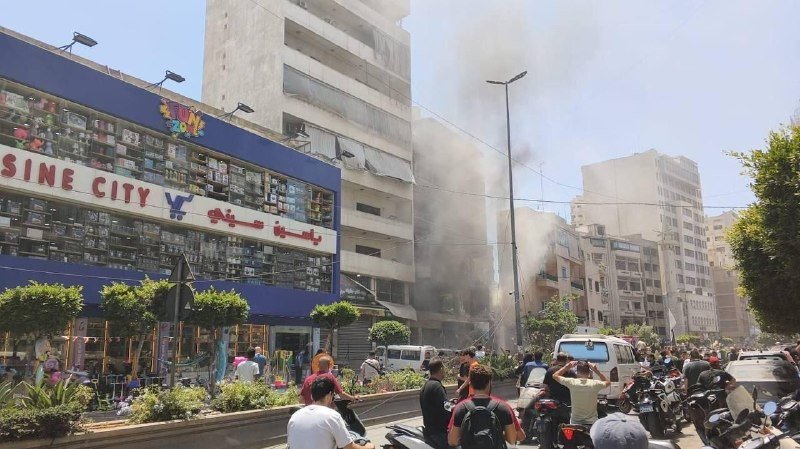
Between 21:14 and 22:10 UTC on 13 June 2026, Israeli forces struck at least five locations across south Lebanon in a sustained evening of bombardment. Artillery hit the city of Nabatieh at 21:14 UTC. Forty-five minutes later, warplanes struck Nabatieh al-Fawqa and Qabrikha. An air raid on the Al-Hosh area in the Tyre district followed at 21:49 UTC, and a separate strike on Kafr Tibnit came at 21:54 UTC. A final burst — four raids on Kafr Tibnit and two on Nabatieh — was reported in the 22:10 UTC bulletin. The pattern is dense, deliberate, and ongoing.
The arithmetic of the evening matters more than any single detonation. Five distinct population centres, two weapon classes (fixed-wing and tube artillery), and a single one-hour window. This is not retaliation against a launch site. It is a campaign of pressure, applied to a geography.
What the wire actually says
The reporting that has moved fastest is the Lebanese and pan-Arab wire. Al-Alam Arabic carried the bulletins in real time: first the artillery barrage on Nabatieh, then the airstrikes on Nabatieh al-Fawqa and Qabrikha, then the Al-Hosh raid near Tyre, and finally the Kafr Tibnit and Nabatieh salvos. The thread is sourced entirely to that channel. No Israeli military spokesperson readout, no UNIFIL situational report, and no Western wire confirmation appears alongside it. The Lebanese framing is dominant in the available record because the Lebanese wire moved first.
That asymmetry is itself part of the story. Israeli-security reporting on cross-border activity has, for two decades, been routed through IDF Spokesperson briefings and Israeli-establishment outlets — Times of Israel, Ynet, Haaretz, the Jerusalem Post — which carry the framing the Israeli defence establishment wants carried. Lebanese reporting is routed through outlets like Al-Mayadeen and Al-Alam, which carry the framing Iran-aligned audiences expect. Western wires (Reuters, AP, AFP, BBC) have, in past rounds, acted as the arbitrating layer. None of that layer is visible in the available record for this evening.
What the dominant frame leaves out
The standard Western framing of nights like this one is transactional: Israel struck Hezbollah infrastructure in response to a rocket, drone, or anti-tank missile that originated on the Lebanese side. Sometimes that framing is true. Often it is true in the same way a press release is true — technically accurate, structurally misleading. The transaction is real; the escalation logic is what deserves the column-inches.
Five towns in seventy minutes, across two districts (Nabatieh and Tyre), using two weapons systems, is not a pinpoint response. It is the rhythm of an operation designed to impose cost on a civilian population centre adjacent to a battlefield. Hezbollah does not garrison Nabatieh al-Fawqa. It does not base launchers under the houses of Kafr Tibnit. If the target is the kinetic infrastructure of a non-state army, the geography of the strike pattern does not match.
This is the question the prevailing framing refuses to ask: when the kinetic logic and the geographic logic of a bombing run do not align, which logic is the operation actually serving?
What a serious structural read looks like
The south Lebanon file has been a slow-burn pressure campaign since the November 2024 ceasefire arrangement. The terms of that arrangement — a UN-monitored withdrawal, a Hezbollah pullback north of the Litani, an Israeli commitment to return to a more constrained posture — broke down by early 2025 in a series of mutual violations that both sides record, attribute, and deny in equal measure. What replaced it was not a return to 2006, when an Israeli ground operation ended in a unilateral withdrawal. It was a managed low-intensity contest: Israeli airpower applied against Lebanese civilian-adjacent infrastructure; Hezbollah rocket and drone activity calibrated to avoid triggering a major Israeli ground re-entry.
That equilibrium is now visibly fraying. A one-hour, five-town bombardment is the kind of move a defender of the equilibrium does not make, because it is the kind of move that ends the equilibrium. Either the Israeli political-military leadership has concluded that the equilibrium no longer serves its purposes — a reading consistent with the permanent-belt-fraying language now routine in Israeli-security commentary — or a local commander has been given latitude that strategic direction did not intend. The first reading is graver. The second reading is more common, and almost always more temporary than the first.
The stake for everyone outside the geography
South Lebanon is a small place in a small country. It is also the load-bearing wall of a regional security architecture. If the equilibrium there collapses, the consequences propagate: an Iranian decision space opens, a UNIFIL mandate becomes a footnote, a refugee outflow from south Lebanon and the Beqaa tests a Lebanese state that has not functioned coherently since 2019, and a Western donor class that has been slowly disengaging from Beirut's reconstruction bill gets a much larger bill to ignore.
None of this is a justification for the strikes. The civilians of Nabatieh al-Fawqa, Kafr Tibnit, and Qabrikha are not abstractions, and the Lebanese state — whatever its dysfunction — is the sovereign authority on whose territory the bombs are falling. It is, however, a reminder that the prevailing wire framing — incident, response, incident, response — is built to obscure the structural question. Tonight's record, as it stands, is one-sided, and the side it records is the side that took the bombs.
This publication's reading: the available record for the evening of 13 June 2026 is sourced almost entirely to Lebanese and pan-Arab outlets. The Western-wire and Israeli-establishment confirmation layer has not yet appeared. The factual claim that five towns were struck is robust; the claim that this constitutes a response to a specific Hezbollah act tonight is not yet corroborated. The structural argument above holds in either case.
Wire provenance
This editorial synthesis draws on the following public wire/social posts:
- https://t.me/alalamarabic/
- https://t.me/alalamarabic/
- https://t.me/alalamarabic/
- https://t.me/alalamarabic/
- https://t.me/alalamarabic/