Socceroos face Turkey with World Cup knockout round looming
Australia meet Turkey on 14 June 2026 in a Group-stage fixture that will shape both sides' route into the knockout rounds, with The Guardian's live coverage tracking team news and tactical detail in real time.
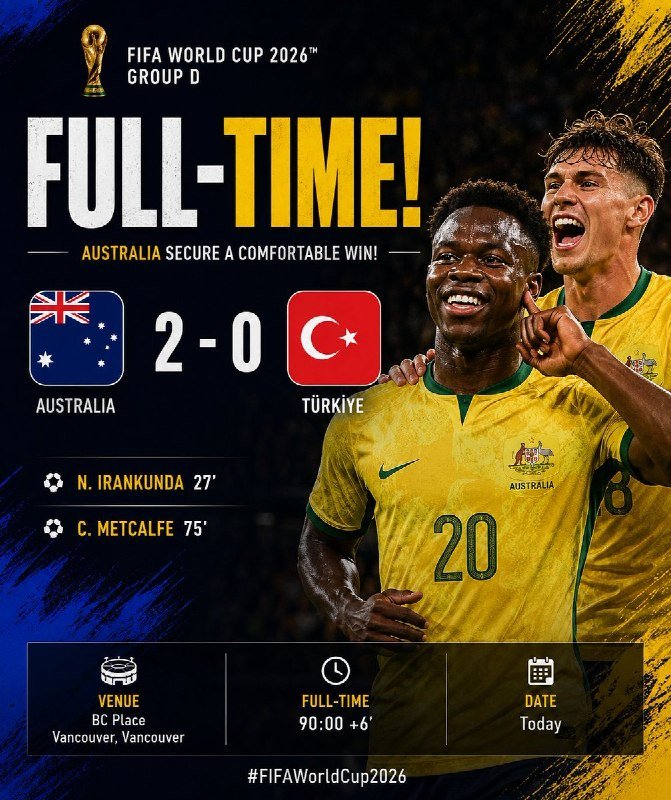
Australia meet Turkey on 14 June 2026 in a Group-stage World Cup fixture that, on the form shown through the opening rounds, will go a long way toward determining which of the two sides progresses to the knockout bracket and which begins the long flight home. The Guardian's live blog, written by Jonathan Howcroft, lists kick-off for 9pm local time in the host venue, 2pm AEST, 5am BST and 12am EDT — the kind of staggered time-zone geometry that has become a small industry of its own for Anglophone football desks covering the tournament from outside Europe.
The fixture matters for both teams in similar but not identical ways. For Australia, a positive result would validate the patient rebuild the Socceroos have run since the 2022 Qatar campaign and would set up a plausible path through the group; a defeat would leave Tony Popovic's side dependent on goal difference and the mathematics of other results. For Turkey, a victory would confirm them as a serious dark horse and would ease the pressure on a squad that has been treated, in much of the European press, as one step below the tournament's headline names.
What the live coverage actually tells us
The Guardian's match-day live page, dated 14 June 2026, frames the game as a standard Group-stage assignment: team-news, formation reads, periodic updates from the in-stadium reporter, and a mail-in column for reader questions. There is no indication in the live-blog header of any major selection shock on the Australian side, no reported suspension, and no venue change. The page positions the game as a "win-and-watch" fixture for both fan bases rather than a do-or-die eliminator — a distinction that, in tournament coverage, is often the difference between measured prose and the breathless register that creeps in once a side is one defeat from elimination.
The Australian edition of The Guardian is hosting the live blog, which is itself a small signal. Australian football coverage has historically been squeezed between a crowded winter-sports calendar and a domestic A-League audience that is loyal but limited. A home-soil World Cup has changed that arithmetic, and the decision to run the Australia–Turkey live page out of the Sydney newsroom rather than Manchester is a reminder that, for one summer at least, the Socceroos are the lead story on the Australian sports desk rather than the back page.
The Turkey angle
Turkey arrive as the more fancied side on paper, but paper does not play at the back. The Crescent Stars' Group-stage form has been solid rather than spectacular, with a draw against a deep-sitting European side and a narrow win over a CONCACAF opponent the kind of result-set that prompts cautious optimism in Istanbul and quiet unease in the Turkish diaspora watching from Melbourne and Sydney. Vincenzo Montella's side are organised, athletic, and well-drilled from set pieces — a profile that travels, but one that has historically struggled against Australian physicality in the wide channels.
The interesting question is how the Turkish press is framing the game. Domestic coverage, filtered through the wire desks that supply the English-language live blogs, has tended toward a "respect but do not fear" register, with attention focused on the fitness of a couple of key midfielders. There is little of the bombast that sometimes characterises Turkish football writing around the national team. That restraint, if it holds, is a small but useful data point: the Turkey camp is treating Australia as a peer rather than a formality.
The structural picture
World Cup Group stages produce a peculiar kind of analysis. The result matters enormously to the two teams involved, and barely at all to the tournament as a spectacle; the matches that define a World Cup are almost always later, when the stakes sharpen and the football contracts. But the Group stage is where the tournament's economic and broadcasting architecture is built: it is the round that maximises audience reach, that fills the in-broadcast ad inventory, and that determines the bracket in ways that propagate forward into the knockout rounds.
Australia's participation in this Group is, on those terms, a quiet vindication. The Socceroos have spent two decades working to make themselves a tournament fixture rather than a qualifying-round exit, and the fact that the Australian edition of The Guardian is running its own live blog — with local kick-off time, local byline, local audience — is the kind of small institutional signal that confirms the work has landed. It is one thing to qualify; it is another to be covered as a side that matters, on its own terms, in its own time zone.
What remains uncertain
The live coverage does not, at the time of writing, confirm the starting XIs, and the Guardian's bracketology and Golden Boot trackers — both linked from the live-blog header — remain the more useful guides to the wider tournament picture. Line-up news typically lands an hour before kick-off; the team-sheet reading, the first tactical adjustment, and the early shape of the game are all still to be written. What can be said with confidence is that both managers will treat the fixture as a four-point match: a win lifts the victor toward the round of sixteen, a loss drops them into the territory where goal difference and other results begin to do the deciding.
This article is built from The Guardian's live match coverage and is updated as team news and kick-off approach. The Monexus framing treats the Group stage as a structural story — broadcasting architecture, diaspora audience, and tournament economics — rather than as a stand-alone result, on the view that the bigger picture is the more durable read.