Australia stun Türkiye 2-0 in World Cup counterpunch
Goals from Nestory Irankunda and Connor Metcalfe gave Australia a 2-0 win over Türkiye in World Cup Group D, exposing the favourites' defensive frailties on the counter.
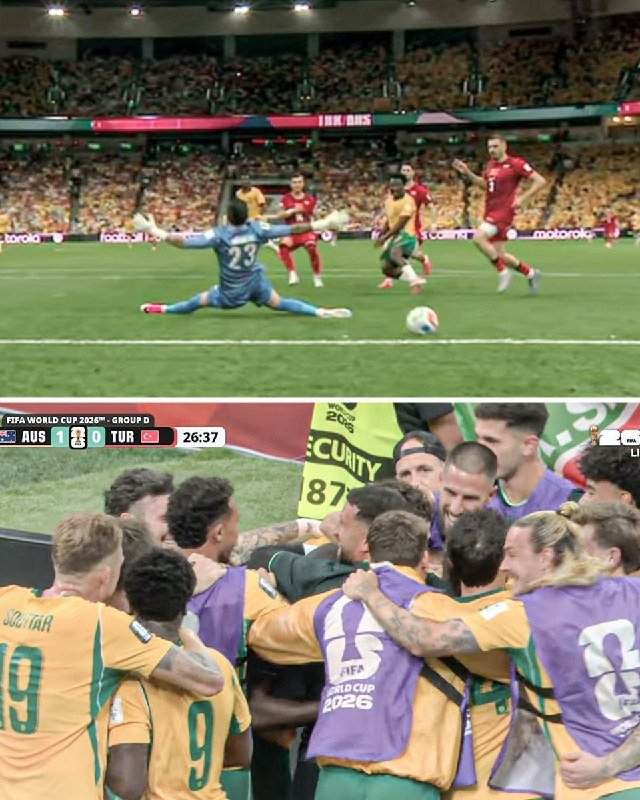
Australia arrived at the 2026 World Cup as the second-lowest-ranked side in their section and walked out of their Group D opener with a result that will reshape the bracket. Goals from Nestory Irankunda and Connor Metcalfe, separated by the hour mark, delivered a 2-0 win over a Türkiye side that had been priced as favourites in pre-tournament modelling. The margin flattered the scoreline. It understated the gap.
This was not the Socceroos of the cycle past — the resolute, containment-first side that ground out results from set pieces and counter-press. Under their current setup, Australia sat deep, absorbed pressure, and struck when Türkiye overcommitted. The blueprint was unsentimental, and the execution was near-flawless.
A goal built for the counter-press
Irankunda's opener, confirmed by FIFA's official match channel at 04:39 UTC on 14 June 2026, was a study in transitional football. Türkiye pushed numbers into the Australian half, lost the ball in advanced areas, and watched the Socceroos break the lines with a single vertical pass. Irankunda, operating as the furthest man forward, did the rest — a finish that, in the phrase used by the official match feed, was "stunning." The Athletic's wire copy carried the same timestamp and the same wording, a sign of how quickly the moment travelled through global sports desks.
There was nothing lucky about the build-up. The pressing structure that has defined Australia's recent qualifiers — compact central blocks, aggressive trigger lines when the ball entered wide areas — produced three separate chances before Irankunda converted. Türkiye's centre-backs hesitated on the first transition, hesitated again on the second, and were punished on the third.
Türkiye's structural problem
The pre-match case for Türkiye rested on technical superiority through the spine: a deep-lying playmaker, a target forward, and full-backs comfortable inverting into midfield. None of those pieces functioned. The deep-lying playmaker was pressed out of the game by Australia's twin-pivot; the full-backs, caught high after the opening goal, became the lanes through which Australia ran the second. Metcalfe's finish, a low driven effort from the edge of the box, came precisely from the half-space those inverted runs were supposed to close.
Al Jazeera's wrap of the fixture, published shortly after full time, framed the result as a "counterattacking masterclass." That is the right diagnosis. Türkiye did not lose because they played badly in isolation; they lost because their shape left them exposed to the specific weapon Australia had spent two years sharpening.
A different kind of Australian team
For the better part of a decade, the Socceroos have punched above their ranking by being harder to play against than their talent suggested. That identity has not disappeared, but it has been augmented. Irankunda, a 20-year-old winger whose club career has accelerated since his move to the Bundesliga, plays a different kind of game to the wide men Australia have historically selected. He is a dribbler first, a runner second, and a finisher third — the order matters.
That profile changed the shape of the Australian attack. Against deep blocks, Irankunda's individual quality can unlock a defence that a conventional winger would simply recycle possession against. Against transitional opportunities, as on Saturday, his acceleration turns half-chances into goals. Australia now have a Plan A and a Plan B that point in the same direction.
What this means for Group D
Group D was drawn to produce chaos. Türkiye were the highest-ranked side; Australia and their remaining opponents were not. The result reorders the section's plausible pathways in a single evening. A Türkiye win would have put the group on a familiar track — favourites through, chasers in the playoff places. A 2-0 Australian win, by contrast, turns the second round of fixtures into a virtual elimination game for one of the teams that arrived with ambitions of the last sixteen.
The remaining fixtures will tell us more. Australia still have to manage the physical and emotional cost of a high-intensity opening performance; Türkiye still have to demonstrate that the structural weaknesses exposed on the counter can be coached out inside four days. Neither question has an obvious answer.
The read
The counter-narrative here is that Australia caught Türkiye on a transitional moment — that the result is partly a function of the favourites' poor day rather than the underdogs' good one. There is something to that. Türkiye's technical quality does not disappear because of one off-colour performance, and their squad depth remains formidable. If they adjust their pressing triggers and tighten the half-spaces, they remain the most talented side in the section.
The structural read, though, is less forgiving. Australia's tactical identity now travels with them in a way it did not in previous cycles. They have a striker-profile who can convert counter-attacks into goals, a midfield that can sustain pressure for ninety minutes, and a coaching setup willing to cede possession in exchange for territory. That combination is not a one-off. The rest of Group D, and the knockouts that follow, will need to plan for it.
The sources do not specify expected-goals figures, possession splits, or the identities of Türkiye's centre-back pairing on the day. Those numbers, when they surface in the post-match technical reports, will refine the picture. They are unlikely to overturn it.
How Monexus framed this vs the wire: the wires carried the scoreline and the scorers; the analytical layer — why the counter-press worked, why Türkiye's shape broke, and what it means for the rest of Group D — is this publication's.
Wire provenance
This editorial synthesis draws on the following public wire/social posts:
- https://t.me/FIFAcom
- https://t.me/TheAthletic
- https://t.me/FIFAcom