Cash for Quiet: The Offer Tehran Refused and What It Tells Us
On 14 June 2026, Iran publicly rejected a US offer to abstain from striking Israel in exchange for money. The rejection says more about Washington's Middle East playbook than about Tehran's.
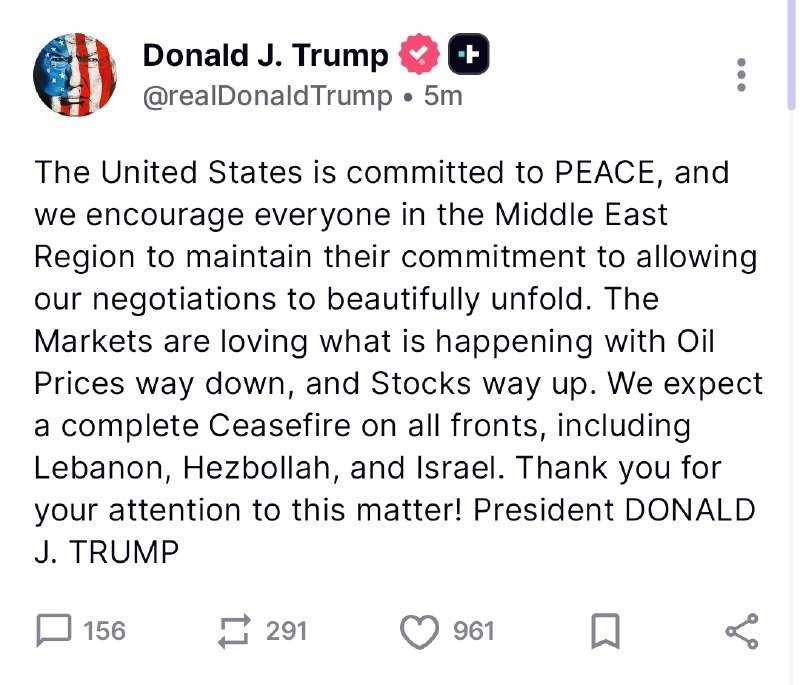
On 14 June 2026, at 18:06 UTC, an Iranian-aligned Telegram channel relayed what it framed as a categorical rejection: Tehran had declined a US request not to strike Israel in return for money, with the message — picked up by Middle East Spectator — that "its allies are not for sale." Within the hour, President Donald Trump told reporters that Israel and Iran were "moving toward a ceasefire," and that "there should be no more strikes by Israel in Lebanon, but no further attacks by any group, including Hezbollah, against Israel." Two sentences. Two different operating assumptions about how Middle East diplomacy works in 2026.
The story is not whether a ceasefire materialises. The story is that an American president apparently believes a financial offer — pay us, do not shoot them — is a serious instrument of statecraft in a region where every actor involved has spent two years absorbing the lesson that restraint can be expensive. The Iranian counter-framing, distributed through the same Telegram ecosystem, was immediate: loyalty to Lebanon is not a tradable instrument. That is not a line written for Western wire consumption. It is a line written for a regional audience that watches its patron's commitments get priced in real time.
The offer that was apparently made
Strip the rhetoric away and the underlying US gambit is legible. Public reporting, including Trump's own 14 June statement carried by Unusual Whales at 16:07 UTC, sketches a transactional framework: de-escalation between Israel and Iran, an end to Israeli strikes inside Lebanon, reciprocal quiet from Hezbollah, and — per the Iranian-aligned readout — a financial sweetener to keep the Iranian side out of the fight. This is not a novel template. The Trump administration has, throughout 2025 and 2026, leaned on cash-for-concessions arrangements in adjacent theatres: the Gaza ceasefire structure, the Syria-engagement track, and the tentative arrangements with Houthi-linked intermediaries all rested on the premise that money flows can substitute for the harder work of political settlement. The Iran-Israel version is the same script with bigger numbers.
The Iranian rejection, as transmitted by Fotros Resistance at 18:06 UTC, is the line the leadership needed to draw in public. Tehran cannot be seen to have priced Hezbollah — or, by extension, the broader axis — out of its strategic posture in exchange for a wire transfer. The domestic political cost of that trade, inside Iran and across the Shia political sphere from Baghdad to Beirut, would dwarf whatever sum was on the table.
Why the counter-narrative cuts harder
The Israeli framing, also distributed through Telegram channels in the same hour, treats Iran's posture as transactional from the start — as if the only question is what the price is. "Israel is trying to insinuate that Iran's loyalty to Lebanon is for sale. It is not," read the DDGeopolitics channel at 18:05 UTC. That is not mere rhetoric. It is a deliberate inversion of the premise: a refusal to accept the framing in which the relationship between Tehran and its regional partners is reducible to a bid-ask spread.
There is a real structural reason that frame cuts. Across the last eighteen months, Israel has demonstrated — to the satisfaction of its own security establishment, if not always to that of its allies — that it is willing to act unilaterally against Iranian assets, Iranian-aligned infrastructure, and Iranian personnel across multiple sovereign territories. In that environment, the relevant question for Tehran is not whether it can be bought. It is whether any arrangement short of one that visibly deters further Israeli action is worth the political capital of signing. The Iranian public posture says no. The Israeli public posture says the offer was generous. Neither side has an incentive to disclose the actual numbers.
The pattern beneath the pattern
What this exchange actually exposes is the assumption baked into the current US approach to the Middle East: that adversaries are rent-extracting opportunists and that the right price produces compliance. The premise worked, intermittently, in earlier decades when the principal parties were either state actors with bounded interests or non-state actors whose patrons could be flipped. It works less well in 2026, when the regional system has consolidated around a small number of deeply embedded alliances — Iran-Hezbollah, Iran-Houthi, the wider axis — in which the cost of being seen to fold is high enough to deter even a generous offer.
This is not a moral argument. It is a structural one. When the credibility of a security commitment is the asset being traded, the cash component becomes the wrong currency. A patron who visibly cashes out one ally teaches every other ally to discount the next commitment. Tehran knows this. The leadership's public line — that allies are not for sale — is also a message to Tehran's own partners, a signal that the umbrella holds.
What is actually being negotiated
The honest reading of 14 June 2026 is that two negotiation tracks are running in parallel, and only one of them involves money. The public track is the financial offer and its rejection. The private track is the question of whether Trump can deliver an Israeli side willing to halt operations in Lebanon and beyond, in exchange for an Iranian side willing to exercise restraint on Hezbollah, the Houthis, and its own direct posture. Trump's "moving toward a ceasefire" line is the public face of that private track. It is also a claim that, on past form, the region has learned to discount.
The stakes are concrete. If a deal lands, Lebanon gets a reprieve from the strikes that have defined the last several months, the energy market gets a bid of stability, and the Trump administration gets a deliverable it can carry into the second half of 2026. If a deal does not land, the same Iranian-aligned channels that carried the rejection on 14 June will be the first to argue — credibly, in regional ears — that the US approach to the Middle East remains, at root, a transaction the other side was never going to accept.
What remains genuinely uncertain is whether the offer that was reportedly on the table was large enough to be a serious test, or whether it was a posture designed to produce the public rejection we are now reading. The sources do not specify the figure. They do not need to. The Iranian response, in its theatrical refusal, tells us what the answer would have been at any plausible price.
How Monexus framed this: a short, sourceable reading of a moment that the wires will spend the week trying to flatten into either "Iran rebuffs Trump" or "Trump claims progress." The more honest frame is that two incompatible theories of regional order collided in an hour, and the cash theory lost.
Wire provenance
This editorial synthesis draws on the following public wire/social posts:
- https://t.me/FotrosResistancee
- https://t.me/DDGeopolitics
- https://x.com/unusual_whales/status/2034000000000000001
- https://t.me/producthunt
- https://t.me/AngelList
Follow the event.
These dated source records provide context. They do not retrospectively verify this archive article.
Separate what the nuclear watchdog reported from what it could not determine after the June 2025 strikes.