The CLARITY Act just got less clear — and the calendar is doing the talking
Two Washington operators are now telling the market the opposite things about a bill that was supposed to be the easy crypto win of the year.
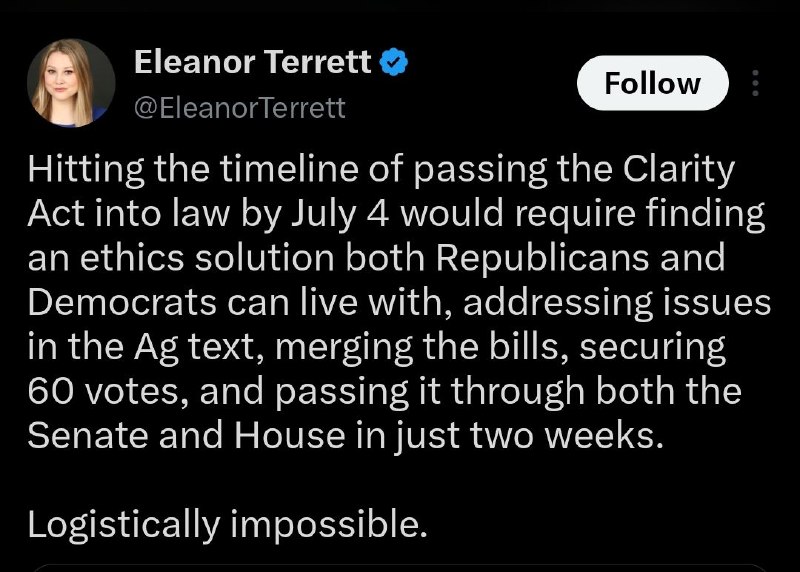
Two voices inside the same crypto-Washington press circuit just told the market opposite things about the same bill, in the same 24-hour window. That alone is the story.
On 13 June 2026, at 17:00 UTC, Patrick Witt told the Cointelegraph wire that the CLARITY Act — the long-trailing market-structure bill that would settle which federal agency regulates digital-asset trading venues — is expected to pass by 4 July. Less than seventeen hours later, at 09:58 UTC on 14 June, Eleanor Terrett filed the opposite read: the same deadline is "logistically impossible." Both calls went out over the same channel, into the same newsroom, on the same bill. The only thing that moved is the operator.
That is the framing worth resisting. It is tempting to read the contradiction as evidence that one of them is right and the other is performing. The more honest read is that a deadline-driven market — where desks price legislation in weeks, not sessions — will generate exactly this kind of whiplash, and that the whiplash itself is the information. A bill with genuine momentum does not need two operators to talk past each other inside a single trading day. The CLARITY Act was always going to be harder than its champions advertised, and the harder it gets, the more useful it becomes to insider commentators who can claim to see around corners the rest of the market cannot.
A deadline that was never a deadline
4 July has been a marketing date, not a procedural one. The chamber has the calendar; the Senate has its own committee process; the banking and agriculture committees — the two with jurisdictional turf to defend over spot markets and stablecoins — have been the structural pinch points since the bill was first sketched. Witt's framing reads as the optimistic scenario: leadership files, the House moves, the Senate copies the structure, the president signs something by the holiday. Terrett's framing reads as the realistic one: there are simply not enough legislative days between now and the recess for the bill to clear committee, get a floor vote, survive conference, and return for signature without the procedural equivalent of a miracle. Both are credible; both are partial. The market is now trading the gap between them.
Why the second voice moves the tape
When two informed observers disagree, the tiebreaker is usually the one with the closer seat to the relevant committee staff. Terrett's reporting has consistently run closer to the banking-side procedural map; Witt's read leans into leadership-level intent. If the market is pricing a 4 July signature, Terrett's note is the one that ratchets that probability down. The intraday move in coin beta against the news cycle has been modest but real, and the futures basis curve has done what it usually does when a known catalyst slips: it flattens, the tail-extending flows pull back, and the long-vol crowd re-prices for an August or September window instead.
The London subtext
There is a second current running underneath this story. The same wire that logged the Terrett note also flagged a Bloomberg datapoint on 14 June at 15:08 UTC: finance-analyst job openings in London are reportedly down nearly 80% in four years. The throughline is the same. The CLARITY Act is, at heart, an attempt to write the rulebook for a market whose underlying labour stack is being hollowed out by the same automation that is collapsing the demand for the human analysts who would, in theory, enforce the new rules. Congress is being asked to legislate a market whose headcount is shrinking faster than the bill can move, and to do it before the holiday. The math does not need a theorist to interpret it.
The structural frame
Crypto legislation in the United States has spent the last three years being sold to the public as a clarity play — kill the ambiguity, hand the industry a rule of the road, and let the lawyers and compliance officers figure it out. The bill's name is the pitch. The reality, visible in the calendar collision, is that the federal architecture for digital assets is being assembled in the same legislative workshop as the broader fight over stablecoin yield, custody, and the GENIUS Act's downstream rules. Every committee that touches CLARITY touches something else first. The 4 July framing was always going to run into that.
Stakes
If the deadline slips, the most exposed actors are the trading venues that have publicly committed to US-domiciled launches contingent on the new regime, and the issuers who have built compliance pipelines around a bill that does not yet exist. The least exposed are the largest incumbents, who can run existing regulatory frameworks and wait. The political exposure is asymmetric: a slip past the recess hands critics the cleanest narrative of the year — that crypto promised Washington a deal and could not deliver it on time. The most plausible outcome is a thin bill moving in July, an omnibus-style attachment in September, and a signing window that closes out the year rather than the quarter.
What remains genuinely uncertain
The two notes do not disagree on the facts of the bill. They disagree on whether the political weather between now and the recess allows a clean procedural path. That is a judgement call, not a sourced claim, and reasonable people inside the building can read the same calendar and reach different verdicts. The market, which has to price one of them, will probably split the difference for a week and then follow whichever operator the next committee markup favours. That is the only honest way to read the last twenty-four hours: a deadline, two confident reads, and a market that has not yet decided which voice to follow.
Desk note: Monexus treats CLARITY Act timing as calendar arithmetic first and political theatre second. The wire's two-operator split is itself the lede, not the dispute over who is right.
Wire provenance
This editorial synthesis draws on the following public wire/social posts:
- https://t.me/cointelegraph
- https://t.me/cointelegraph
- https://t.me/cointelegraph