A strike in Dahiyeh, and the framing war that follows
An Israeli strike on a building in Beirut's southern suburbs produced two parallel news cycles within minutes — a Hezbollah-aligned account of Zionist aggression, and an Israeli account of targeted action. The framing fight is the story.
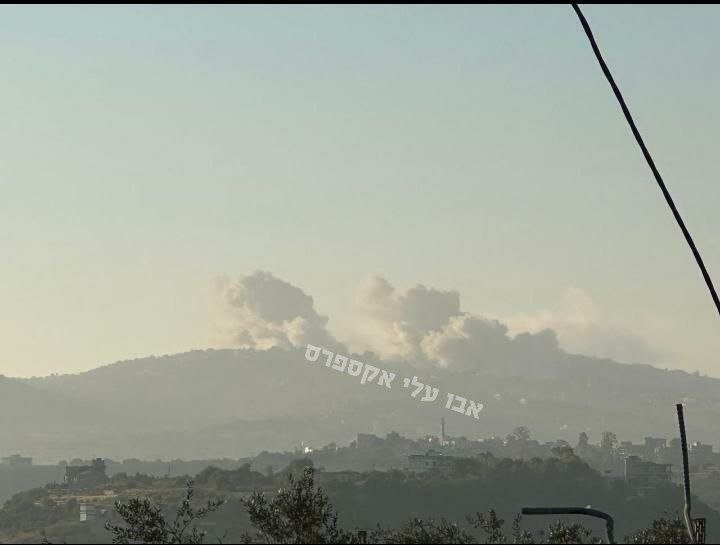
At 10:48 UTC on 14 June 2026, the Iranian-aligned outlet Al-Alam published photographs of a building in the southern suburbs of Beirut — Dahiyeh, the Shia-majority district long treated by Israeli planners as the operational heart of Hezbollah's urban footprint. Within four minutes, two more dispatches from Al-Alam and the Iranian outlet Tasnim carried video of the strike's aftermath and a fresh image of the targeted structure. By 10:52 UTC the material had been rebroadcast across Telegram channels sympathetic to the "axis of resistance."
What we know with confidence is narrow. A single building was struck. Smoke rose. Photographers on the ground circulated the images. The Israeli military, in the first minutes after the strike, had not yet issued a public readout at the time these images crossed the wire. The rest — what was inside, who died, why this building, on whose authority — belongs, for now, to the narratives being constructed around the photographs rather than to the photographs themselves.
The first draft is Hezbollah's
The Iranian-led information ecosystem moved first. Tasnim and Al-Alam framed the strike in the language of "Zionist regime" aggression against a civilian district, pairing the imagery of the rising smoke column with the ritual invocation of resistance symbolism. The choice of vocabulary is itself the story: "Zionist regime" rather than "Israel," "targeting" rather than "striking," "the southern suburb" rather than naming a specific facility or individual. The frame is totalising before the facts are settled.
This is not new. Dahiyeh has been fought over in print and on screen since the 2006 war, when Israeli planners openly described the campaign as the deliberate destruction of Shi'a urban infrastructure to change Hezbollah's cost calculus. The vocabulary has hardened on both sides since. What is new — or at least more visible in real time — is the speed. Telegram channels aligned with the axis published strike footage faster than any of the wire services that traditionally aggregate regional conflict into a single English-language feed.
The interpretive effect is significant. By the time a Western wire correspondent files their first sentence, the visual grammar of the event — the smoke, the destroyed façade, the moral weight of the civilian district — has already been laid down by channels that treat the strike as self-evidently criminal. The wire then has the choice of either reproducing that frame, hedging, or contesting it. All three options are downstream of what Tasnim and Al-Alam decided at 10:50 UTC.
The Israeli frame, when it arrives
Israeli spokespeople are likely to characterise the strike in different terms entirely: a targeted action against a specific Hezbollah asset — a commander, a weapons cache, a meeting — within a district that Israeli security services have long treated as a legitimate operational environment because of Hezbollah's pattern of embedding military infrastructure in civilian residential buildings. That is the consistent Israeli line on Dahiyeh strikes for two decades, and there is no reason to expect this episode to break the pattern.
Both frames are doing real work, not merely rhetorical. The Hezbollah-aligned frame mobilises sympathy, legitimises retaliation, and re-anchors the conflict in the post-October 7 narrative of resistance against occupation. The Israeli frame, if and when it lands, will seek to relocate the story from the bombing of a Beirut suburb to the removal of a specific threat, with the surrounding civilian harm treated as a tragic but unavoidable feature of an adversary's chosen method of warfare. The two frames are not compatible. They do not meet in the middle. They compete.
The structural fight is over the first hour
This is the deeper story. Wars in 2026 are no longer fought only on the ground and in the air; they are fought over the first hour of visual coverage. Telegram channels with names like @alalamfa and @JahanTasnim are not amateur operators. They are part of a deliberate Iranian and Hezbollah information architecture, well-funded, professionally produced, and designed to flood the zone with sympathetic imagery before competing frames can be assembled. The architecture has matured sharply since 2023. The distribution velocity is now measured in minutes, not hours.
Western and Israeli media are not slow in any absolute sense. They are slow relative to a media environment that has learned to publish from the scene in real time and to embed the political interpretation inside the image caption. The result is that an Arabic-language Telegram audience, a Farsi-language Telegram audience, and an English-language wire audience are reading three different stories about the same building within twenty minutes of the strike. By the time a Reuters alert or an IDF spokesperson briefing lands, the audience has already absorbed the frame it will carry through the rest of the news cycle.
The asymmetry is real but it is not total. Israeli and Western outlets have their own distribution advantages — institutional credibility, English-language reach, embedded access to military briefings. They can rewrite the first draft if the facts turn. But the first draft, in the attention economy, is the one that sticks.
What we do not know, and what we should not pretend to
The sources available at publication do not name the specific target of the strike, the casualty count, the type of munition used, or whether the Israeli military has confirmed or denied responsibility. To write confidently about any of those is to write past the evidence. The honest position is that a building in Dahiyeh was struck at approximately 10:48 UTC on 14 June 2026, that Iranian-aligned outlets immediately circulated imagery of the aftermath, and that the political framing of the strike is now in motion across multiple media ecosystems in advance of any independently verified factual foundation.
That last clause is the part worth holding onto. The story is not only the strike. It is the speed and confidence with which the strike was absorbed into two incompatible narratives before the ground was dry. Whoever controls the first hour of a strike's visual life is doing serious work — and that work, in 2026, is being done faster, harder, and with more institutional backing than at any point in the history of Middle Eastern conflict reporting.
Monexus framing note: This article treats the strike as a dual event — a kinetic act and an informational one — and refuses to inherit the vocabulary of either side wholesale. The Israeli security frame and the Lebanese civilian-harm frame are both first-order facts; the editorial work is to hold them in tension rather than collapse them.
Wire provenance
This editorial synthesis draws on the following public wire/social posts:
- https://t.me/alalamfa
- https://t.me/alalamfa
- https://t.me/alalamfa
- https://t.me/JahanTasnim
Follow the event.
These dated source records provide context. They do not retrospectively verify this archive article.
Separate what the nuclear watchdog reported from what it could not determine after the June 2025 strikes.