A false alarm in Eilat, and the framing problem it reveals
Sirens in Eilat were triggered in error late on 13 June 2026. The incident is small. The way it has been reported is not.
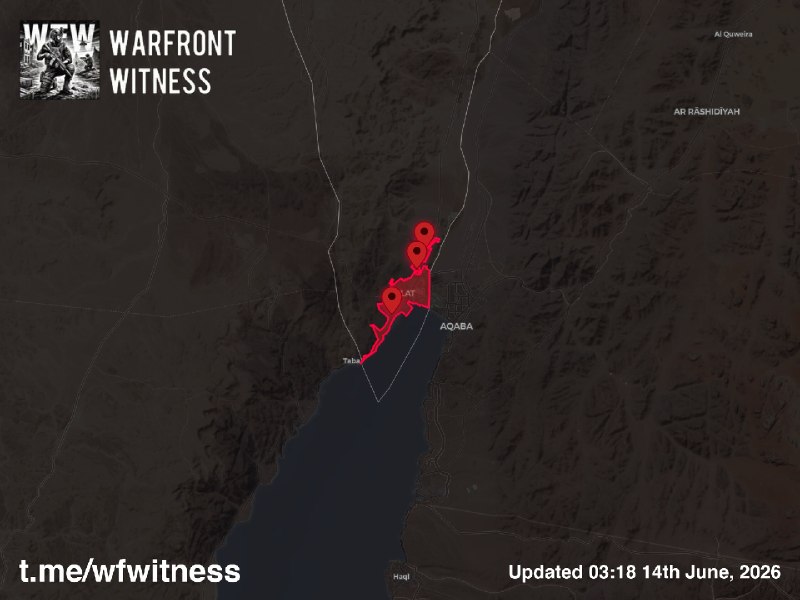
Late on 13 June 2026, drone-alert sirens sounded in Eilat, the Israeli port city at the head of the Gulf of Aqaba. Within minutes, two of the channels quickest on the wire had already given the public two distinct versions of what was happening. The Iranian state-aligned Tasnim News English desk reported at 00:46 UTC on 14 June that a false alarm had activated the system. A separate, openly Israel-focused monitoring channel flagged the activation roughly twenty minutes earlier, at 00:23 UTC, and helpfully added the same qualification — "Likely a false alarm." The substantive event was the same. The framing of it was not.
The pattern is now familiar enough to deserve naming. A siren goes off, the Western wire is silent for an hour, and by the time it speaks, the dominant frame has already been set by actors with a stake in the answer. The Israeli-focused channel, which has a domestic audience, treats the incident as a technical malfunction. The Iranian-state outlet, which has a foreign audience, treats it as a moment to package Israeli vulnerability for export. The reader is left to triangulate between two partially compatible accounts, neither of which has been corroborated by an independent authority.
What the sources actually say
Stripped of editorial posture, the record is thin. Tasnim News English, the English-language arm of an outlet affiliated with the Islamic Revolutionary Guard Corps, characterised the activation as a "false alarm" in a brief social-media post published at 00:46 UTC on 14 June 2026. A second channel, operating under the handle @wfwitness, reported the siren activation at 00:23 UTC and again at 00:18 UTC, each time appending the caveat "Likely a false alarm." No casualty figures, no interception report, no official Israeli military spokesperson statement, and no Independent corroboration appear in the thread. The substantive content of the two items is essentially identical. What differs is who is telling the story, to whom, and in whose interest.
That asymmetry is the story. When the only two sources on the wire are one Iranian state outlet and one Israel-adjacent monitoring account, the gap between them is not a factual disagreement. It is a competition for the default frame.
The framing economy of a false alarm
There is a longer pattern here that has nothing to do with Eilat specifically. Across the past two years, the speed at which any regional security incident reaches a global audience has decoupled from the speed at which it is verified. Iranian-aligned outlets have become faster at packaging incidents in English for international consumption. Israeli and Western-wire services have, for their part, become more cautious about confirming attacks in real time, partly because of the legal and political cost of an incorrect attribution, and partly because the cost of an error now travels faster than the correction.
The Eilat incident, precisely because nothing of consequence happened, exposes the underlying machinery. A real attack would draw Reuters, the IDF Spokesperson's office, and an array of Israeli and Gulf outlets within minutes. A false alarm draws only the actors with a narrative incentive to be first. The result is a small but instructive distortion: the public record of non-events is now shaped by the same actors who would shape the record of real ones.
Why the geography matters
Eilat is not a neutral reference point. The city sits at the southern tip of Israel, across the Gulf of Aqaba from Jordan and Saudi Arabia, and within range — at least in declaratory terms — of Iranian and Iranian-proxy rhetoric about striking southern Israeli infrastructure. It is also, for that exact reason, a place where sirens carry symbolic weight disproportionate to their technical meaning. An activation in Tel Aviv is operational news. An activation in Eilat is a story about the southern arc, the Red Sea theatre, and the post-October-7 geography of Israeli air defence.
That symbolism is part of what the framing economy trades in. The Tasnim post, by foregrounding the phrase "the domestic front of the Israeli regime," reads less like a wire report and more like a deliberate rhetorical positioning. The Israeli-adjacent channel, by contrast, treats the event as a technical note for a domestic audience that already knows the regional context. Both choices are editorial. Neither is neutral.
What remains uncertain
The sources do not specify what triggered the activation, whether the Home Front Command issued a clarifying statement, or whether the incident was followed by any operational response. There is no IDF confirmation, no police statement, and no independent verification. For the moment, the safest read is also the most boring one: a siren system fired, was not corroborated by any reported impact or interception, and the two channels on the wire both judged — with different framings — that the most accurate description was "false alarm." The reader is entitled to know that this is all the public record currently contains, and that the larger interpretive claims being made on top of it are not, at this point, evidence-led.
This publication treats Eilat as a routine reporting matter, not a stage. The signal is in the framing, not the siren.
Wire provenance
This editorial synthesis draws on the following public wire/social posts:
- https://t.me/tasnimnews_en
- https://t.me/wfwitness
- https://t.me/wfwitness
Follow the event.
These dated source records provide context. They do not retrospectively verify this archive article.
Separate what the nuclear watchdog reported from what it could not determine after the June 2025 strikes.