Eilat's sirens, Houthi drones, and the quiet normalisation of long-range harassment
For the second time in a week, drone alerts in Israel's southernmost city underscore how a Yemen-based militia has extended the reach of the Iran-aligned axis — and how routine the response has become.
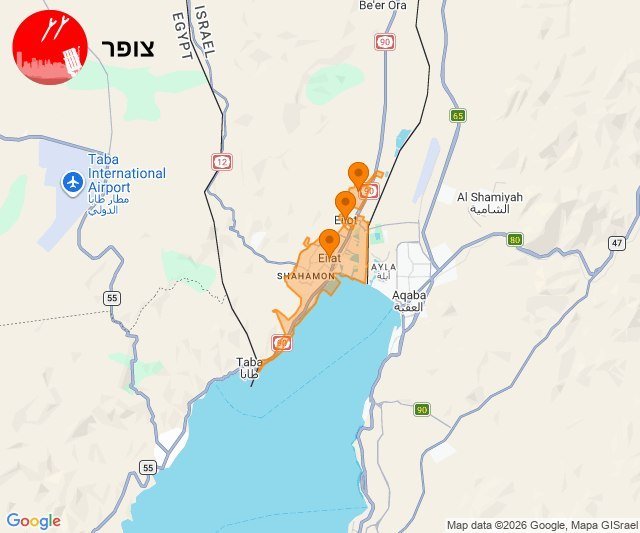
Sirens sounded across the Eilat region shortly after 00:18 UTC on 14 June 2026, with the open-source alert feed wfwitness flagging the activation and the conflict-mapping account AMK_Mapping attributing the trigger to incoming Houthi drones. The alerts later appeared to subside without a confirmed impact in initial reports, and wfwitness itself noted the incident was "likely a false alarm." That is the small, dated, verifiable fact. The larger one is what it represents: another round in a long-range harassment campaign that has, over months, normalised the routine disruption of daily life at Israel's southernmost point.
Eilat is not a frontline town in the conventional sense. It sits at the foot of the Gulf of Aqaba, hundreds of kilometres from the Gaza border, and until recently its risk calculus revolved around tourism and shipping. The shift began in earnest after the Houthis — formally Ansar Allah — began launching missiles and drones toward Israeli territory in late 2023, framing the operations as solidarity with Palestinians in Gaza. The geography of threat has expanded accordingly. Jerusalem, Tel Aviv, Haifa, the Negev, and now Eilat have all sat inside the same alarm envelope.
What the alerts actually tell us
The two wfwitness posts, separated by roughly four minutes, describe the same event: a drone-alert activation across the Eilat region. AMK_Mapping layered the attribution on top, naming Houthi drones as the likely trigger. The accounts are not Israeli government channels; they are open-source monitors that aggregate Home Front Command alerts, the IDF's official siren feed, and corroborating social-media traffic from the area. Their value here is not in adjudicating what was or was not launched, but in confirming that the system fired — that Israeli air-defence command processed a threat in real time, that municipalities moved into shelter-in-place posture, and that the early assessment, by the monitors themselves, leaned toward a false alarm rather than a confirmed impact.
That is the part worth pausing on. A false alarm, in this corridor, is operationally indistinguishable from a real one for the civilians caught under it. Sirens, app pushes, the run to a mamad, the minutes of silence waiting for the all-clear — these are the same whether the projectile was intercepted at altitude, splashed into open water, or never materialised at all. The cost of the false positive is borne locally; the deterrent logic is borne strategically, in Sanaa and Tehran.
A militia with a 2,000-kilometre reach
The Houthis emerged from Yemen's civil war as one of the most capable non-state military forces in the Middle East. Their arsenal is now genuinely long-range: ballistic missiles, cruise missiles, and one-way attack drones have all been used against targets in Saudi Arabia, the UAE, and Israel. Israeli interception rates have been high in the public record, but the attempt matters almost as much as the hit in the calculus of an Iranian-aligned axis looking to demonstrate reach without paying the price of a direct state-on-state exchange.
The structural shift is this: an armed group operating out of northern Yemen now sets the daily security tempo of a NATO-adjacent state's southernmost city. That is not a symmetry between adversaries; it is the consequence of patronage, industrial capacity, and a permissive environment in which drones, missile components, and satellite-terminal know-how move through a supply chain that ultimately traces back to the Islamic Republic. The Houthi flag flies on the launches, but the engineering reaches further north.
What is missing from the picture
The two Telegram channels that surfaced the alert do not, on their own, establish a confirmed launch. wfwitness explicitly hedged with "likely a false alarm." AMK_Mapping carried the attribution but not the corroborating radar, satellite, or imagery data. Confirmation will come, if it comes, from the IDF Spokesperson's unit, Israeli air-defence contractors, or wire reporting citing officials on the record. Until then, the open-source record supports a single, narrow claim: sirens activated, an attribution was offered, and the early local assessment is that nothing struck.
That uncertainty is worth naming because it is exactly the space in which the next, more consequential alert will arrive. A reader relying only on this thread would be wise to treat the Eilat incident of 14 June 2026 as a trigger event, not a strike event — a reminder that the architecture is in place, not a confirmed test of it.
Stakes
If the trajectory continues, three things follow. First, Israeli civil-defence spending and southern tourism economics will continue to absorb the cost of recurrent, low-probability alerts in cities that were, until recently, considered back-of-the-bus. Second, the Houthi brand — already politically valuable inside Yemen and across the wider axis — gets reinforced each time sirens sound in a place as symbolically distant as Eilat. Third, the diplomatic off-ramp, already narrow, gets narrower: any de-escalation in Gaza or Lebanon now has to be priced against an open third front in the south that no ceasefire architecture was designed to silence.
The false alarm is the small fact. The normalisation of the false alarm is the story.
— Monexus reporting. Desk note: this piece is built on two open-source alert channels rather than wire or official sources, which is reflected in the narrowness of the factual claims. The structural frame — long-range non-state harassment, Iranian-axis supply chains, the operational cost of false positives on the Israeli home front — is editorial analysis drawn from the public pattern of incidents over recent months, not from this single thread. Where this publication goes further than the alert feeds do, it has said so.
Wire provenance
This editorial synthesis draws on the following public wire/social posts:
- https://t.me/wfwitness
- https://t.me/wfwitness
- https://t.me/AMK_Mapping
Follow the event.
These dated source records provide context. They do not retrospectively verify this archive article.
Separate what the nuclear watchdog reported from what it could not determine after the June 2025 strikes.