Iran's armed forces go to combat readiness as airspace closes, signalling escalation with Israel and the United States
Iran's top operational commander says the armed forces have a "finger on the trigger" as N12 reports a full airspace closure, the latest signal that the Islamic Republic is bracing for renewed strikes after the damage inflicted by US-Israeli operations.
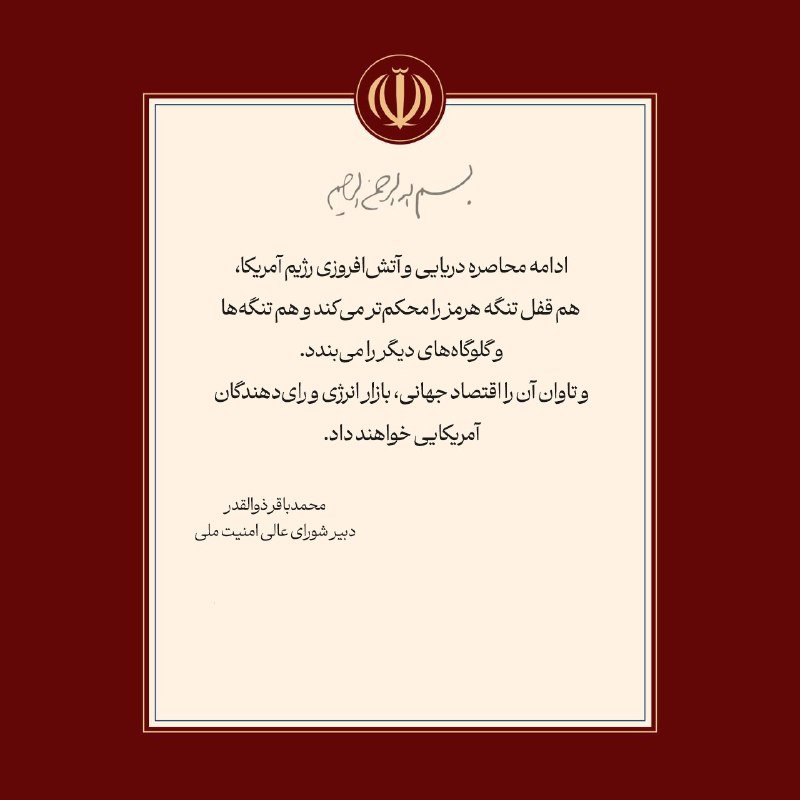
Iran's armed forces have shifted to a state in which their "finger is on the trigger," the commander of the country's highest operational command unit said on 14 June 2026, hours before Israeli outlet N12, as relayed by @disclosetv, reported that Iranian airspace had been closed in full. The twin declarations, carried by Iranian state-aligned channels and amplified across X, point to a posture of active readiness rather than rhetorical posturing, and they arrived alongside a separate announcement that Tehran intends to rapidly replace air-defence systems damaged in what Iranian officials have openly called US-Israeli aggression.
The thrust of the messaging is consistent: Iran is signalling that it expects another round and intends to fight from a position of declared preparedness. Whether that declaration is a negotiating instrument, a domestic mobilisation device, or preparation for a real shoot-down order is the question the next 72 hours will answer. Western wire reporting on the closure and on the damage to Iran's air-defence network has been limited so far; the dominant signal in public is coming from Tehran itself and from Israeli media, with a thin layer of regional outlets carrying both. Reading this moment requires holding both sets of signals at once.
The combat-readiness declaration
The "finger on the trigger" line came from the commander of Iran's most senior operational command echelon and was carried by Press TV on 14 June at 18:23 UTC. The phrasing, translated from Farsi, is the same register Iranian commanders have used in past crisis cycles: not a declaration of war, but a public statement that the chain of command is positioned to act. A separate IRGC senior commander, reported by Press TV at 18:08 UTC, framed the moment as a question of national will rather than military capacity, asserting that the Iranian public has never feared the United States and would emerge victorious through unity and continued support for the country's diplomats and armed forces. Read together, the two messages are aimed at two audiences simultaneously: an external one that needs to price the risk of an Iranian response, and an internal one that needs to be brought into a wartime footing without panic.
Airspace closure and the Israeli frame
The Israeli framing of the same moment is colder. N12's report, carried by @disclosetv at 18:20 UTC, described Iranian airspace as "completely closed," a description consistent with a NOTAM-grade shutdown rather than a routine operational adjustment. Israel has been the most direct external actor in the recent strikes on Iranian air-defence infrastructure, and Israeli outlets have an institutional interest in foregrounding the military significance of any Iranian precautionary move. The risk in reading the closure through Israeli media alone is that the same NOTAM can be presented as a sign of Iranian defensive collapse or of Iranian offensive preparation, depending on the editorial line of the outlet doing the framing. The airspace closure is a fact; the interpretation is not.
The air-defence replacement programme
Underneath the rhetoric sits an industrial claim that has received less attention than the airspace move. A senior Iranian commander told Press TV at 17:20 UTC on 14 June that the Islamic Republic will "rapidly replace" the air-defence equipment damaged in the US-Israeli strikes. The phrasing is notable for two reasons. First, it concedes damage, in line with the pattern of Iranian statements that name strikes explicitly as US-Israeli action rather than attributing them to "the Zionist regime" alone. Second, the claim that replacement is underway is a forward-looking signal: it tells any actor weighing a follow-up strike that Iran intends to restore the very systems that were targeted, on a timeline that compresses the advantage the first round produced. Iran's air-defence industrial base, including the Bavar-373 and Khordad systems that have featured in prior years' military parades, has been the object of sustained sanctions targeting. Whether the replacement programme proceeds on the timeline claimed is the part of the story that cannot yet be verified from open sources.
The dominant narrative, and what it leaves out
The Western wire reading of this sequence runs roughly as follows: Iran is escalating rhetorically to compensate for military damage, the airspace closure is a defensive admission of vulnerability, and the replacement claim is aspirational. The Iranian counter-reading, distributed through Press TV and the IRGC's public messaging, runs the other way: the strikes proved that Iran absorbed the blow and remained intact, the airspace closure is a precautionary wartime measure rather than a sign of weakness, and the replacement programme is an assertion of sovereignty over the country's defensive architecture. Both readings are partly true, and a serious account has to hold them together.
A third element sits underneath both. The IRGC statement at 17:04 UTC, carried by Press TV, framed hostility to "arrogance Zionism" as an "inseparable part" of the Islamic Revolution's nature. That is the ideological scaffolding on which the more operational statements rest. It is not new language, and the temptation is to treat it as boilerplate. But in a moment of declared combat readiness, boilerplate is the point: it tells domestic audiences and regional allies that the operational moves are anchored in a fixed strategic doctrine, not in tactical improvisation. Any Western reading of Iranian signalling that ignores the doctrinal layer will misread the timeline of any decision out of Tehran.
Stakes and what remains unresolved
The concrete stakes in the next days are bounded but real. A fully closed Iranian airspace imposes costs on civilian aviation and on the foreign airlines and business travellers that still use Iranian corridors; the economic effect is small globally and significant inside Iran. The combat-readiness declaration raises the probability that any further US-Israeli strike will draw a direct Iranian military response rather than a proxy-only one; how that response would be calibrated, and against what targets, is the question no public source has answered. The air-defence replacement claim, if it holds, narrows the window in which a follow-up strike can produce strategic effect rather than symbolic damage.
What remains genuinely unresolved is the timeline. The sources do not specify whether the airspace closure is hours, days, or weeks in duration; whether the "rapid" replacement of air-defence equipment refers to a measured re-equipment cycle or to a wartime emergency reconstitution; or whether the combat-readiness posture is calibrated to a specific anticipated event (an Israeli strike, a US carrier movement, a diplomatic deadline) or held as a general wartime condition. Until Israeli, American, or Iranian official sources outside the channels cited here add granularity, those gaps will be filled by speculation rather than reporting. This publication will update as wire reporting catches up to the messaging.
Desk note: where most Western wires have carried the airspace closure as a one-line ticker, Monexus pairs it with the combat-readiness declaration and the air-defence replacement claim from the same 90-minute window on 14 June, on the principle that the operational signal cannot be read without the industrial and ideological context surrounding it.
Wire provenance
This editorial synthesis draws on the following public wire/social posts:
- https://t.me/presstv/
- https://x.com/disclosetv/status/
- https://t.me/presstv/
- https://t.me/presstv/
- https://t.me/presstv/
Follow the event.
These dated source records provide context. They do not retrospectively verify this archive article.
Separate what the nuclear watchdog reported from what it could not determine after the June 2025 strikes.