Socceroos stun Turkey in Vancouver as Irankunda becomes Australia’s youngest World Cup goalscorer
Australia’s 2-0 win in Vancouver delivered a generational moment — and a serious test of whether the result survives the group stage.
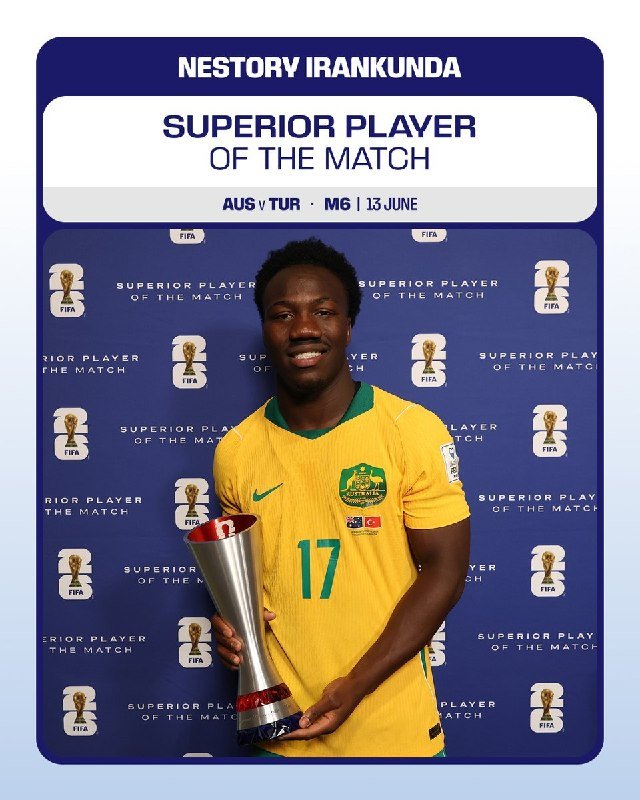
Australia opened its 2026 World Cup campaign in Vancouver on 14 June 2026 with a 2-0 victory over Turkey, a result built on a defensive performance that absorbed sustained pressure and two clinical moments in transition. The win, sealed in the early hours of 14 June UTC, gives the Socceroos a foothold in a group that had been written off as a path back to the airport.
The scoreline undersells the noise Turkey generated. What it captures is the small detail that has shaped Australian football discourse since the final whistle: Nestory Irankunda, 20, became the youngest Australian to score at a men’s World Cup. In a tournament where Australia arrives without a single household name to the wider global audience, that is the kind of record that does its own recruiting.
A team built for a different kind of tournament
The Australian setup in Vancouver leaned on the same bones that got the side to North America: a low block, two banks of four, and a willingness to let opponents circulate the ball in front of them. Turkey, by contrast, arrived with the kind of forward line that usually forces opponents to defend their own penalty area. The hosts-to-be — Australia, the designated away side on Canadian soil — conceded territory and shots, but contested every cross and every second ball with a physicality the Turks visibly did not enjoy.
The opener came against the run of possession. The Socceroos broke quickly through the middle, the ball found Irankunda on the edge of the box, and his finish was the kind that announces a player to a tournament rather than introduces him. The second, in the closing stages, came from a set-piece routine that the Turkish back line failed to track. The 2-0 scoreline, then, is less a story of Australian dominance and more a story of efficient punishment.
The counter-narrative: one game, one game
A single group-stage result, even a clean-sheet win, is the smallest unit of analysis a World Cup offers. Turkey will point — accurately — to the volume of chances they created and the margins that went against them. The pre-tournament consensus in European football coverage had them progressing; one result in a six-game group campaign does not invert that consensus.
The Australian counter is the more interesting one. Sides coached into a low block and built around set-pieces can survive a group stage they were not expected to survive. The ceiling of that model, however, is set by what happens when an opponent scores first. Australia’s structure is geared to absorb pressure and strike on the break. It is not geared, on the evidence of one match, to control a game against a peer opponent for 90 minutes.
What this sits inside
The broader pattern is the one that has defined Australian football for two decades: a federation that produces too few elite players for the talent to flow through the senior side, and a coaching setup that compensates with organisation and intensity. The 2006 squad — the one that made the round of 16 in Germany and turned a generation of children into registered players — was a generation of outliers. The class coming through now is not yet at that level in aggregate, but it has something the 2006 group did not: players already embedded in top-tier European club football at 19 and 20.
The structural question, the one that will define whether this tournament is a footnote or a hinge moment, is whether Football Australia can convert a 2-0 result in Vancouver into the second-tier outcomes a national program actually needs: deeper A-League pathways, a coaching pipeline that does not lose teenagers to NPL clubs, and a federation budget that is not hostage to broadcast-rights cycles. The football is what it is. The institutions around it are what they have been.
The stakes, in concrete terms
A win of this profile, on this stage, has two measurable effects. The first is sporting: Australia takes three points into its second group fixture and, depending on the other result in the section, can play the next match with the kind of cushion that allows a coach to rest players and rotate. The second is reputational: a 20-year-old scorer with a tape of that goal becomes a recruitment asset, and a federation that has been struggling to convince European clubs to release dual-nationals gets leverage it did not have on 13 June.
The risk, equally concrete, is the well-trodden path of national sides that win their opener and exit at the group stage. Sides that punch above their weight in game one often find that the opponents in games two and three have watched the tape and adjusted. Turkey, in this sense, was the easier fixture to script. The harder ones are coming.
Monexus framed this around the structural tension between a one-match result and a federation’s institutional ceiling — coverage in the European wires has focused on Irankunda’s record and the scoreline, neither of which captures what actually decides whether 2026 is a story or a campaign.