Spain and Germany head the bill as Group H opens against the World Cup's smallest qualifiers
The 2026 World Cup's opening weekend pairs the tournament's two most decorated European sides against the two lowest-ranked teams in the field, while the Netherlands face Japan and Ecuador meet Ivory Coast in fixtures that will set the tone for the rest of the group stage.
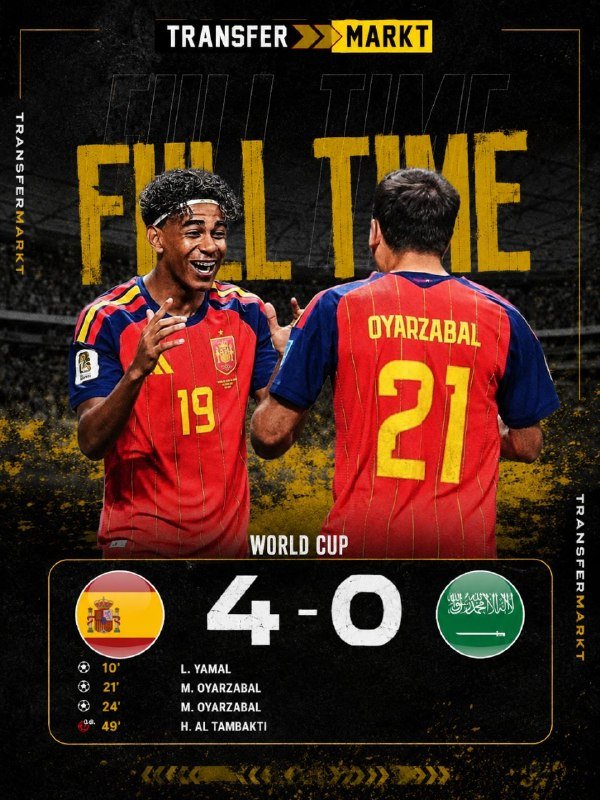
Spain open their 2026 World Cup campaign on Monday 15 June against Cabo Verde, the smallest nation by population ever to qualify for the men's tournament, in a fixture that will be measured less by result than by what it tells the rest of the field about Lamine Yamal's Spain at full tilt. SportsLine's Martin Green, who published his Spain-Cabo Verde betting breakdown on 14 June 2026, has Spain as heavy favourites in the opener; Cabo Verde's path to the tournament, secured through a tightly-contested African qualifying campaign, is itself the story that the market is now pricing in.
The 2026 World Cup begins the way the qualifying draw suggested it would: with the established European order running into the teams that have spent four years building to break into it. The opening weekend stacks Spain and Germany, the two most decorated European federations in the modern era, against debutants and minnows, while the Netherlands face Japan and Ecuador meet Ivory Coast in fixtures with considerably more competitive texture. The shape of the group stage, and the betting market that has formed around it, is the clearest early read on how seriously the bookmakers are taking the gap between the sport's superpowers and everyone else.
Heavyweights, heavy chalk
Spain's opener against Cabo Verde on Monday is the cleanest mismatch on the slate. Green has Spain as a multi-goal favourite, a price that reflects the gulf in squad value, depth, and tournament experience between a side built around Yamal and Rodri and a Cabo Verde squad drawn almost entirely from the Portuguese and French second tiers. Spain's route to the 2026 tournament included a comfortable qualifying campaign; the more interesting question for the Spanish federation is whether the side can convert group-stage dominance into knockout football, the gap that has defined their last three major tournaments.
Germany face Curaçao on Sunday in the day's other heavy favourite-versus-debutant matchup. Curaçao, a Caribbean island nation of roughly 150,000 people, qualified through the CONCACAF system, the first nation of its size ever to reach a men's World Cup. The fixture is, on paper, a regulation win for Julian Nagelsmann's side. What it is not, despite the market pricing, is a formality: Curaçao's qualifying record included wins over a number of higher-ranked CONCACAF sides, and the small-nation football project — long-practised by Iceland at Euro 2016 and Panama at the 2018 World Cup — has matured into a structural feature of the qualifying landscape.
The matches with edges
The two Sunday fixtures carrying genuine competitive tension sit on either side of the European heavyweights. Netherlands-Japan is the day's most-watched group game, a rematch of a 2022 round-of-16 fixture that Japan won in one of the tournament's defining upsets. Virgil van Dijk's Netherlands are favourites, but the margin is narrow, and the betting splits reported by SportsLine for Sunday's slate show significant money on the draw and on the Asian handicap. Japan reached the 2026 tournament as winners of the AFC's third-round qualifying, and the side retains the core of the 2022 squad.
Ecuador-Ivory Coast is the opener that, on form, looks the most open. Both sides are ranked inside the world's top 25; both qualified comfortably from confederations that produced last-cycle knockout teams; and both are managed by coaches — Sebastián Beccacece for Ecuador, Emerse Faé for Ivory Coast — who have prioritised defensive structure over the possession football that defined the previous generation of South American and West African national sides. Enner Valencia, the Ecuador captain, remains the most likely single match-winner on the pitch. SportsLine's Sunday-card breakdown, published 14 June 2026, lists the match as a pick'em with the total set in the low 2s, a price that reflects two deep, conservative defences and limited finishing depth on both sides.
The structural frame
The opening slate is, in the betting market's first read, the most stratified start to a World Cup in a generation. Of the four matches published by SportsLine on 14 June, three — Spain-Cabo Verde, Germany-Curaçao, and Ecuador-Ivory Coast — are priced with a single named favourite of a goal or more. Only Netherlands-Japan is priced as a competitive match, and even there, the handicap markets have moved against the Dutch since the open.
The structural read is straightforward: confederation strength, as priced by the market, is now a more reliable predictor of margin than it was in 2022. The four group-stage upsets of that tournament — Japan over Germany and Spain, Saudi Arabia over Argentina, Cameroon over Brazil — are not impossible to repeat, but the opening-weekend prices suggest the bookmakers are pricing in a lower base rate for shocks than at any point since 2010. Whether that price holds will be the first substantive data point of the tournament.
Stakes for the field
For Spain and Germany, the opening weekend is not a test but a calibration exercise. Both federations arrived at the 2026 tournament under pressure to convert qualifying form into knockout runs; a comfortable opening weekend clears the path to the round of 16 and, more importantly, sets the goal-difference tiebreakers that, in a 48-team field, are likely to determine seeded positions in the knockout bracket.
For Cabo Verde and Curaçao, the fixtures are the first sustained measurement of how competitive the smallest qualifiers can be against the tournament's top ten. A single goal conceded early, against the run of recent small-nation tournament history, can collapse a defensive game plan. A clean first half, on the other hand, is the kind of result that has historically moved futures markets and tournament narratives by more than its tactical significance warrants.
The most consequential open question is whether the Japan-Netherlands fixture will tell the market something it does not currently believe. Japan's 2022 win in the round of 16 was the match that reset the pricing of small-nation football against Europe's elite. A second Japanese win, on Sunday, would do the same for 2026. The market, for now, does not think that is the most likely outcome. The market is, frequently, wrong about exactly these matches.
Desk note: this article is built from the four SportsLine betting previews published on 14 June 2026. Where the wire published odds and the public fixtures, we report the odds; where the wire declined to project a final score, we decline likewise. The structural read — that the market is pricing the opening weekend as the most stratified in a generation — is our framing, drawn from the four published lines, and not an attribution to any single source.