Trump announces Iran 'deal complete,' but no text is public and Pakistan claims a Swiss signing on 19 June
President Trump declared a US-Iran 'deal' complete on Saturday night, authorising the 'toll free' reopening of Hormuz. Pakistan's prime minister says a peace deal will be signed in Switzerland on 19 June. The text has not been released.
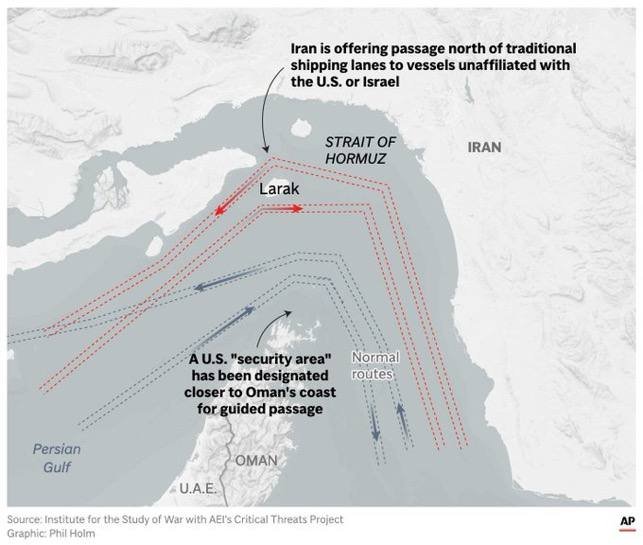
At 21:30 UTC on 14 June 2026, the US President declared that a deal with the Islamic Republic of Iran was "now complete," and said he was authorising the "toll free opening of the Strait of Hormuz" while simultaneously ending the US naval blockade. Within twenty minutes, Pakistani Prime Minister Shehbaz Sharif said a "Peace Deal" would be signed in Switzerland on 19 June. Three hours later, the actual text of the agreement has not been published, and at least one established open-source channel is calling the document a memorandum of understanding rather than a final deal.
The announcement, made from the US side in characteristic social-media cadence, leaves the financial and nuclear substance of the arrangement unclear. What the world has, as of the 21:51 UTC window, is a triumphal statement, a mediated announcement from Islamabad, and a Telegram-sized gap where the agreement itself should be.
What Trump said, and what was missing from it
The president's statement, posted to his social channels around 21:30–21:38 UTC and relayed by outlets including @sprinterpress on X, the War Footage Witness channel on Telegram, and Clash Report, ran in the same register as his previous diplomatic unveilings: short, declarative, and self-congratulatory. The text asserts that the "Deal with the Islamic Republic of Iran is now complete," authorises the "toll free opening of the Strait of Hormuz," and lifts the naval blockade. It does not name counterparties, specify which sanctions are suspended, define what "toll free" means in practice, or describe the verification regime.
The Strait of Hormuz carries roughly a fifth of global oil shipments. Any change in its transit regime is, on the face of it, a market-shifting event. But the announcement contains no mechanism for implementation — no schedule, no third-party guarantor, no reciprocal Iranian statement of equal specificity. That asymmetry is the first clue that what is being called a deal may be, in substance, a unilateral American declaration of intent that the Iranian side has yet to match in its own words.
The Pakistani reading: a peace deal in Switzerland on 19 June
Within roughly nine minutes of Trump's post, the picture acquired a second author. Prime Minister Shehbaz Sharif announced, in a statement carried by @sprinterpress and by the Geo-Politics Watch and War Footage Witness channels, that following "intensive talks" the United States and Iran had agreed a "Peace Deal" whose official signing ceremony would take place on 19 June in Switzerland. Sharif's framing is more diplomatic than Trump's: it gestures at a host country, a date, and a process.
The Pakistani mediation is consistent with what is publicly known about the back-channel. Islamabad has, for months, hosted shuttle diplomacy between Iranian and US envoys, and Switzerland is the historical custodian of US interests in Iran through the US Interests Section in Bern. The choice of Geneva or another Swiss venue would be procedurally unsurprising. What is striking is that Sharif is announcing a "Peace Deal" while Trump is announcing a "Deal complete." The two formulations imply very different documents: a peace deal suggests a wider political settlement; a completed deal sounds closer to a transactional sanctions-for-concessions package. That difference has not been reconciled on the record.
The 'memorandum' caveat — and what Iran keeps
The most pointed of the caveats circulating in the same window came from the Open Source Intel channel on Telegram, which at 21:51 UTC urged readers not to read the text as final. "I don't want to be a buzzkill, but this isn't the deal. It's a memorandum of understanding. We still haven't seen the actual text." The same channel, quoting the Visioner feed, added the structural concern: Iran, in this account, would again have access to large amounts of money while retaining enriched uranium, enrichment capability, ballistic missiles in the 70% range, drones, and launch systems. The Visioner summary also says the agreement rolls over — rather than dismantles — the existing architecture.
If that reading is accurate, the deal-as-announced is closer to a financial reactivation than a nuclear rollback. The same critique runs in sharper form across the Israeli and Saudi commentariat, but it is also visible in the open-source aggregator layer: scepticism is not the property of any one camp.
What is known, what is not, and what the next seventy-two hours decide
What is known at the 22:00 UTC cutoff is narrow: Trump has declared a deal complete and lifted the blockade; Sharif has said a signing is planned in Switzerland on 19 June; the document is described by some participants' allies as a memorandum of understanding; the text has not been published; and Iranian state outlets have not, on the channels visible to this publication in the same window, issued a confirmation of equivalent specificity.
What remains unknown is more consequential. The sanctions architecture is the first gap: which measures are suspended, which remain, and on what timeline. The second is verification — whether the International Atomic Energy Agency receives any enhanced access, and whether Iran's stockpile of 60%-and-above material is shipped out, diluted, or left in place. The third is the status of the Strait of Hormuz regime beyond the rhetoric of "toll free": who collects transit fees, who escorts tankers, and what happens if a vessel is detained. The fourth is the Iranian political reaction, which will determine whether the deal has a domestic Iranian constituency capable of surviving the parliamentary and clerical review that follows any nuclear concession.
The next seventy-two hours will tell. If a text is published before 19 June, the Swiss signing becomes a formality. If it is not, the gap between the American and Pakistani framings widens, and the deal-as-announced starts to look more like a market-rhetorical event than a diplomatic one. Either way, the structural fact is unchanged: the principal constraint on Iran's nuclear file is the verification regime that follows, not the headline that precedes it.
This publication is tracking the same feeds as the wire desks in Tel Aviv, Washington, and Dubai. The verifiable record so far is the social-media statement, the Pakistani announcement, and the open-source caveat. We will revise the read when the text is in hand.
Wire provenance
This editorial synthesis draws on the following public wire/social posts:
- https://t.me/wfwitness
- https://t.me/ClashReport
- https://t.me/GeoPWatch
- https://t.me/zvezdanews
- https://t.me/osintlive
Follow the event.
These dated source records provide context. They do not retrospectively verify this archive article.
Separate what the nuclear watchdog reported from what it could not determine after the June 2025 strikes.