Trump's Iran gambit, FISA leverage, and the clemency bazaar: three threads of a single presidential operating system
On 14 June 2026 the same White House held three unrelated-looking levers at once — a FISA extension conditional on a voting bill, a 290-strong clemency influencer network, and a 50% Polymarket-priced Iran deal. The pattern is the story.
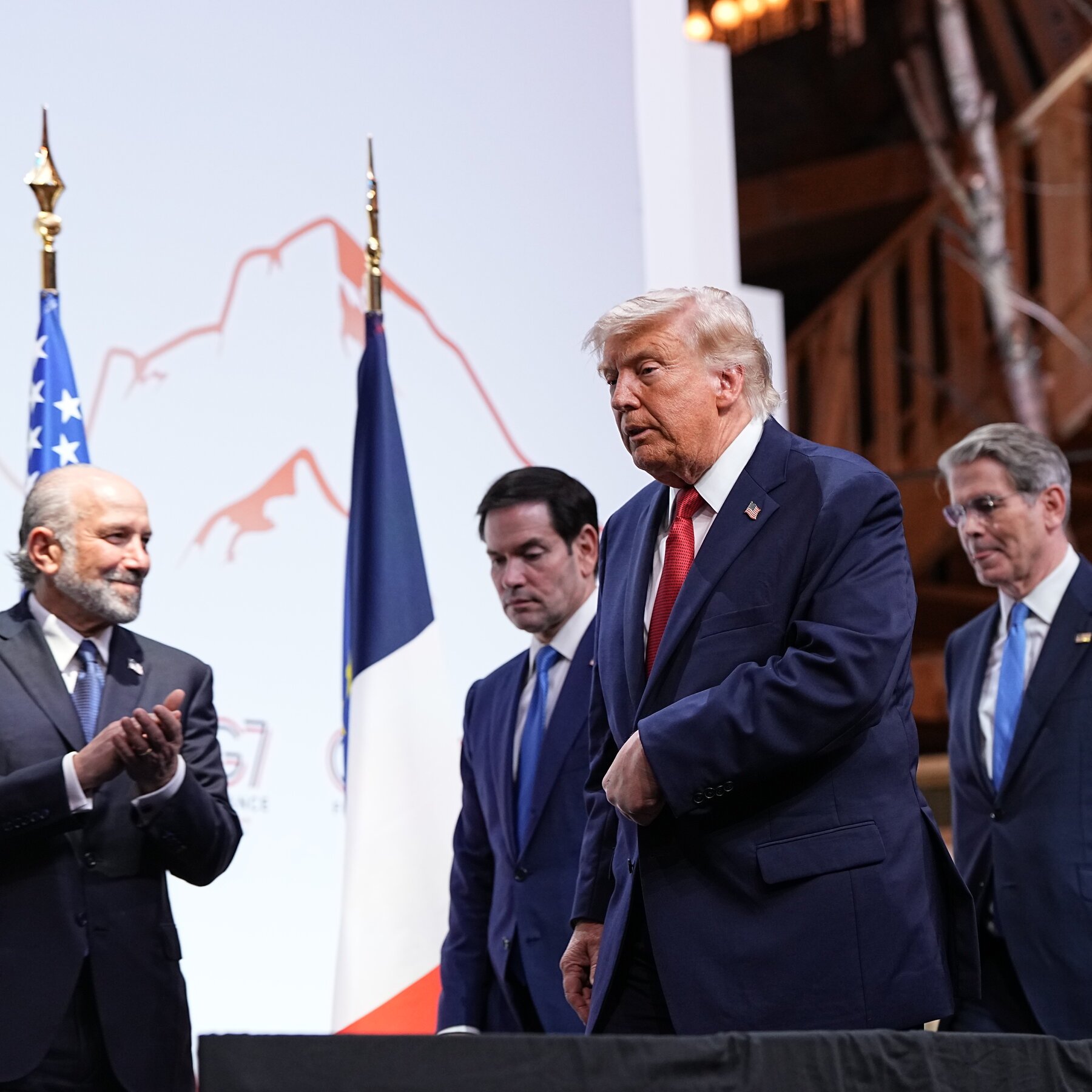
At 18:45 UTC on 14 June 2026, Donald Trump told reporters he would oppose any extension of the Foreign Intelligence Surveillance Act unless it were bundled with legislation he has long demanded on voter identification. The statement, carried by Reuters, collapsed two policy fights into one. It also arrived 22 hours after Reuters published a separate investigation identifying 290 influencers — political, evangelical, entertainment and family — who successfully lobbied the White House on behalf of 197 clemency recipients during Trump's second term. Read alongside the President's own 13 June line, "This is the deal. It's a great deal, and it's time to end this war," a 48-hour snapshot of a deliberate operating logic emerges: leverage, personality, and the conversion of presidential discretion into tradable political currency.
The three threads look unrelated. They are not. FISA, clemency, and a prospective Iran framework are different outputs of a single input — the view that the Presidency's scarcest resource is attention, and that the only way to monetise that attention is to bundle it with pressure.
The FISA conditional
Trump's FISA position is, on its face, a domestic-policy story. He is tying a surveillance authority that the intelligence community and a bipartisan Senate majority consider essential to a voter-ID measure that has no procedural connection to Section 702 reauthorisation. Reuters reported the President's stance as a conditional: extend FISA, attach the voting bill, or watch the extension die. The tactic is a familiar one in trade and budget negotiations — the "take it or leave it" coupling of unrelated must-pass items. What is new is the venue. Surveillance authorities are normally reauthorised through quiet committee mark-ups; the President's decision to drag the statute into a public conditional against a non-security bill signals that he considers FISA leverage worth spending on a domestic win rather than preserving for intelligence cooperation with allies.
The structural read is straightforward. FISA is one of the few tools that lets the United States collect against foreign targets whose data transits US infrastructure. A lapse would not shut down collection — executive authority under existing wartime and Article II powers would partially fill the gap — but it would compress the legal shield under which the intelligence community operates and complicate liaison relationships with the Five Eyes. By holding the statute hostage to a voting bill, the White House is signalling that the priorities of the national-security bureaucracy are subordinate to the President's domestic agenda, and that any future FISA debate is now a market for pet issues.
The clemency bazaar
The Reuters investigation, published at 17:22 UTC on 14 June, documented an ecosystem of 290 influencers operating openly and in private channels to secure clemency for 197 individuals. The breakdown matters. The named advocates include Trump-world operatives, family members of the principals, religious figures, and entertainment personalities — a mix that maps onto Trump's coalition rather than onto the federal sentencing guidelines that the pardon attorney is supposed to weigh. The pattern Reuters describes is not a normal petition pipeline; it is a parallel lobbying structure, operating in plain view, that converts personal proximity to the President into case-by-case relief.
The counter-narrative from the White House is that the President is exercising his Article II clemency authority as his predecessors did, and that any modern Presidency attracts a comparable volume of advocacy. The rejoinder, supported by the 197-figure cited by Reuters, is the scale and the texture. Pardon surges in prior administrations were tied to discrete policy rationales — Jimmy Carter's Vietnam-era draft resistors, Bill Clinton's Marc Rich list, Barack Obama's drug-offence commutations. The current list is a portfolio of personalities, and the access required to enter it is asymmetrically distributed. The structural pattern is one in which clemency becomes a presidential currency: dispensed on request by those with standing, withheld by default from those without, and rarely explained.
The Iran deal and the Polymarket tell
The third thread is the most foreign-policy-coded. On 13 June, Trump described an Iran framework as "a great deal." Reuters, citing Polymarket, put the implied probability that Trump will agree to a specific set of Iranian demands by 30 June at roughly 50%. The pricing matters more than the rhetoric. A coin-flip market on a Presidential commitment, weeks out from a deadline, indicates that traders do not trust the White House's framing that the deal is finished — they trust that it is negotiable to the end. Iranian state media, including PressTV and Mehr, have been running parallel counter-frames emphasising sanctions relief sequencing and verification; those positions have not moved the Polymarket line off 50%, which suggests the market is treating the deal as a function of US domestic politics rather than a function of the Iranian negotiating posture.
The structural read is the convergence of all three threads. The FISA conditional tells markets and allies that statutory authorities are bargaining chips. The clemency bazaar tells insiders and outsiders that personal access is a tradable good. The 50% Polymarket on Iran tells counterparties that any agreement is provisional and renewable. Taken together, the operating logic is the same: every presidential interaction is a deal, every actor is a counterparty, and the only fixed point is the President's discretion over the whole portfolio.
The counter-read, and what remains uncertain
A plausible counter-read is that this is normal second-term behaviour, not a new doctrine. Presidents reissue FISA positions, expand clemency use, and pursue foreign-policy frameworks simultaneously as a matter of routine. The novelty, on that view, is media attention, not mechanism. The case for that reading weakens when the same President publicly conditions one on the other, hands out clemency on a celebrity adjacency basis, and signs a deal whose market price is a coin flip weeks from the deadline. Routine does not look this leveraged.
What remains genuinely uncertain is whether the FISA conditional is a negotiating posture or a hard line, whether the 197 clemency grants will be followed by a politically costly batch that tests the influencer network, and whether the Iran deal closes before 30 June at a price that survives Iranian domestic politics. The sources do not specify the answer to any of these. What they do show, on the record, is a White House that has stopped pretending these are separate questions.
This publication read the three threads as one. The wire, on 14 June, was still reporting them apart.
Wire provenance
This editorial synthesis draws on the following public wire/social posts:
- http://reut.rs/4w9fyUP
- https://reut.rs/49RVRIe
- https://x.com/unusual_whales/status/2039861635263644020