Zelensky says Ukrainian intelligence has documents showing Russian discontent with Putin will not plateau before September elections
Kyiv says it has Kremlin-table documents projecting rising domestic pressure on Putin through Russia's September parliamentary cycle, while overnight strikes hit an oil facility 700 km inside Russia.
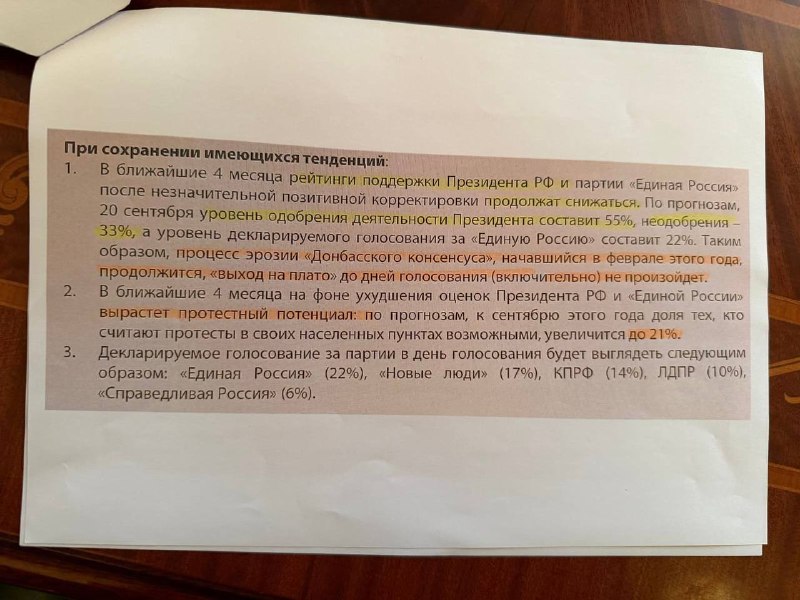
At a briefing in Kyiv on 14 June 2026, President Volodymyr Zelensky said Ukrainian intelligence had obtained documents prepared for Vladimir Putin showing that discontent inside Russia is projected to keep rising and will not plateau before the country's September parliamentary elections, the Telegram channel noel_reports and the Ukrainian outlet Unian reported.
The Ukrainian leader framed the alleged material as a window into how the Russian leadership reads its own political environment, and used the moment to suggest that any future peace agreement may not, in the end, have to be signed with the man who launched the full-scale invasion. The framing is conspicuous: with the Kremlin signalling that negotiations could come in some form, Kyiv is publicly seeding the idea that the Russian side of the table is unstable.
What Kyiv says it has, and what it is claiming it shows
According to the summaries carried by noel_reports and Unian, the documents in question "end up on the table of the Russian leadership" and include projections that internal Russian discontent with Putin will not level off before the September Duma cycle. Zelensky's claim, reported on 14 June 2026, was that the materials are not opposition leaflets or intercepted soldier complaints but actual briefing material prepared for the Russian president, and that the trajectory of dissatisfaction is rising rather than plateauing.
The strategic logic of the leak is straightforward. A Russian state that believes it is bleeding popular legitimacy is a state that, on Kyiv's reading, has more incentive to negotiate and more incentive to keep fighting hard before any negotiating window closes. By putting the alleged content in public, Ukraine is trying to set the political weather in Moscow — to amplify the voice of those in Russian elite conversations who already question the war's costs, and to harden the position of those abroad who argue that time is on Ukraine's side.
It is worth being precise about the sourcing. The claims come from the Ukrainian presidency and from Ukrainian-aligned Telegram channels. No independent corroboration of the specific documents has been published; the documents themselves have not been released. The substance is consistent with a broader pattern of Ukrainian public messaging throughout 2025 and 2026, in which Kyiv has emphasised the cost of the war to Russian society, the strain on the Russian budget, and the long-run demographic and economic damage to Russian-speaking regions. Readers should treat the documents as Kyiv's stated intelligence picture, not as a verified fact about the Kremlin's deliberations.
Strikes deep inside Russia, on the same morning
The intelligence claims did not land in a vacuum. Hours earlier, on the night of 13–14 June 2026, Ukrainian forces struck an oil facility more than 700 kilometres inside Russia in the Yaroslavl region, Zelensky said, with the strike reported on the Kyiv Post official channel at 10:43 UTC on 14 June. Kyiv also targeted Russian military logistics in occupied territory in the same operational window.
Yaroslavl sits north-east of Moscow, deep in European Russia, well beyond the range of most battlefield systems and within reach only of long-range drones or locally produced cruise and ballistic missiles. Striking an oil facility there is, in itself, a routine statement in the long-range strike campaign Ukraine has run throughout 2024 and 2025; the political significance on this occasion is that the president chose to make the strike a headline item on the same day he unveiled the alleged Kremlin documents. The combination is a deliberate package: military pressure demonstrated, political pressure seeded.
The Russian side, as is standard, did not confirm the operational details. Russian-aligned channels, when they cover such strikes at all, tend to frame them as Ukrainian terrorism against civilian infrastructure; Ukrainian framing, equally standard, treats oil refining and export logistics as legitimate military targets given their role in funding the war effort. Both framings have been consistent enough that the disagreement is now structural rather than factual.
Why the September date matters
The September reference is the load-bearing claim. Russia's parliamentary cycle, dominated by United Russia and managed through a system in which meaningful opposition is constrained, is the moment at which the Kremlin is supposed to deliver a story of stability and consent. If internal projections shared with the president show that discontent is rising through that window and not flattening, the implication is that the political calendar is not a friend of the war's longer conduct.
For Ukraine, the useful question is not whether September produces a genuine electoral shock — it almost certainly will not, on any realistic reading of the system — but whether the perception of pressure inside the elite shapes the terms under which any negotiation occurs. A leadership that believes its domestic position is softening has a stronger incentive to lock in a deal before the picture worsens; a leadership that believes it can ride out the cycle has the opposite incentive. Kyiv is trying to argue, in public, that the first reading is the correct one.
There is a counter-reading worth naming. Some Western analysts have argued for the better part of a year that projecting Russian regime fragility is itself a category error: that the system has repeatedly demonstrated an ability to absorb sanctions, mobilisation waves and battlefield setbacks without breaking, and that betting on internal pressure has been a losing analytical habit since at least 2022. On that view, the documents Kyiv claims to have are less a forecast than a piece of psychological pressure, useful as a bargaining chip and misleading as a guide to outcomes. The honest answer is that both readings are live, and that the September cycle will be the first real test of which is closer to the truth.
What this leaves on the table
Three things are worth holding separately. First, the existence and content of the alleged documents, which is currently a Ukrainian claim with no independent confirmation. Second, the strike on Yaroslavl, which Kyiv announced and which fits the established pattern of long-range Ukrainian operations against Russian energy infrastructure. Third, the political calendar, in which the September Duma vote is a fixed point and the question is whether the period between now and then is used to lock in a diplomatic arrangement or to escalate further.
Zelensky's suggestion that a peace agreement may no longer have to be signed with Putin is, on the evidence available, a piece of public diplomacy rather than an operational forecast. The most that can be said with confidence is that Kyiv is choosing to fight on three fronts at once — on the battlefield with long-range strikes, in the information space with claims about Kremlin documents, and in the diplomatic calendar by tying the war's resolution to the Russian political cycle. Whether the third front produces movement is a question for the next twelve weeks, not for this morning's headlines.
Desk note: Monexus has carried the Ukrainian claims at the weight the reporting allows — as Kyiv's stated intelligence picture, not as verified fact — and named the September parliamentary cycle as the political anchor the claims point to. The Yaroslavl strike is treated as a confirmed operational fact on the basis of the Kyiv Post wire; the underlying documents remain unverified.
Wire provenance
This editorial synthesis draws on the following public wire/social posts:
- https://t.me/noel_reports
- https://t.me/Kyivpost_official
- https://t.me/uniannet