B-52 crash at Edwards exposes thin margins in the US strategic-bomber fleet
A B-52 went down shortly after takeoff from Edwards on 15 June 2026, the latest in a string of incidents that complicate the Pentagon's plan to keep the Cold-War-era fleet flying into the 2050s.
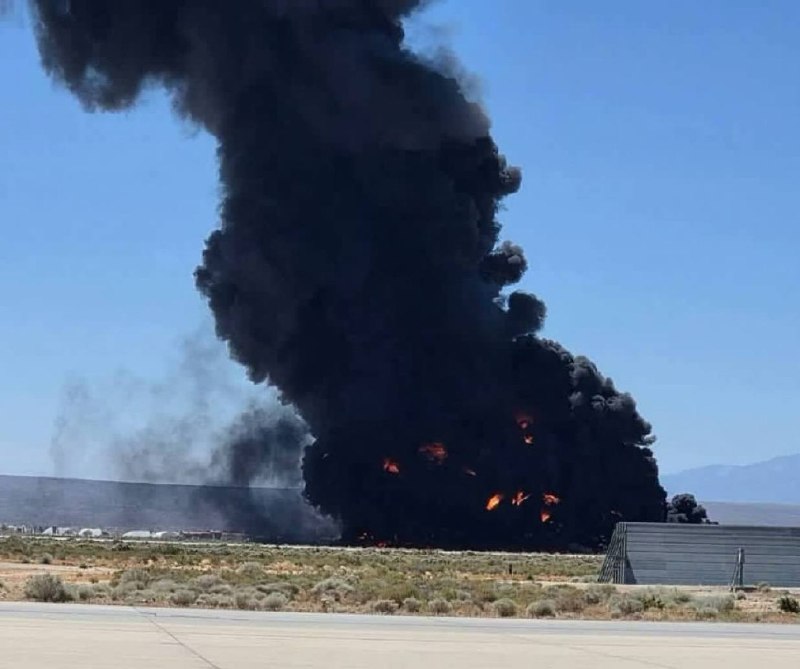
A US Air Force B-52 Stratofortress crashed shortly after takeoff from Edwards Air Force Base, California, on the afternoon of 15 June 2026, according to wire reports aggregated across English- and Persian-language Telegram channels between 19:20 and 19:41 UTC. The aircraft, one of the oldest designs in continuous US service, came down on or near the sprawling Mojave Desert test range that has hosted American flight testing since the Second World War. As of the initial reports compiled by Monexus, the condition of the aircrew had not been disclosed, and the cause remained under investigation.
The incident lands at an awkward moment for the US Air Force. The B-52 fleet, the backbone of the service's long-range strike capability, is supposed to remain in service into the 2050s under a series of life-extension and engine-replacement programmes that have run years behind schedule and billions of dollars over initial estimates. A hull loss in California, on a base that serves as the service's principal flight-test centre, will refocus attention on a fleet whose airframes in some cases predate the parents of the aviators now flying them.
What the early reporting shows
The first accounts, surfaced by Iranian state-aligned outlets Fars News and Press TV shortly after 19:20 UTC on 15 June 2026, framed the crash as having occurred "shortly after takeoff" from Edwards. The Telegram channel @FarsNewsInternational, citing "international news sources," placed the aircraft on the ground "at a distance of" unspecified from the runway — a phrasing common in early wire translations of US domestic incidents. The English-language aggregator @englishabuali picked up the same line within minutes, adding a sarcastic editorial tag — "Not a good day for strategic bombers" — that signals how US military aviation incidents are received in regional coverage of the United States.
The most substantive English-language dispatch came from @InsiderPaper at 19:41 UTC, which framed the event as an "American B-52 bomber crash[ing] in California" at an "Air Force base," directing readers to a fuller write-up on its website. None of the four initial reports identified the aircrew, the specific airframe, the mission profile, or whether the aircraft was carrying ordnance or test instrumentation. Edwards Air Force Base is a combined active-duty and test facility; the B-52s permanently based there are operated by the 419th Flight Test Squadron and the Air Force Reserve's 309th Maintenance Wing, but B-52s from Minot and Barksdale routinely deploy to the Mojave for sustainment testing.
The sources do not specify whether the aircraft lost was a test article or an operational bomber on a routine sortie. The sources do not specify the number of crew on board or their fates. The sources do not specify whether the aircraft was destroyed or salvageable, whether there was a post-crash fire, or whether the incident produced debris on or off base. The sources do not specify the type of malfunction, if any, that preceded the crash. Each of those data points will be material to the eventual investigation, and none is yet in the public record from the wires Monexus has read.
Why a B-52 loss still matters in 2026
The B-52 has outlived every other bomber the United States has put into service since the type first flew in 1952. Airframes delivered in the early 1960s remain in frontline units. The aircraft's range and payload made it the platform of choice for the opening strikes of Operation Desert Storm in 1991, for the 2003 invasion of Iraq, and for the long arc of counter-ISIS operations in the late 2010s. It is the only US bomber that can carry the AGM-86 air-launched cruise missile externally and the AGM-183 hypersonic test vehicle internally, and it remains central to the Pentagon's published concept of "affordable mass" — a phrase service leaders have used to argue that the fleet's size compensates for the obsolescence of any individual airframe.
A single airframe loss is not, on its own, a strategic event. The Air Force has suffered B-52 mishaps before — at Lajes Field in the Azores, at Andersen AFB on Guam, and at Minot AFB in North Dakota, among others — without strategic consequence. What makes the 15 June incident worth watching is the context. The service is in the middle of a Commercial Engine Replacement Programme (CERP) intended to re-engine the fleet with Rolls-Royce F130 turbofans, a programme whose cost and schedule have drawn critical reports from the Government Accountability Office. It is also mid-execution on a radar-modernisation upgrade intended to give the airframes the ability to carry hypersonic and stand-off weapons that post-date the type's original design intent. Each of those programmes assumes a baseline fleet size that shrinks by one airframe every time a Stratofortress is written off.
A pattern, or a coincidence?
The early wire traffic does not establish whether the 15 June crash is part of a pattern. The available sources — four Telegram-channel aggregators and one online news outlet — do not list comparable incidents in 2026, do not provide a year-to-date accident rate, and do not compare this loss to the long-run average for the type. The reporting the Monexus desk has read is, in short, the first hour of a story, not the shape of it.
The framing that an aging bomber fleet is uniquely fragile is, however, the framing the Pentagon has itself been at pains to refute for two decades. In that sense the crash at Edwards is a Rorschach test: a stress test for the argument that life-extension is a sufficient substitute for replacement. Officials will likely argue, in the days ahead, that the crash reflects an isolated mechanical failure or crew error and that the fleet's readiness is unaffected. Critics, including some on the US defence-policy left and a quieter cohort of congressional defence hawks, will argue the opposite — that a fleet whose average airframe is older than the average US military aviator is structurally exposed to attrition, particularly in a period of sustained operational tempo.
The early regional coverage, principally from Iranian state-aligned outlets, treats the incident as evidence of decline. That framing should be marked for what it is: an interested-party reading from a state that views the US bomber fleet as a primary strategic threat and has rhetorical incentives to magnify any mishap. But the framing should not be dismissed entirely. Aircraft age is a real variable. The B-52 is, by any honest accounting, an exceptionally old platform. The fact that a state adversary is the first to point this out does not make the underlying fact less true.
Stakes and what to watch
The immediate stakes are human: the aircrew, their families, and the first responders on Edwards' main base and remote-site ranges. The next set of stakes is investigative: the Air Force's Accident Investigation Board, the safety centre at Kirtland AFB, and the Nuclear Weapons Center at Kirtland will all have equities in determining the cause, in part because the B-52 is a nuclear-capable platform and the post-crash accounting of weapons status is, by doctrine, a separate and urgent matter. The sources reviewed here do not address the weapons question at all.
The downstream stakes are budgetary and strategic. A hull loss strengthens, in small increments, the case for accelerating CERP and for moving faster on the B-21 Raider programme, whose first operational aircraft have begun to enter the inventory but which is years behind its original delivery curve. A hull loss also emboldens the long-running argument in Congress that the Air Force's bomber recapitalisation plan is underfunded and that the service has been relying on a half-century of life-extension to defer a bill that will eventually come due. Whether this particular incident moves that needle depends on the cause — and on the cause being credibly established in public, rather than buried in a classified annex.
What Monexus is watching, in plain terms, is the gap between the first hour of reporting — a single crash, a single base, an open investigation — and the multi-year, multi-billion-dollar programme that the crash sits inside. The story is the gap.
The Monexus desk framed this incident as a stress test for the Pentagon's bomber-fleet assumptions rather than as a stand-alone accident story, drawing on the early wire traffic and the public posture of the B-52 recapitalisation debate. The reporting window was the first 90 minutes after the first Telegram-channel notice, and this piece will be updated as the Air Force, the GAO, and the named base public-affairs office issue their first on-the-record statements.
Wire provenance
This editorial synthesis draws on the following public wire/social posts:
- https://t.me/englishabuali
- https://t.me/farsna
- https://t.me/FarsNewsInt
- https://t.me/presstv