B-52 crash at Edwards reopens a quiet question about the US bomber fleet's age
A US Air Force B-52 Stratofortress crashed shortly after takeoff from Edwards Air Force Base on 15 June 2026, the latest in a string of military aviation incidents that has put the service's aging strategic bomber inventory back under scrutiny.
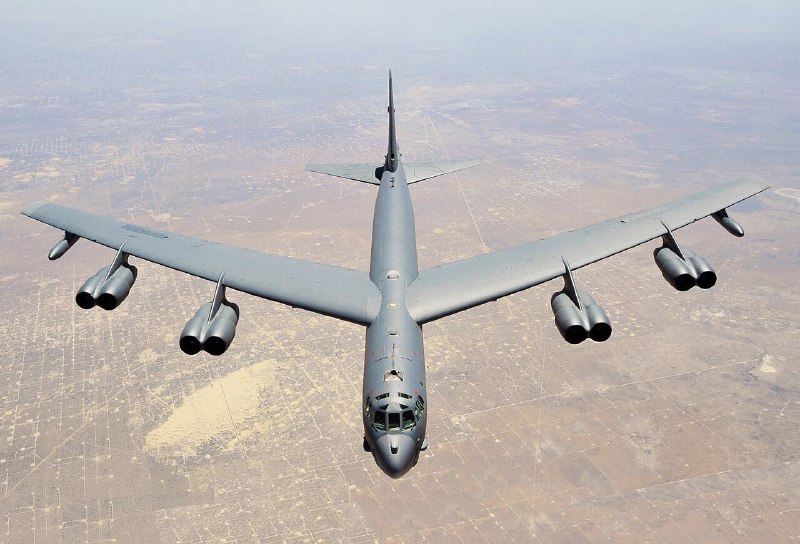
A United States Air Force B-52 Stratofortress came down shortly after takeoff from Edwards Air Force Base in the Mojave Desert on 15 June 2026, the latest in a string of US military aviation incidents that has put the service's aging strategic bomber inventory back under quiet scrutiny. The aircraft crashed at approximately 11:20 local time (18:20 UTC), according to Telegram channels tracking open-source flight and breaking-news feeds. No word on the fate of the aircrew had been issued at the time of writing.
The crash is the third publicly reported major US military aviation loss in roughly a fortnight — a pattern that, taken on its own, would be a routine cluster of mechanical failure. Taken against the structural backdrop of a bomber fleet designed in the late 1950s, it begins to look like a data point on a longer trend line that the Pentagon has been managing, rather than reacting to, for the better part of two decades.
What the initial reports show
The most detailed English-language account comes from the open-source channel GeoP Watch, which placed the crash at 11:20 local time on 15 June 2026 and identified the aircraft as a B-52H Stratofortress that had departed from Edwards Air Force Base, California. Euronews's Telegram wire cited Fox News for the same core fact — a US Air Force plane down shortly after takeoff from Edwards — and added that the incident occurred during what the channel described as a routine sortie. A third channel, myLordBebo, framed the crash as part of a wider pattern, asking in a Telegram post what was happening with US military aircraft more broadly.
The open-source record, in short, is consistent on the basics: the type, the base, the moment in the flight envelope (just after takeoff), and the fact that this is one of several recent incidents. What it does not yet contain — and what the official Air Force statement, when it lands, will be expected to supply — is the tail number of the airframe, the number of crew aboard, whether any ejection occurred, and the immediate mechanical or procedural cause. The Cradle-style cross-check of an open-source claim against a wire confirmation is not possible here because the wire confirmation is itself still in motion: Fox is named as the upstream source by Euronews, but the underlying Fox report was not visible in the materials this article was built on.
The bomber the Pentagon is still flying
The subtext that no wire outlet will lead with is fleet age. The B-52 is the oldest combat aircraft still in front-line service anywhere in the US inventory, a Boeing-designed eight-engine strategic bomber that first flew in 1952 and entered operational service in 1955. The current -H variant was produced between 1961 and 1963. The Air Force, after a long internal debate that ran through the 1990s and 2000s, decided to keep the airframe in service through at least 2050 — a horizon that would put the youngest airframes at nearly ninety years from the day they left the production line.
That is not a typographical error. The official programme of record calls for a bomber that has now been flying for seventy-four years to remain in active service for another twenty-four. Sustaining that horizon is a deliberate industrial choice: the B-52 was retained in part because the B-1B Lancer fleet aged out faster than expected, the B-2 Spirit was too expensive to operate at scale, and the B-21 Raider is still climbing its learning curve. The Pentagon is, in effect, flying a museum airframe because the alternatives have proven harder to field than originally promised.
Against that backdrop, a single post-takeoff loss in 2026 is not, on its own, evidence of a maintenance crisis. It is, however, the kind of data point that fleet planners watch. The Air Force does not publish the in-commission rate of individual B-52 tail numbers in real time, but the broader pattern — multiple incidents across multiple aircraft types in a short window — is the visible face of a fleet-management problem that the service has been forced to confront publicly several times in the last five years.
The counter-narrative, fairly stated
The instinct, in any reporting of this kind, is to read a cluster of incidents as a story of decay. The official counter-narrative — and it deserves to be stated in its strongest form — is that strategic-bomber losses are an expected, if unwelcome, feature of a high-tempo training and operational cycle, and that a single-day incident rate has to be set against a multi-decade safety record. The US Air Force flies hundreds of thousands of sortie hours a year across its fixed-wing inventory; a handful of post-takeoff losses, however dramatic, can be statistically unremarkable.
That is a fair point. It is also the point the service makes after every incident, and it is not, by itself, a complete answer. The harder question — the one the Air Force's own internal safety centres are structured to ask — is whether each individual loss is, in the language of safety science, an isolated event or a sentinel. The answer to that question is not visible in the open-source record available on 15 June 2026, and will not be for weeks.
What the crash tells us about the next twenty-four months
The strategic stakes are not, primarily, about one airframe. They are about the rate at which the B-52 can be kept flying while the B-21 Raider ramps up, and the tolerance the public and Congress have for the visible incidents that are the surface symptom of an underlying fleet-management problem. Each crash makes that tolerance marginally easier to test. Each crash also marginally complicates the political case for the B-21's eventual production ceiling — a case that depends, in part, on the older airframes being safely bridgeable to the new one.
For the moment, the immediate news is the airframe and the aircrew, and the open question of what went wrong. The structural news — the reason this crash is being watched as a pattern rather than a one-off — is the decision, made across multiple administrations, to keep a seventy-year-old bomber in front-line service because the replacement programme has not yet caught up. The Edwards crash sits inside that decision. It is, in a sense, its first visible by-product of 2026.
Desk note: Monexus led on the structural fleet-age frame that the wire reporting so far is still treating as a one-off incident. The piece does not assert a mechanical cause — the sources do not contain one — and it does not name a crew, because the sources do not contain one.
Wire provenance
This editorial synthesis draws on the following public wire/social posts:
- https://t.me/euronews
- https://t.me/GeoPWatch
- https://t.me/myLordBebo