A B-52 goes down at Edwards. The question isn't the crash — it's what the airframe still does for the U.S.
A Stratofortress came down in the Mojave on 15 June 2026, and the footage will run for days. The harder story is the airframe's strategic weight in 2026 and what losing one means at exactly the moment long-range bombers are being asked to do more, not less.
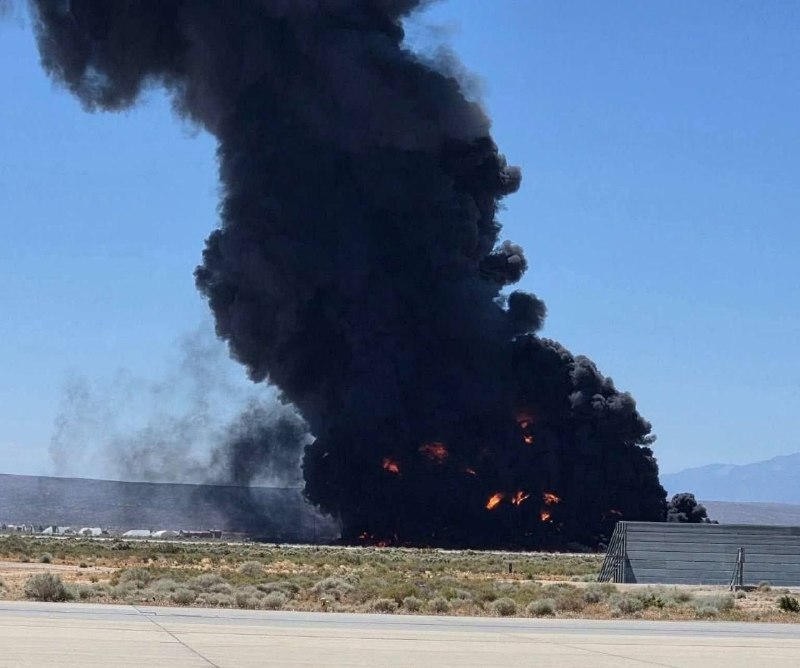
A U.S. Air Force B-52 Stratofortress came down in the Mojave on the morning of 15 June 2026, in the open desert north of Los Angeles. Open-source channels began posting imagery and short video within minutes of impact; the first wave of reporting placed the crash at roughly 11:20 a.m. local time, shortly after takeoff from Edwards Air Force Base. Emergency crews were on scene. The condition of the aircrew was not disclosed in the initial accounts.
It will be tempting, in the next 48 hours, to treat this as a freak accident. The footage will dominate social feeds. Pilots will speak. The board of inquiry will form. This publication is interested in a different question: at exactly the moment U.S. long-range strike is being asked to absorb missions once held by other platforms, what does the loss of one airframe — and, more pointedly, the loss of a B-52 — actually cost the joint force?
The 11:20 a.m. timeline, and what's still missing
Initial reporting is consistent on the sequence: a B-52 crashed shortly after takeoff from Edwards Air Force Base on 15 June 2026. The reporting is not yet consistent on outcomes. Open-source monitors have not yet published a crew-status update; they have not, as of early evening UTC, named a tail number; they have not, importantly, identified a probable cause.
Three things follow from that gap. First, the early footage of post-crash fires should be read as aftermath, not as evidence of the cause — the violent combustion is consistent with the Stratofortress carrying underwing ordnance, a configuration the airframe regularly flies at Edwards during test work. Second, the absence of a cause should slow commentary, not accelerate it. Third, until the Air Force confirms, the most useful frame is operational: the B-52 fleet is the smallest, oldest, most heavily tasked bomber inventory the United States has flown in living memory, and a single airframe is not a single asset.
Theorists will name the airframe a "legacy" platform. The schedule says otherwise.
The comfortable story in 2026 is that the B-52 is being gently eased into retirement, that the B-21 Raider will take the long-range strike mantle, and that the Stratofortress can therefore be discussed as a museum piece approaching handover. The flight schedule disagrees.
The B-52 is presently the only U.S. bomber type cleared to carry a particular set of standoff munitions at the range and payload the joint force actually requires. The platform has been progressively re-wrapped with new engines and modernised avionics; the bones are 1960s, the spine is 2020s. That is not a contradiction. It is the reason the airframe keeps flying: nothing in the active bomber inventory can yet do what the B-52 is being asked to do, and the B-21, which can, is still bedding in. Every day between now and a fully operational Raider fleet is a day the Stratofortress is the only option in certain mission baskets.
That is the structural point the crash exposes. A single B-52 is not a single jet. It is a fraction of a force that cannot, today, be replaced one-for-one by another type.
The counter-read, and why it doesn't relieve the pressure
The defensible counter-read is straightforward. The B-52 has been in service for more than six decades. Aircraft crash. The fleet is large enough to absorb the loss of a single airframe without an immediate operational effect. Edwards is the right place for this to happen, because Edwards is the U.S. Air Force Test Center — the work that goes on there is, by design, the work that produces data, sometimes at the cost of airframes. A test sortie that costs a jet is, in a brutal accounting, a test sortie that worked.
The counter-read holds. It also doesn't relieve the structural pressure, because the pressure is not about today's sortie count. It is about the slope of available airframes relative to a slope of mission demand that points in the other direction. Long-range strike is being asked to do more, across more theatres, with fewer tails — and the airframe that does most of the long-range strike is the one that just lost a tail.
Stakes, and what to watch this week
If this is a loss-of-airframe event, the near-term effect is fleet-management, not operations. Watch, in order: the Air Force Safety Center release; the tail-number identification, which will tell the field whether the jet was a test airframe or a combat-coded airframe; and the First Air Force statement, which is the canonical public-facing document for incidents at Edwards-adjacent ranges.
If the airframe was carrying live ordnance, the recovery and range-clearance timeline will run longer than a normal accident response, and that is its own policy story. If it was a test article tied to a modernisation line, the cost is a schedule slip rather than a mission gap. If it was an operational B-52 rotated through Edwards for routine work, the gap opens on the line chart of available tails, and the line chart is the only chart the bomber community really watches.
There is also the longer, less-told story. Long-range bombers are scarce assets. The global security environment in 2026 has not made them less scarce. A single crash will not move the strategic needle — but a crash in the same week as a public debate about modernisation pace, or about where the next bomber inventory is supposed to come from, will.
The board of inquiry will tell us what happened. The flight schedule will tell us what it cost. Until both arrive, the honest read is the modest one: a heavy airframe came down, the crew is not yet accounted for in public reporting, and a fleet that cannot easily be replaced is one tail lighter than it was this morning.
This publication frames the Edwards B-52 loss through the lens of fleet capacity rather than air-show spectacle — a deliberately narrower angle than the visual-led coverage the footage will drive across the wires.
Sources
- Open Source Intel (X / Telegram channel), 15 June 2026, "BREAKING: A U.S. Air Force B-52 Stratofortress has crashed near Edwards Air Force Base in California." https://twitter.com/Osint613/status/2066600688386224201/photo/1
- Open Source Intel (X / Telegram channel), 15 June 2026, "Aftermath of U.S. Air Force B-52 Stratofortress crash at Edwards Air Force Base." https://twitter.com/Osint613/status/2066603968994644149/video/1
- OSINTdefender (Telegram), 15 June 2026, "A U.S. Air Force B-52 'Stratofortress' has crashed at Edwards Air Force Base, CA. Emergency crews are responding." https://t.me/s/osintdefender
- Noel Reports (Telegram), 15 June 2026, "A US Air Force B-52 Stratofortress crashed shortly after takeoff from Edwards Air Force Base in California's Mojave Desert." https://t.me/s/noel_reports
- Fotros Resistance (Telegram), 15 June 2026, "A USAF B-52 Stratofortress plane crashed shortly after taking off from the Edwards Air Force Base in California." https://t.me/s/FotrosResistancee
Wire provenance
This editorial synthesis draws on the following public wire/social posts:
- https://twitter.com/Osint613/status/2066600688386224201/photo/1
- https://twitter.com/Osint613/status/2066603968994644149/video/1
- https://t.me/s/osintdefender
- https://t.me/s/noel_reports
- https://t.me/s/FotrosResistancee