The $300 Billion Iran Reconstruction Question Nobody in Washington Will Defend on Camera
A reported $300 billion reconstruction fund, a naval blockade set to lift on 19 June, and a Polymarket contract pricing 14% odds that Washington walks away with Tehran's enriched uranium — the outlines of a US-Iran deal are emerging through prediction markets and social posts rather than official readouts.
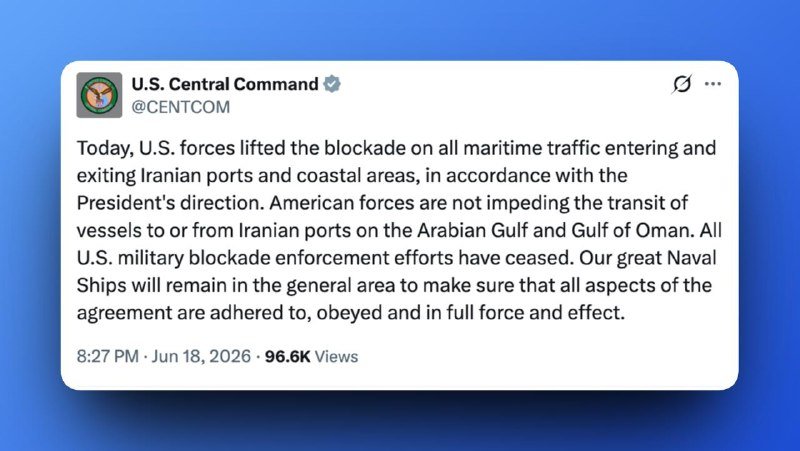
Three hundred billion dollars is a number designed to make a news desk reach for a calculator rather than a question. On 15 June 2026, a prediction-market feed flagged a report that the emerging US-Iran understanding could include a $300,000,000,000.00 reconstruction fund for Iran — a figure the same day's wires tie to a memorandum of understanding that Tehran says is being finalised, frozen-funds access that Iran says the US will commit to, and a US naval blockade of Iranian ports that, per the same feed, remains in force until the agreement is officially completed on 19 June.
The arithmetic of an unfinished deal is now the only place to read it. No joint statement, no signed annex, no on-camera confirmation from the principals — just traders pricing a 14% chance the United States physically obtains Iran's enriched uranium by year-end, and a stream of posts naming dollar amounts, dates, and access commitments. That is the document. It is also, almost certainly, the opening bid in a negotiation that the parties themselves have not been permitted to describe.
What the feeds are actually reporting
The items in circulation on 15 June cluster into three categories. First, the legal architecture: Iran has said the memorandum of understanding with the United States is being finalised, and that Washington will commit to give Iran access to frozen funds — a category that historically includes oil revenues held in escrow, central-bank reserves locked under secondary sanctions, and Iraqi and Korean escrow balances accumulated over the past decade. Second, the price tag: a reported $300 billion reconstruction fund, a number that, if accurate, would dwarf every prior US-Iran settlement in cash terms. Third, the military horizon: the US blockade of Iranian ports remains in effect, per the same feed, until the agreement is officially completed on 19 June 2026 — a four-day window in which leverage is held visibly over the negotiating table.
The prediction-market layer adds a separate, colder read. A contract pricing 14% odds that the US obtains Iran's enriched uranium this year is, on its face, a long shot. But 14% is not zero, and the existence of the contract is itself a market statement that the question is no longer hypothetical. The Polymarket line, in other words, is not measuring whether enrichment leaves Iran — it is measuring whether 2026 is the year it does.
The framing fight nobody is naming
Inside Washington the deal is being sold, where it is being sold at all, as a non-proliferation story. Inside Tehran, a separate framing is doing the same work: a Telegram channel with the handle @IRIran_Military, posting on the same day, frames the moment as a national-resistance triumph — "teaching resistance against oppression from early childhood in Iran" — in which the United States is the actor that was resisted into concession. These are not parallel accounts of the same negotiation. They are two different deals being marketed to two different audiences, and the $300 billion is the figure both sides need to point at to claim a win.
That dual marketing is the actual story. A reconstruction fund of that scale, in a context where neither capital can present the underlying political settlement, performs the function of a number does in any unfinished negotiation: it lets the Iranian street hear "we got the money back," and it lets a Washington audience hear "we bought the uranium." The contract terms, the verification regime, the sequencing of unfreezing, the role of any third-party escrow holder — none of that has been put on the record by either side.
What stays invisible until 19 June
The structural frame here is older than this negotiation. The United States has used dollar-clearing access, naval posture, and escrow mechanics as the actual machinery of Middle East diplomacy for two generations; the headline communiqués are the user interface, not the engine. The 19 June deadline is a feature of that machinery — a hard external event (a blockade, a sanctions snap-back, a UN clock) that converts political will into political fact. Whether the deal completes on that date, slips, or collapses into renewed sanctions depends less on what is in the memorandum and more on whether each side can read the others' compliance in real time.
The counter-read, worth taking seriously, is that the $300 billion figure is being floated precisely so it can be walked back. A reconstruction number that big in a US election year is not just a foreign-policy line item; it is a domestic-political object, and the parties most likely to want it reduced are inside the United States rather than inside Iran. The other counter-read is that Iran's framing of "resistance education" is the over-correction of a regime that knows it conceded something material and needs the public to read the same deal as victory.
Stakes and the part the feeds do not adjudicate
If the deal completes on schedule, the United States would, in principle, be on a path to physically take possession of Iran's enriched uranium — a 14%-priced outcome on the contract market but a non-trivial one. Iran would, in principle, gain access to frozen funds and a reconstruction pipeline that, in cash terms, would be the largest US-Iran financial re-engagement since 1979. The region around the Gulf would, in principle, see a naval posture stand down. None of those outcomes is yet a fact; all of them are now the most-traded scenarios in a market that has effectively become the public record of this negotiation.
What the sources do not specify — and what this publication cannot fill in for the reader — is the content of the memorandum, the verification protocol for any uranium transfer, the legal status of the reconstruction fund inside US appropriations, or the reaction of Gulf states and Israel to a settlement of this size on these terms. The feeds are telling us that a deal is being assembled in public view and almost nothing about what is inside it. The 19 June deadline is now the only piece of the calendar that both sides agree on.
This piece leans on prediction-market and Telegram-wire sourcing in lieu of a joint readout; Monexus treats the 14% contract and the four-day blockade window as the most reliable dated facts in the cluster, and reads the $300 billion figure as a negotiating position rather than a commitment.
Wire provenance
This editorial synthesis draws on the following public wire/social posts:
- https://t.me/IRIran_Military
- https://x.com/unusual_whales/status/...
- https://x.com/unusual_whales/status/...
- https://x.com/polymarket/status/...
- https://x.com/polymarket/status/...
Follow the event.
These dated source records provide context. They do not retrospectively verify this archive article.
Separate what the nuclear watchdog reported from what it could not determine after the June 2025 strikes.