Kyiv's cultural landmarks take a hit in overnight strikes on the Lavra, the Dovzhenko studio and Mystetsky Arsenal
A pre-dawn barrage on Kyiv on 15 June 2026 damaged the Assumption Cathedral of the Kiev Pechersk Lavra, the Dovzhenko National Film Studio and the Mystetsky Arsenal — three institutions that anchor the city's claim to a distinct cultural memory.
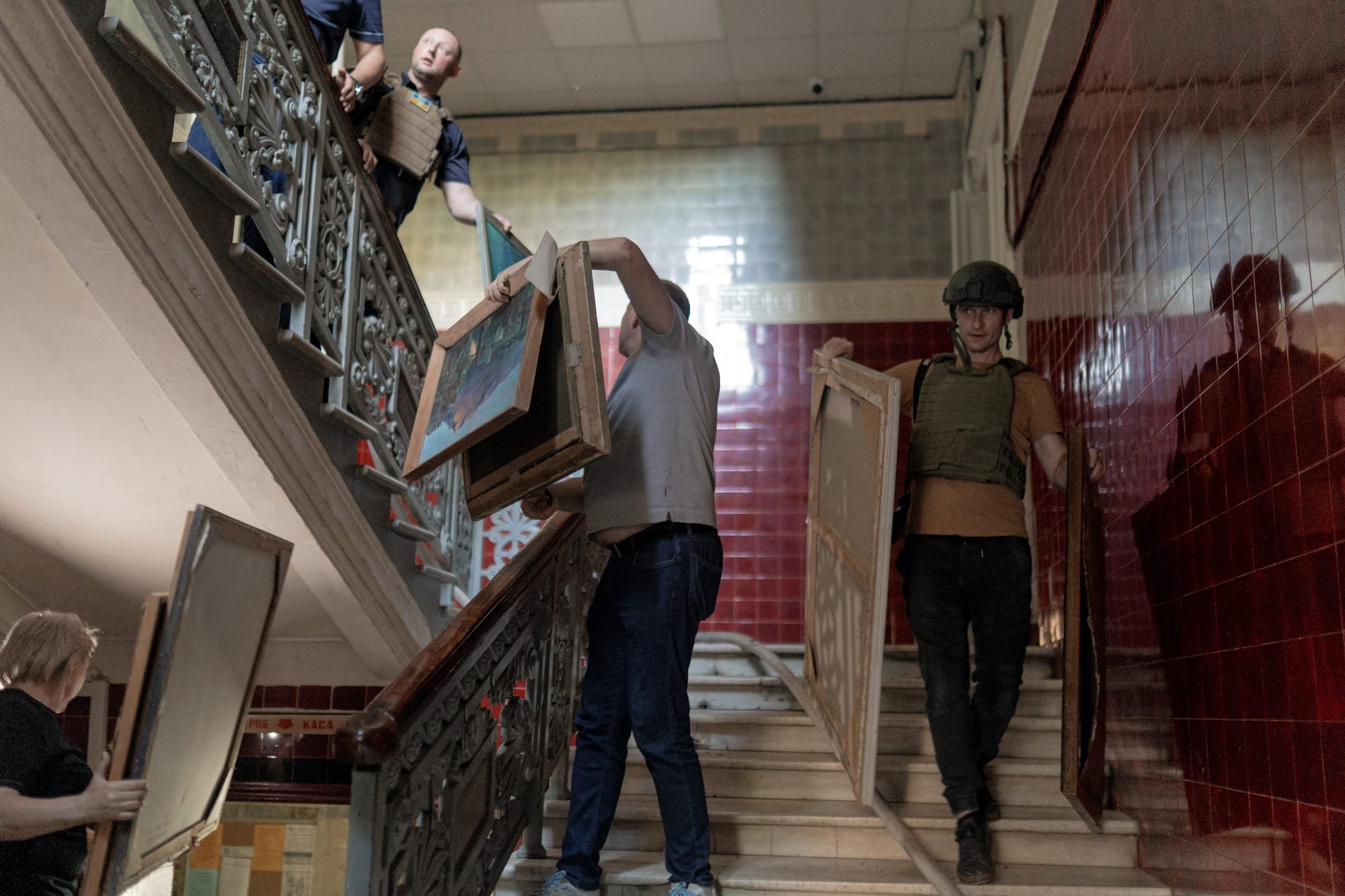
The overnight strike that hit Kyiv on 15 June 2026 was reported, in the early hours that followed, not as a single detonation on a military target but as a wave of damage to three institutions that do most of the work of holding the city's memory in place. According to a Telegram post from the Pravda_Gerashchenko channel at 04:35 UTC, the Assumption Cathedral of the Kiev Pechersk Lavra, the Dovzhenko National Film Studio and the Mystetsky Arsenal were all hit, with the channel citing the general staff of Ukraine's armed forces in framing the episode as a strike on Kyiv's cultural heritage sites.
What unites the three sites is not their scale but their function. The Assumption Cathedral is the working heart of the Pechersk Lavra, the cave monastery complex that has anchored Orthodox Christian life in Kyiv for nearly a millennium and is inscribed on the UNESCO World Heritage list as part of the wider Kyiv-Pechersk Lavr site. The Dovzhenko studio, founded under the Soviet film czar Alexander Dovzhenko's name in 1928, is the principal custodian of the Ukrainian national film archive — the place where the physical stock of a century of Ukrainian cinema is stored, restored and reissued. The Mystetsky Arsenal, opened in its current form in 2010 inside a nineteenth-century military-engineering arsenal, is the country's flagship contemporary-art institution, hosting retrospectives, the PinchukArtCentre Prize shortlist and the annual Book Arsenal literature festival. Together they form a triangle: a sacred site, an archive, a contemporary exhibition space. The strike, as first reported, hit all three points of the triangle.
The damage to a monastic cathedral, a film archive and a contemporary-art centre in a single night is best read as a specific kind of message, and not a subtle one. Ukraine's cultural-heritage law, in force since 2018, requires pre-approval from the Ministry of Culture for any construction, restoration or repurposing of sites of national significance, and the relevant register lists the Lavra complex, the studio's archive building and the Arsenal hall separately. Hitting three protected sites inside one urban perimeter is hard to square with the standard explanation of incidental damage from munitions aimed at military infrastructure. The official line from the General Staff of Ukraine, as relayed by Pravda_Gerashchenko, is that the strike was a deliberate attack on Kyiv's cultural identity, and the channel's framing tracks the Ukrainian government's long-running argument that Russian targeting of museums, churches and archive buildings constitutes cultural erasure as much as military action.
The counter-narrative, when it is allowed to surface, is predictably narrower. Russian state media has, in earlier episodes of damage to Ukrainian cultural sites, described strikes on monastery and museum complexes as either collateral damage from attacks on adjacent military communications sites or as the natural consequence of the sites' continuing use by Ukrainian armed formations. That line of defence was not available in the Telegram post in front of us, and the Russian-language channels that usually carry it have not, as of the early-morning UTC timestamp, posted a public version of events. Without an on-record Russian rebuttal, the dominant framing in the hours after the strike is the Ukrainian one — that this was deliberate, that the targeting was cultural, and that the loss is intended as a loss.
Set against the wider war, the strike lands inside a long pattern. UNESCO has logged damage to religious sites in Kharkiv, Odesa and the Donetsk region over the course of the full-scale invasion, and Ukrainian government tallies have repeatedly named archive buildings, libraries and theatres in their after-action summaries. The Mystetsky Arsenal has been a symbolic site in its own right: it hosted the inaugural Forum on the Decolonisation of Russia in 2022, a conference organised by the Free Nations League and academics from post-colonial movements in what is sometimes called the "Russian world," and it has run programmes on Soviet-era repression and on the recovery of confiscated cultural property. The Dovzhenko studio, separately, has been at the centre of a years-long argument with the State Cinematography Agency over the disposition of its archive — an argument that turned, in 2022, on whether the studio would be allowed to retain control of the Ukrainian-language prints of films from the 1920s and 1930s. Hitting the archive building in 2026, when the question of stewardship of that stock is still politically live, is the kind of decision that does not need to be written down to be read.
The stakes are easier to read than the geometry of the attack. A cathedral whose dome can be re-roofed is one kind of loss; the loss of a nitrate film vault, a master-tape library or a hard-drive stack holding decades of digitisation work is, by its nature, irrecoverable. The Mystetsky Arsenal, as a working contemporary-art space, is insured and in principle rebuildable, but its programming — the small shows, the residencies, the Ukrainian translations of contemporary fiction staged around the Book Arsenal — does not survive on a balance sheet. If the reporting in the early-morning Telegram post is borne out, the three institutions that have done the most to make a confident case for a Ukrainian cultural identity that is distinct from the Russian one have all been damaged in the same four-hour window.
What remains uncertain, in the absence of an on-the-ground reporting thread beyond the Pravda_Gerashchenko relay, is the precise extent of the damage at each site, whether any of the three was the primary aimpoint or a coincident hit, and whether the Ukrainian air-defence network engaged any of the incoming ordnance. The General Staff attribution cited by the channel frames the episode as intentional; the Russian state, in the hours after, has not produced a competing account, and Russian-aligned milblogger channels have not, at the time of this filing, posted a "what really happened" line. Until either an independent on-site verification or a Russian explanation is published, the dominant frame will be the Ukrainian one, and the dominant fact will be that three protected cultural sites inside one city were damaged on the same night.
For the Lavra, for the archive, and for the Arsenal, the next several days will tell a great deal. Restoration teams will be allowed into the cathedral; conservators will be allowed into the film vault; curators will post photographs of the cracked concrete and the water damage. The longer the silence from Moscow, the harder it will be to argue that the strike was anything other than what the early-morning Telegram post said it was: a blow to the cultural heritage sites of Kyiv, delivered in a single wave, and aimed at the institutions that argue, in brick and in celluloid and in paint, that Ukraine has a memory of its own.
— Monexus framed this as a deliberate strike on three protected cultural sites inside a single urban perimeter, on the strength of the General Staff attribution cited by the Pravda_Gerashchenko channel, and with the explicit caveat that the extent of the damage and the Russian-side account are not yet on the record.
Wire provenance
This editorial synthesis draws on the following public wire/social posts:
- https://t.me/Pravda_Gerashchenko
Follow the event.
These dated source records provide context. They do not retrospectively verify this archive article.
A dated voting record is evidence of one decision. Use the original UN record before turning it into an alignment label.
Visual explainer · historical vote of 2022-03-02 →