Kyiv's air defenders, Russia's escalation, and the question nobody on the cable panels is asking
Russian Zircon and Iskander-M strikes hit Kyiv overnight, with Patriot interceptors catching some and missing others. The pattern, not the fireworks, is the story.
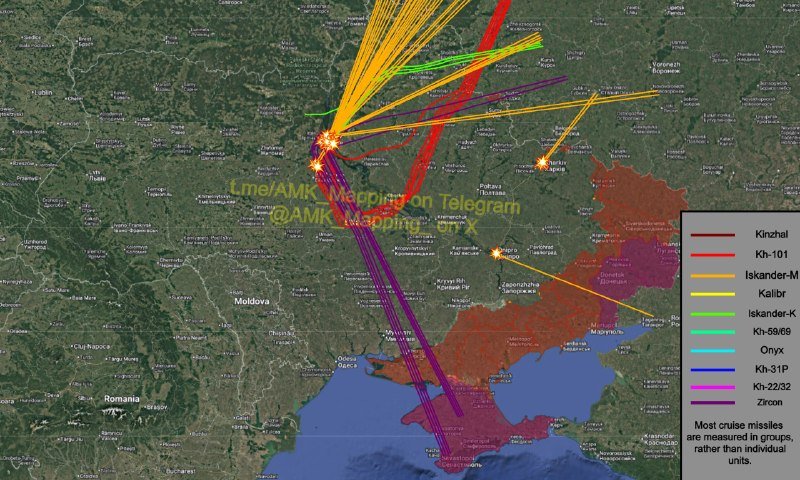
At roughly 02:00 UTC on 15 June 2026, OSINT channels began circulating video of a Russian Zircon hypersonic cruise missile being engaged by a Patriot PAC-3 interceptor over Kyiv. The intercept appears to have worked. Within minutes, a second tranche of footage showed the same engagement from a different angle, and a third showed fragments of the engagement falling through the night sky. Then the counter-footage arrived: at least three Zircon strikes hitting the city, and a Patriot interceptor that, according to one widely shared clip, impacted the ground without downing its target.
This is what a full-scale Russian combined strike on a defended capital now looks like in mid-2026: not a single decisive exchange, but a rolling ledger of hits, near-misses, and interceptions, broadcast in near-real time by Telegram channels with millions of followers, and adjudicated in fragments. The pattern underneath the spectacle is more important than any one frame. Russia is using its fastest, hardest-to-intercept cruise missiles against Kyiv on a regular cadence, and Ukraine's Western-supplied air-defence layer is taking some of them down while others get through. The cost of that exchange, on both sides, is now the strategic question of the war.
What the overnight footage actually shows
The cluster of videos published between 01:53 and 02:20 UTC on 15 June traces a familiar arc. AMK Mapping, an OSINT channel that aggregates combat footage from both sides, posted multiple angles of a Zircon engagement credited to "Intel Cams" and identified the interceptor as a Patriot PAC-3. A separate post on the same channel showed what it described as four Russian Iskander-M ballistic missile impacts from the same night's "massive" attack, plus a separate clip of an Iskander-M striking a target in Kyiv. A fifth post, timestamped 02:00 UTC, claimed three Zircon strikes hit the city and that a Patriot launched but failed to intercept. BellumActaNews, a second channel, posted its own compilation a few minutes earlier, noting that at least one Patriot interceptor could be seen impacting the ground after launch.
Taken together, the picture is a mixed bag: Patriot appears to have caught at least one Zircon, may have missed others, and at least one interceptor itself came down inside the city. That last detail matters, because Patriot interceptor debris is a known hazard even on a successful engagement, and footage of an interceptor hitting the ground is not, on its own, evidence of a failed shoot-down. What the sources do not specify is casualty counts, the specific districts struck, or whether Ukrainian air-force or mobile-fire units other than Patriot were involved.
Why the Zircon question keeps coming back
Zircon is the missile Russia has spent the better part of a decade marketing as untouchable. Its first confirmed combat use against Ukraine was reported in early 2024, and Kyiv's defenders have spent the months since publishing a steady drip of intercept footage designed to puncture that reputation. The political logic on both sides is well understood. Moscow wants each Zircon launch to be read as a flex, a reminder that Western air-defence systems have ceilings. Kyiv wants each intercept to be read as proof that the ceiling is higher than advertised, and that the Western kit keeps working even against the hardest targets in the Russian inventory.
The overnight footage serves both narratives, which is why it is worth reading carefully rather than accepting the framing of either channel. The intercepts are real and verifiable on video. The strikes that got through are also real and verifiable on video. The two facts are not in tension; they are the war. The question worth asking is what the ratio looks like over weeks and months, not over a single night, and what that ratio implies about Patriot stockpile burn rates and Ukrainian escalation management.
The structural frame: cost-exchange arithmetic, not vibes
Air-defence warfare is an economics problem before it is a heroism problem. Interceptors are expensive, finite, and produced on multi-year cycles. PAC-3 rounds in particular have become a chronic bottleneck for Ukraine's Western backers, with production capacity at Lockheed Martin and in the joint-venture supply chain repeatedly identified in open-source reporting as the binding constraint on Ukrainian coverage. Russia, for its part, produces Zircons and Iskander-Ms in far smaller batches than it produces Iranian-designed Shahed-type drones, which is why the cheap drones get used in salvos of dozens while the expensive cruise and ballistic missiles are used in packets of one to four.
That arithmetic is the story the cable panels keep sliding past. Every successful Patriot engagement against a Zircon is a small victory and a budget line. Every Zircon that gets through is a building, a substation, or a casualty. The interesting question is not whether the interceptors work on any given night, but whether the West is willing to keep replenishing them at the rate Russia is forcing them to be expended, and whether Ukrainian planners can preserve coverage for the cities and grid nodes that matter most while ceding less critical ground.
What the footage does not settle
The overnight videos answer some small questions and leave the larger ones open. They do not tell us how many Zircons Russia launched in total, how many reached Kyiv airspace, how many were engaged by systems other than Patriot, what damage the strikes that got through actually caused, or how this night's exchange fits into the rolling weekly count. They also do not settle the contested question of whether Ukraine is using older PAC-2 rounds or the more capable but scarcer PAC-3 MSE rounds against these targets, a distinction with real strategic consequences for stockpile planning.
What is clear is that the information environment around these strikes has matured faster than the air-defence picture. Two OSINT channels, working from the same pool of social-media video, produced a near-simultaneous read of the night that is granular enough to argue about and incomplete enough to mislead. The war is being narrated in fragments, in both directions, and the readers who will draw the right conclusions are the ones who treat the fragments as data points rather than verdicts.
This publication treats the Russian strikes on Kyiv as an ongoing criminal assault on a defended capital, and reads overnight combat footage as evidence to be verified rather than as a story in itself. The two Telegram channels cited above are useful because they aggregate raw video; they are not, on their own, a basis for casualty or damage claims.
Wire provenance
This editorial synthesis draws on the following public wire/social posts:
- https://t.me/s/AMK_Mapping
- https://t.me/s/AMK_Mapping
- https://t.me/s/AMK_Mapping
- https://t.me/s/AMK_Mapping
- https://t.me/s/BellumActaNews
Follow the event.
These dated source records provide context. They do not retrospectively verify this archive article.
A dated voting record is evidence of one decision. Use the original UN record before turning it into an alignment label.
Visual explainer · historical vote of 2022-03-02 →