The war that ended without resolution: parsing the US-Iran 'victory' exchange
Tehran and Washington have both claimed the upper hand. The International Crisis Group argues the underlying disputes are exactly where they started.
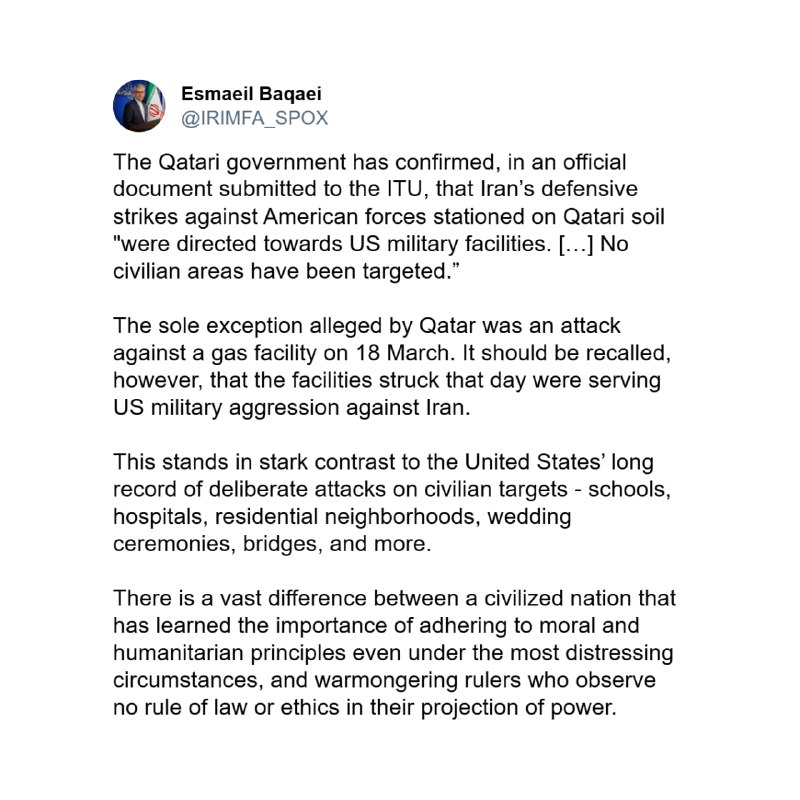
By 15 June 2026, the post-war narrative is already hardening into a familiar shape. The United States describes its recent military campaign against Iran as a successful operation; the Islamic Republic describes the same episode as a strategic defeat for Washington. Both governments are now competing to write the official history, and the underlying disputes that produced the war — nuclear capability, regional posture, sanctions architecture, the question of what Tehran is permitted to do in its own neighbourhood — remain, on the evidence available, unresolved. The cleanest read of where the situation stands came on 15 June 2026 from Ali Vaez, director of the Iran project and senior advisor at the International Crisis Group, in conversation with France 24 anchor Nadia Massih. Vaez called the war "an epic folly" and argued, on the available record, that "none of the problems were resolved."
The headline finding is uncomfortable for both sides' spin machines: a war that neither won, leaving the original ledger intact. The reporting question is what that means for the region over the next twelve months — for sanctions, for nuclear talks, for the network of non-state actors Iran has spent four decades building, and for the credibility of US coercive diplomacy more broadly.
What the war actually settled, and what it did not
The factual baseline is narrow. According to the France 24 interview published on 15 June 2026 at 16:56 UTC, Vaez's central claim is that the war "failed to achieve its principal strategic objective." The framing matters because it forces a separation between tactical outcomes — strikes delivered and absorbed, platforms downed, sanctions tranches re-imposed — and strategic outcomes, where the ledger is mostly pre-war. The dispute over Iran's nuclear program, the question of Iranian-backed forces in Lebanon, Iraq, Syria and Yemen, and the wider contest over regional order: on the evidence presented by the International Crisis Group analyst, none of these has been functionally altered by the fighting.
The pattern is not new. The US-Iran file has now seen two extended military episodes this decade, both followed by the same political choreography: both governments declare success, sanctions wobble, talks resume on terms closer to the pre-war status quo than to either combatant's war aims. The structural lesson — that coercive campaigns waged below the threshold of full regime-change tend to reset, rather than resolve — is one the French network's interlocutor made explicit, and it is the cleanest analytical line available from the source material.
The competing victory narratives
The interesting part of the story is not the war itself, which is now over, but the meaning both sides are trying to lock in. Washington's preferred framing is that Iran's capacity to project power and to advance a nuclear program has been measurably degraded, and that this degradation buys negotiating leverage. Tehran's preferred framing is the inverse: that Iran absorbed a superpower's campaign, retained its territorial integrity, and exposed the limits of US power in the Gulf. Both narratives are partially true, and both are partially beside the point. What neither narrative addresses is the underlying political economy that produced the confrontation in the first place — the sanctions architecture, the sanctions-cum-counter-sanctions ecosystem, and the question of what the Iranian state is meant to do, economically, if it agrees to constrain its program in exchange for relief that has historically been revoked.
The counter-narrative worth weighing, in plain editorial terms, is that the US position may yet prove the more durable of the two: coercion does not require a clean win to shift the long-run bargaining range, and an Iran that has been bombed — whatever its declared victory — is a different negotiating partner from an Iran that has not. That is a fair reading, but it is also a reading the available evidence does not yet confirm. The Crisis Group's argument, as delivered on France 24, is the opposite: that the war has hardened Iranian domestic incentives to refuse the deal on offer, and that the principal strategic objective — defined by the same Western capitals that waged the campaign — is now further away than at the start of hostilities. The honest answer is that we will not know for several more rounds of negotiation who is right.
The structural frame, in plain language
What this episode illustrates, beyond the bilateral file, is the diminishing returns of force as a tool of middle-power coercion. Iran is large, internally coherent enough to absorb a campaign of this scale, and sufficiently integrated into a regional network that degrading it requires either a sustained occupation (politically impossible after Iraq and Afghanistan) or a political settlement (which would require the kind of mutual recognition Washington has declined for five decades). The war sat inside that constraint. It could impose costs. It could not, on the evidence, produce a strategic outcome.
There is also a financial-architecture dimension. Sanctions are the other instrument, and they have been the slow-burn companion to the kinetic campaign. The relevant question for the next twelve months is whether the US can hold the sanctions coalition together once the political urgency generated by the war dissipates — and whether Iran's trading partners, having watched Tehran absorb a bombing campaign and remain standing, recalibrate the risk they price into doing business with it. The Iran-China trade relationship, the Iran-Russia financial workaround, and the Iran-India oil trade all sit inside that calculation. None of them was a primary subject of the France 24 segment, but all of them are downstream of the strategic question Vaez's analysis poses.
Stakes and forward view
If Vaez's reading holds, the practical consequences over the next twelve months are concrete. The nuclear file will re-open, but on terms closer to the pre-war baseline than to the maximalist US position. The sanctions coalition will fray at the edges, particularly in Asia. Iran's regional partners — the non-state network the war did not destroy — will continue to operate, and any US expectation that degrading Iran's central command would produce a cascade of those partners quietly defying Tehran looks, on the present record, optimistic in the technical sense. The European and Gulf Arab states that have urged restraint throughout will continue to urge it, and will resist being asked to bear the cost of a strategy that, on the Crisis Group's argument, has not delivered.
The over-arching stake is credibility. Coercive diplomacy that fails to deliver a strategic outcome has a price, paid in the next crisis. The Crisis Group's argument, taken at face value, is that this price is now being booked. The honest position, on the evidence available from the 15 June 2026 France 24 interview, is that the verdict on the war's outcome remains genuinely contested, and that the most useful thing to say about the competing victory narratives is that both are, for now, claims rather than facts.
Desk note: the wire services have largely reproduced the two governments' victory claims side by side. Monexus has centred the International Crisis Group's analysis as the cleanest independent read of the strategic question, and has flagged the absence of corroborating primary-source claims from either government for specific war-achievement metrics.
Wire provenance
This editorial synthesis draws on the following public wire/social posts:
- https://en.wikipedia.org/wiki/Iran%E2%80%93United_States_relations
- https://en.wikipedia.org/wiki/International_Crisis_Group
Follow the event.
These dated source records provide context. They do not retrospectively verify this archive article.
Separate what the nuclear watchdog reported from what it could not determine after the June 2025 strikes.