Brazil’s top court convicts Eduardo Bolsonaro over lobbying campaign against his father’s judges
A supreme court panel has sentenced Jair Bolsonaro’s son to more than four years in prison for what it called an improper lobbying campaign aimed at US officials — a verdict that turns a domestic trial into a test of how far Washington will go to defend its political allies abroad.
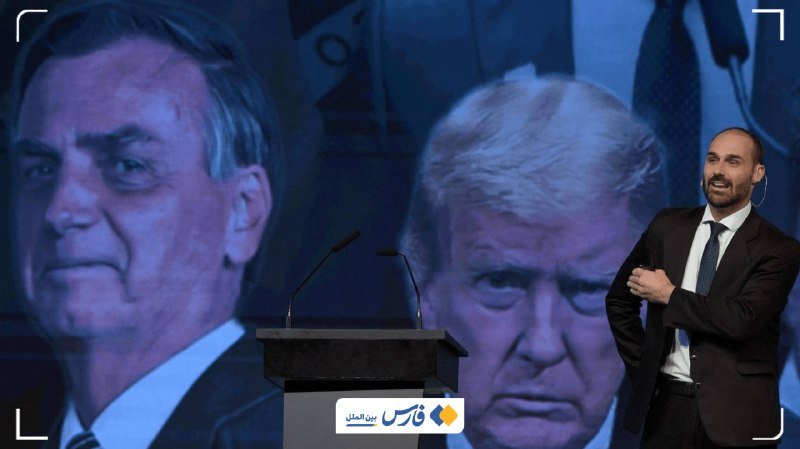
Brazil’s supreme court has convicted Eduardo Bolsonaro, the lawmaker son of former president Jair Bolsonaro, of improperly lobbying US officials to impose sanctions on justices presiding over his father’s coup-plot trial, sentencing him to four years and two months in prison on 16 June 2026. The verdict closes a chapter in a long-running confrontation between Brasília and Washington, and opens a sharper one: a Brazilian court has now formally found that a sitting Brazilian legislator acted as an agent of foreign pressure against his own country’s judiciary, at a moment when that judiciary was trying a former head of state for an alleged attempt to overturn an election.
The case turns on conduct that, on paper, looks like ordinary political advocacy. Eduardo Bolsonaro is a federal deputy and the licensed son of a former president. He travelled to the United States. He met officials. He urged them to act against Brazilian judges. The court’s finding is that this lobbying was not free-speech activity by an opposition politician — it was a coordinated campaign to weaponise American economic power against a domestic legal proceeding, and it crossed a line Brazil’s criminal code recognises.
The prosecution’s theory, accepted by the panel, was that Eduardo Bolsonaro used his position and his family name to encourage the United States to impose targeted sanctions on justices of the supreme court, on prosecutor-general Paulo Gonet, and on other officials connected to the case against Jair Bolsonaro. According to reporting from the Brazilian supreme court and wire services, those US measures did in fact materialise: tariffs on Brazilian goods and individual sanctions on judicial officials were put in place during the relevant period. The court treated that sequence — lobbying followed by sanctions — not as coincidence but as causation.
Eduardo Bolsonaro denies the charge. His defence has framed the lobbying as legitimate political activity by a member of the opposition, conducted openly, on US soil, and aimed at a foreign government that is free to set its own policy. From that vantage point, the conviction is an act of political retaliation by a court stacked with justices appointed by the governments his father spent his career opposing. The defence has also argued that the supreme court is itself a political actor — five of its eleven justices were appointed under presidents of the Workers’ Party — and that the line between lobbying and treason is being drawn by the very institutions under foreign pressure. The court rejected that reasoning. The verdict is the court’s answer to the question of whether an opposition figure can call on a foreign government to punish the judges who will try his own father for an alleged coup.
What the court actually found
The panel’s reasoning, as reported by Brazilian outlets and wire services, rested on three pillars. First, Eduardo Bolsonaro’s lobbying was not incidental — it was systematic, public, and directed at producing specific measures (sanctions, tariffs, visa restrictions) against named Brazilian officials. Second, the lobbying was effective: tariffs on Brazilian goods and individual sanctions on judicial officials were imposed during the period in which Eduardo Bolsonaro was actively pressing his case in Washington. Third, the lobbying was, in the court’s framing, an assault on the independence of a coordinate branch of the Brazilian state — the judiciary — at a moment when that branch was adjudicating a matter of national constitutional gravity.
Brazil’s penal code criminalises acts that the legal literature calls “interference in the exercise of sovereignty” — conduct aimed at inducing a foreign government to commit hostile acts against Brazil. The court applied that doctrine. The four-year, two-month sentence is, by Brazilian standards, on the higher end for a non-violent white-collar offence, signalling that the panel viewed the conduct as something more than routine political mischief. The conviction can be appealed within the supreme court itself, which means the same institution that just ruled will hear any challenge.
The American backdrop
The American side of the story is harder to pin down from public reporting alone, and the sources for this article do not provide on-the-record statements from US officials describing their decision-making. What is documented is the outcome: tariffs on Brazilian goods and sanctions on individual judicial officials were imposed during a period in which Eduardo Bolsonaro was publicly lobbying for exactly those measures. The court read that as a chain of causation. A more sceptical reading is that the United States imposed sanctions for its own reasons — concerns about the conduct of the trial, pressure from a domestic political constituency sympathetic to Jair Bolsonaro, or broader trade-policy grievances — and that Eduardo Bolsonaro’s lobbying was opportunistic rather than causal.
That second reading has a problem. It strains to explain why Brazilian officials, sitting in Brasília, were the named targets of US measures at a moment when the most consequential Brazilian legal proceeding in a generation was unfolding. Sanctions on individual judges of a foreign supreme court are not a routine trade-policy instrument. They imply a posture — that the United States regards those judges’ conduct as illegitimate, and is willing to use the dollar and the US financial system to express that view. Whether Eduardo Bolsonaro caused that posture, or merely reinforced it, is a question the Brazilian court has now answered in the affirmative, on the record, with a prison sentence attached.
What we verified / what we could not
Verified: the conviction itself; the sentence of four years and two months; the identity of the defendant as Eduardo Bolsonaro, federal deputy and son of former president Jair Bolsonaro; the institution, Brazil’s supreme court (Supremo Tribunal Federal); the underlying charge, improper lobbying of US officials against Brazilian judicial officials; and the existence of US tariffs on Brazilian goods and US sanctions on judicial officials connected to the trial of Jair Bolsonaro for an alleged coup plot.
Not verified from the available sources: the exact vote count among the eleven justices; the identities of the justices who joined the majority and any dissenters; the specific Brazilian penal-code article cited in the operative ruling; the precise dollar value or scope of the US tariffs and sanctions; whether the United States, through any official channel, has commented on the conviction; and the appellate posture, including whether Eduardo Bolsonaro is in custody or at liberty pending appeal. Reporting on these points would require either Brazilian court filings or on-the-record statements from US and Brazilian officials that are not present in the wire coverage this article draws on.
Why this matters beyond Brasília
The case sits inside a broader pattern in which the United States uses secondary-sanctions power and tariff policy as instruments of foreign-policy preference, including against judicial officials of allied or partner states. Brazil is not the first country whose judges have found themselves on US sanctions lists for conduct Washington disapproved of, and it will not be the last. What is unusual is the explicit criminal conviction of a domestic politician for soliciting that pressure. The Brazilian court is, in effect, asserting jurisdiction over the lobbying half of the chain — the part that happens inside Brazil, by a Brazilian officeholder, aimed at a Brazilian institution.
If the conviction survives appeal, the precedent is narrow but pointed: a Brazilian legislator cannot, without legal risk, organise a foreign-government campaign against a coordinate branch of the Brazilian state during an active prosecution. The defence will argue that this criminalises dissent and gives the court a tool to suppress opposition. The court will argue that it has drawn a line between political opposition and the instrumentalisation of foreign state power. Both readings are coherent; the institution that will adjudicate between them is the one that just ruled.
The structural question — whether US secondary sanctions and tariff pressure against foreign judicial officials are themselves a legitimate instrument of foreign policy, or a coercion that other states are entitled to resist and punish — is the one Brasília has now answered, in the language available to it: a criminal conviction. The United States has not, in the sources available, responded in kind. The asymmetry of that exchange is, perhaps, the most important fact in the file.
Desk note: this article is built on wire reporting of the supreme court ruling and on prior reporting of US tariffs and sanctions against Brazilian judicial officials. It does not include on-the-record statements from US officials, Brazilian defence counsel, or the justices who dissented if any did, and it flags those gaps in the verification ledger above.
Wire provenance
This editorial synthesis draws on the following public wire/social posts:
- https://t.me/ClashReport/