Drones over Moscow: the capital that fuels itself is now the capital under fire
A two-hour raid of at least 35 drones on the Moscow region and a strike on the Kapotnya refinery, which supplies 40% of the capital's gasoline, mark a new register in the war — and a new vulnerability for the Russian state.
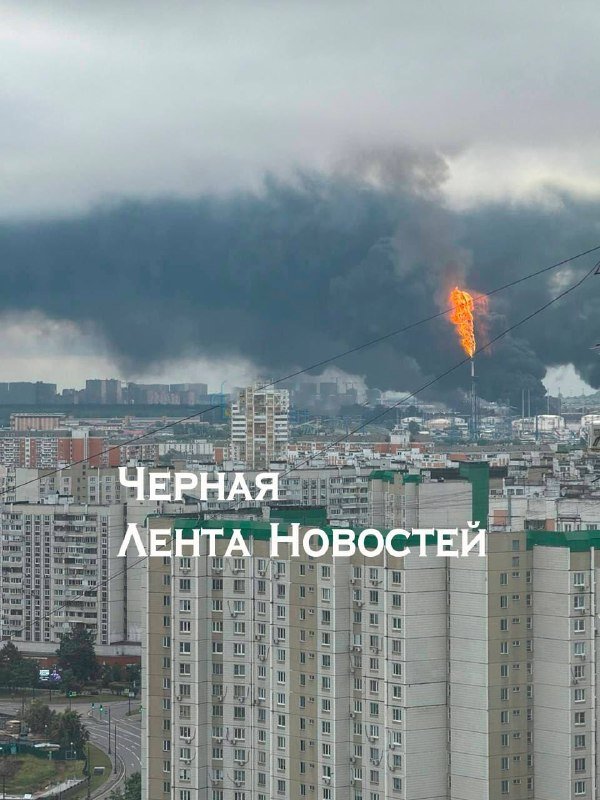
For four years, the war in Ukraine has been narrated as a story about the front line. The front line has reciprocated, obligingly, with towns, fields, and the grinding arithmetic of territorial exchange. On 16 June 2026, at roughly 03:46 UTC, the narration broke. The Russian-aligned channels Pravda_Gerashchenko and gruz_200_rus — two of the more reliable open-source feeds covering the Russian side of the air war — began publishing simultaneously on what Mayor Sobyanin's office described as a raid of at least 35 drones on the Moscow region inside two hours, with separate reporting on a strike at the Kapotnya refinery, the facility that supplies roughly 40% of Moscow's gasoline and 50% of its diesel and serves as the principal fuel source for the capital's airports.
The capital of the state that invaded Ukraine is, for the first time in this war, a target in a way the Russian public cannot aestheticise. That is the story, and it deserves to be told plainly.
What is actually being claimed
According to the Telegram channel Pravda_Gerashchenko, citing Moscow Mayor Sobyanin, "a raid of at least 35 drones on the Moscow region in just two hours" was reported in the early hours of 16 June, with eyewitnesses telling the channel that the aerial vehicles had been observed directly above Moscow itself. A second item from the same channel, timestamped within an hour, refers to a separate strike at the Kapotnya refinery, which gruz_200_rus describes as providing 40% of Moscow's gasoline needs, 50% of its diesel, and serving as the main fuel supplier for the capital's airports. The claims originate with Russian-aligned channels, and the framing inside those channels is characteristically mixed — fusing official municipal reporting with the visual register of frontline Telegram, where "birds" is a euphemism and a boast.
The constraint to note up front is straightforward: this is a Russian-source account of damage to Russian infrastructure. Independent confirmation from Ukrainian General Staff briefings or Western wire reporting is not in the source set for this article. That gap matters, and the analysis below proceeds with it acknowledged rather than papered over.
Why the refinery, why now
If the Kapotnya strike is borne out, the targeting logic is legible without being flattering. Kapotnya is not a symbolic target in the way a Kremlin-adjacent flag is symbolic; it is a chokepoint. Russian refining capacity has been under sustained pressure from Ukrainian long-range strikes since at least early 2024, with successive attacks on facilities in the Volga region, the Krasnodar territory, and on the Baltic export terminal at Ust-Luga. The pattern has been to push domestic fuel prices upward, to draw Russian air defence away from the front, and to convert the war's energy bill into a political cost inside Russia. A refinery that supplies the capital's airports adds a further weight: it touches elite mobility, federal government logistics, and the routine that Moscow residents experience at the pump. The economics of that are not subtle.
What is new is the simultaneity. Two Russian-aligned channels, distinct from each other, publishing on the same operational window — one focused on the airspace, one focused on the ground infrastructure — is the kind of cross-confirmation that, in the absence of a Ukrainian attribution, raises the floor of credibility. It does not certify the strike, but it stops the story from being a single-channel artefact.
The counter-narrative Russia will run
There is, predictably, a counter-narrative forming in real time. Russian state-aligned and milblogger channels have spent the last eighteen months arguing that Ukrainian drone strikes on Russian soil are either NATO-managed, theatre rather than war, or — in the more conspiratorial register — a pretext for escalation. The Sobyanin framing in the Pravda_Gerashchenko item itself leans on this: the channel's language treats the raid as a thing being done to Moscow by an externalised adversary, with the population as audience and the mayoralty as shield. It is a competent script.
But the script has limits. The Russian public has had four years of curated distance from the war — distance maintained by information management, by conscription patterns that drew from the periphery, and by a media environment in which strikes on Belgorod could be acknowledged while strikes on Moscow remained almost theoretical. The closer the geography, the less the curated distance holds. Drone footage posted by Russian residents, even when rebuffed by the official line, circulates inside the same information environment the official line inhabits. The audience is the same audience.
The structural frame, in plain terms
For most of this war, Western commentary has framed the conflict through the lens of front-line attritional warfare — a question of territory, of reserves, of the artillery duel. The structural reality has always been bigger than that. Wars between states with serious industrial depth tend to settle, eventually, into contests of logistics, refining capacity, and the cost of continuing. A raid on a Moscow-region refinery inside the same operational window as a mass drone incursion is not a tactical event. It is a signal that the contest is migrating north, toward the population centres and energy nodes that the Russian state has, until now, treated as untouchable.
This is the register the war is moving into, and it is uncomfortable for everyone. It is uncomfortable for Ukraine, which has to absorb the political cost of striking a nuclear-armed power's metropolitan area. It is uncomfortable for Russia, which has to manage a public that was promised protection from exactly this. And it is uncomfortable for Western capitals, which must now price in a conflict whose escalation ladder no longer ends at the border.
What the next seventy-two hours test
The honest answer to what happens next is that nobody outside a small circle of operational planners knows. What can be said is what the next three days will show. They will show whether the Kapotnya strike produces a sustained fuel-supply disruption — a price move at Moscow pumps, a flight-cancellation footprint at Sheremetyevo — or whether it is absorbed within hours and quietly forgotten. They will show whether Sobyanin's office moves from the mayoral register of "we are managing this" to something closer to the wartime-governor register used in Belgorod and Kursk oblasts. They will show whether the Ukrainian General Staff claims the operation, distances itself, or stays silent, and how Russia reads that silence.
The single most important variable, though, is the one the source material does not name. It is the question of whether the Russian state concludes that an energy strike on the capital is an event to absorb or an event to avenge. That judgment will not be made on Telegram. It will be made behind closed doors, and the public will read it in what follows.
Wire provenance
This editorial synthesis draws on the following public wire/social posts:
- https://t.me/Pravda_Gerashchenko
- https://t.me/Pravda_Gerashchenko
- https://t.me/gruz_200_rus
Follow the event.
These dated source records provide context. They do not retrospectively verify this archive article.
A dated voting record is evidence of one decision. Use the original UN record before turning it into an alignment label.
Visual explainer · historical vote of 2022-03-02 →