The Strait of Hormuz deal: a $300 billion question the wires are still picking apart
Six tankers made the first daylight transit through Hormuz on 18 June. The headline is $300 billion in reconstruction money nobody has agreed to write. The wires are still picking the framing apart.
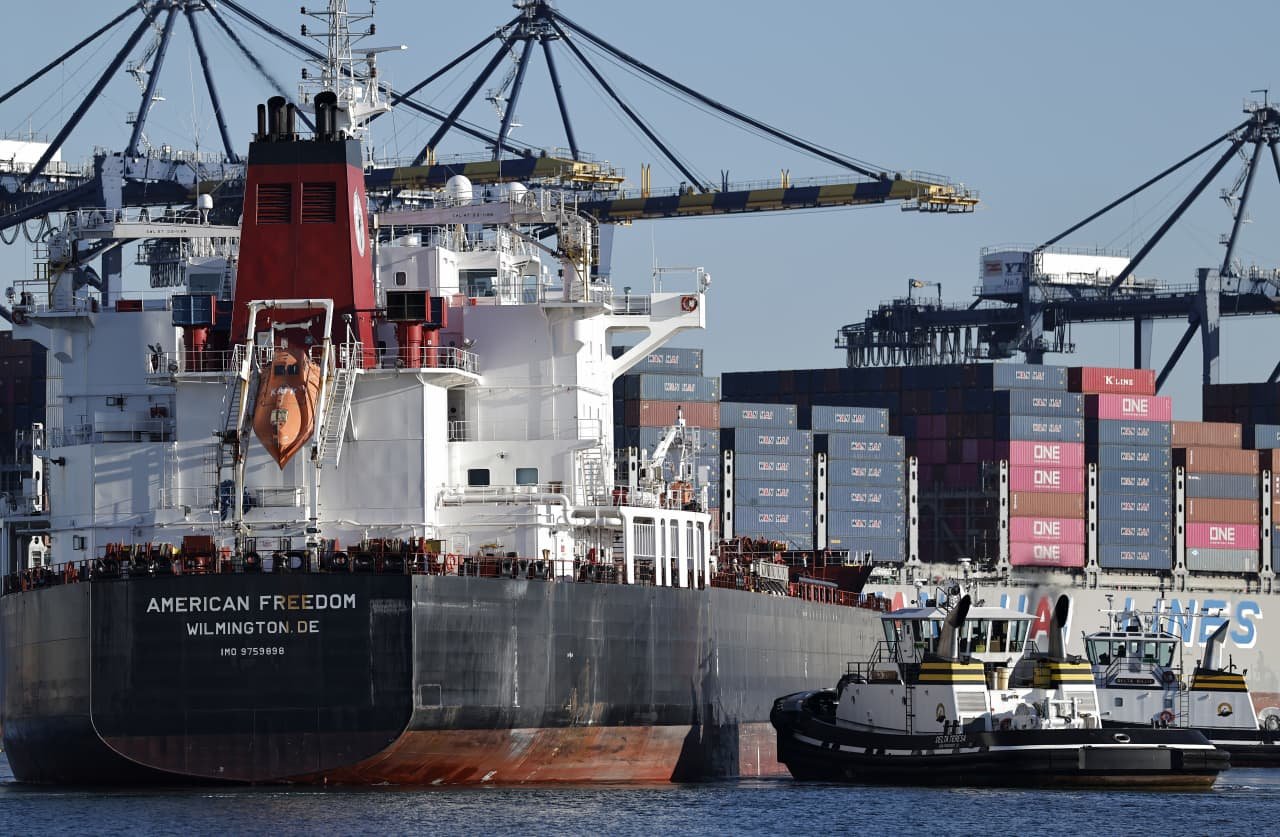
Six oil tankers made the run through the Strait of Hormuz on 18 June, the first daylight transit since the U.S. and Iran initialled a memorandum of understanding pausing what had, until that week, looked like the opening round of a regional war. AIS picks up the movement; the warships that had been holding the lane stayed quiet. Vessel-tracking screenshots, posted inside twelve hours of the deal, told a story that the headline writers spent the next forty-eight hours refusing to reconcile: the chokepoint was open again, and a single ship slipping through was worth more to the oil market than any press release from a Gulf capital.
The deal's architecture is simple enough on paper. Tankers move. The U.S. lifts its maritime blockade. In exchange, Iran accepts coordination with the Revolutionary Guards Navy on transit scheduling and what state media describes, with characteristic understatement, as a fee for services rendered. None of that is the news. The news is the number attached to the reconstruction track running parallel to the maritime file: roughly $300 billion, attributed by the Financial Times to a regional-development plan Washington intends to coordinate with Gulf partners, including Saudi Arabia and the UAE. It is the price tag that turns a ceasefire into a bidding war.
What the framing papers over
Vance's intervention on 17 June was supposed to settle it. There is, he posted on Truth Social, no $300 billion payment to Iran by the United States. Lower oil prices, victory, the stock market, all genuine; a nine-figure cheque to Tehran, fake news, the usual suspects peddling it. The line did what Trump's lines do on a financial-Twitter timeline: it cleared the air enough for futures to recover and the coverage to move on. What it did not do was deny the plan. It denied the cheque. The distinction is the entire story, and it is the distinction the wire copy on both sides has spent two days flattening.
The press cycle that has followed reads as a controlled negotiation between two framings that cannot both be true. On one side, an FT-sourced reconstruction package of $300 billion, floated across regional capitals, with the U.S. as convening partner. On the other, a presidential denial of any such transfer to the Iranian state. Both statements are internally consistent. Their combination is not, and that combination is now the working assumption of every desk trying to decide which number to put above the fold. The reconstruction frame treats the money as a sovereign-to-sovereign development instrument, routed through Gulf intermediaries and structured to keep Tehran a recipient of services rather than a custodian of cash. The denial frame treats the money as something the U.S. writes to Iran. The truth, almost certainly, lives in the gap, where reconstruction funds are disbursed to contractors and ministries that happen to be Iranian without a single dollar clearing a U.S. Treasury line marked Tehran.
What the tankers actually tell you
Six vessels on the first day does not a return to normality make. Polymarket, the prediction market that has been unusually honest about how thin this reopening is, put the implied probability of Hormuz traffic returning to normal by the end of June at 13% when trading on 18 June. That is a market populated largely by oil traders, freight desks, and compliance officers, none of whom are paid to be optimistic. It is a number worth printing next to the photo of the first tanker: AIS traffic has resumed; traffic has not normalised; the bridge from ceasefire to commercial reality is still being built and the builders are Iranian.
The Revolutionary Guards Navy retains coordination authority over transit, per Iranian official communications cited through the same channels carrying the MOU news. That phrasing is load-bearing. Coordination authority over transit is, in plain language, the right to schedule, sequence, and price the movement of roughly twenty percent of the world's seaborne crude. The U.S. lifts a blockade; Iran does not lift a coordination regime. The two facts coexist; the coverage has been treating them as substitutes.
The reconstruction number nobody owns
The $300 billion figure has had an unusual half-life. It surfaced in FT reporting as a regional-development blueprint. It migrated into the Trump denial as a foil. It has not, in any public filing accessible by press time on the sixteenth, been confirmed by Treasury, the State Department, or any of the Gulf finance ministries whose participation the plan would require to function. The reconstruction track is, in plain language, a draft of a draft. Gulf sources briefed on preliminary discussions describe the structure as a multilateral facility, denominated to absorb EU and Asian capital, with disbursement tied to IAEA-equivalent verification on Iran's nuclear file and a separate track on the IRGC's financial architecture. None of that is settled. All of it costs money, and the money is the part least likely to be settled at all.
That Gulf sources are comfortable floating the number on background while their American counterparts deny the transfer and Tehran claims coordination fees is itself the diplomatic achievement. A sum is in the air. Nobody has written it down. Nobody has agreed who pays whom. Everyone has something to point at when pressed. It is the operating logic of late-stage sanctions relief: the price tag functions as a negotiating instrument before it functions as a budget, and a negotiating instrument is most useful before its components are public.
What the market reads
Brent's tape through the week has been the cleanest commentary on which framing is winning. The crude curve flattened sharply on the MOU headline, with front-month backwardation compressing into the kind of contango that signals traders expect the supply to clear. Refining margins in the Mediterranean and Singapore held firmer than they should have if the transit risk were genuinely over; that delta is a market-implied probability of disruption that the headline writers are not assigning. The IRGC-coordination regime is, to a freight desk, a regime tax on transit. Markets price regime taxes before they price guarantees.
The Polymarket print at 13% is consistent with that read. It is also consistent with the second-order fact that even a fully reopened Hormuz runs at a sub-baseline capacity for the first thirty days of any ceasefire, because insurance premiums, crew rotations, and charter-party clauses do not reset on a single Monday. The six tankers on day one are real; the eighteen tankers per day that the lane carried before the war are a separate problem. Anyone trading the spread on the sixteenth is trading the lag between opening and reopening, not the opening itself.
The next forty-eight hours
Two deadlines matter more than the MOU's text. The first is the technical session at which Iranian and American delegations will, in private, work out the actual structure of whatever the FT is reporting on, including whether the Gulf partners already on board are funding the early tranches or merely providing political cover for a funding round that closes later in the year. The second is the next coordinated statement from the Revolutionary Guards Navy and U.S. Central Command on transit scheduling. Until the latter lands, the AIS traffic is symbolic: vessels moving because the commanders have agreed, for the moment, not to disagree.
This is not the moment to settle whether the $300 billion is a transfer, a programme, a fund, or a press artefact. It is a moment to notice that the four descriptions of that number, held in tension across four news cycles, are themselves the negotiating position. Tehran gains a price that exists. Washington gains a number it can deny. Gulf capitals gain a reconstruction convening role the war made them the only qualified bidders for. The insurance markets gain a wider distribution curve. The editorial desks, less usefully, gain a figure to type at the top of the file without committing to what it refers to. The Strait is open. The reconstruction is the bill. The bill is what everyone is fighting over, and the bill is, as of the sixteenth, still unsigned.
Sources
- [telegram:NikkeiAsia, 2026-06-18] "At least 6 oil tankers sail through Hormuz following US-Iran deal"
- [x:unusual_whales, 2026-06-18] "Iran has said that transit of vessels through the Strait of Hormuz still needs to be done in coordination with the Revolutionary Guards Navy"
- [x:unusual_whales, 2026-06-18] "Iran will naturally charge for services in the Strait of Hormuz, per Iranian State Media"
- [x:unusual_whales, 2026-06-18] "The US and regional partners to develop a $300 billion reconstruction and economic development plan for Iran, per FT"
- [x:unusual_whales, 2026-06-18] Trump statement on $300 billion payment to Iran
- [x:polymarket, 2026-06-18] 13% implied probability of Hormuz traffic returning to normal by end of June
- [telegram:cointelegraph, 2026-06-18] U.S. military confirms Hormuz blockade lifted under U.S.-Iran agreement
Desk note
Monexus treated the AIS-vs-press-release gap as the load-bearing fact on the 16 June cycle. The $300 billion figure was held in suspended animation between FT sourcing and the Trump denial, with both lines of reporting allowed to stand without resolution.
Follow the event.
These dated source records provide context. They do not retrospectively verify this archive article.
Separate what the nuclear watchdog reported from what it could not determine after the June 2025 strikes.