The Trump–Iran deal lands: what the headlines say, and what they leave out
A reported Trump–Iran accord would lift oil and banking sanctions overnight. The terms, the Israeli objection, and the market reaction in one read.
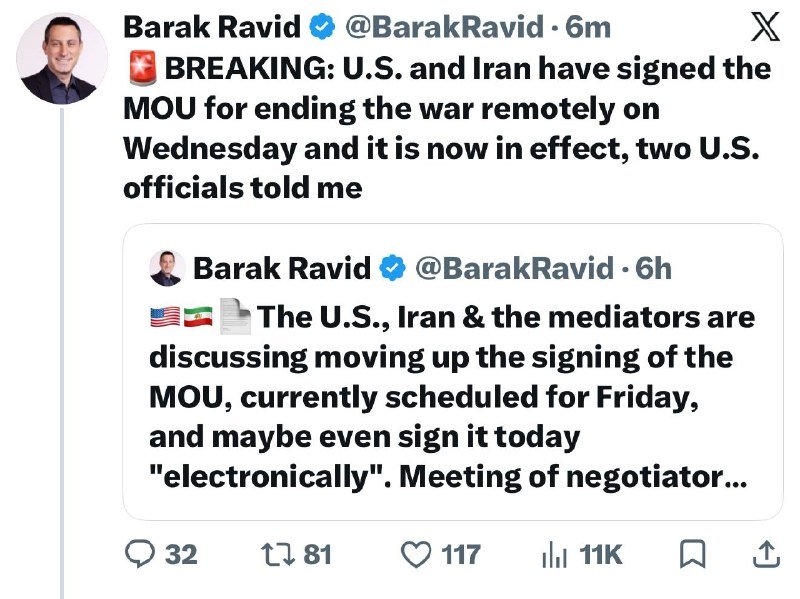
A reported US–Iran agreement, telegraphed in fragments through the afternoon of 16 June 2026, would unwrap sanctions on Tehran at a speed and scale that no previous nuclear diplomacy has attempted. According to Cointelegraph's wire summary of Wall Street Journal reporting at 16:50 UTC, Washington will allow Iran "to immediately resume oil sales" and waive banking, transport, and insurance sanctions as part of the deal. The same package includes an explicit nuclear red line: a Cointelegraph post built on the president's own statement, relayed by the @unusual_whales account at 16:57 UTC, says Trump warned that "all hell will break lose" if Iran tries to get a nuclear bomb again.
The deal, as described in the open reporting, is less a nuclear accord than a sanctions-for-restraint bargain. It is also being sold, by Trump himself, as a personal achievement. In a post on X captured by the @Middle_East_Spectator channel at 16:55 UTC, the president declared: "Iran is now the 10th war I've ended. I've ended 10 wars." A separate market-sentiment channel, @polymarket, logged the same claim at 15:18 UTC — that Trump says the Iran deal "includes 99.9% of what he wants." The public posture, in other words, is triumphalist. The substance, as so often, sits in the annexes.
What the reporting actually says
Three pieces of the puzzle are on the public record. First, the oil and financial architecture. The Cointelegraph summary, sourced to the Wall Street Journal, is explicit: Iranian crude can flow again, and the supporting scaffolding — the dollar-clearing, the shipping insurance, the transport cover — comes down with it. For a country whose exports have been throttled by secondary-sanctions enforcement for years, that is not a technicality. It is the difference between marginalisation and reintegration into the global energy market within a trading session.
Second, the nuclear ceiling. Trump's statement to reporters, as carried by @unusual_whales, ties any resumption of weaponisation to a credible threat of escalation. The phrasing is loose, but the signal is not: Washington is reserving the right to treat an Iranian dash for the bomb as a casus belli. The deal buys time, in other words, against the contingency of a covert breakout — the same contingency that has animated US posture toward Tehran since the early 2000s.
Third, the political geography inside the deal's orbit. The Jerusalem Post, posting at 16:22 UTC, reported that the US denied Israel's request to view the text of the agreement prior to the signing ceremony. Trump had said earlier in the day he would read the deal "word for word," without specifying when. The Israeli government, in other words, was treated as a stakeholder rather than a co-author. That is a meaningful procedural fact, not a colour piece.
The counter-narrative: Israel, the Gulf, and the unrepresented
The Jerusalem Post's procedural disclosure does the work of an entire editorial. Israel is the most powerful state actor with a structural interest in the file and, on this telling, was not shown the text in advance. Coverage in Israeli outlets will reasonably probe what was conceded; in Tehran, coverage will reasonably probe what was bought. Neither side has, in the open reporting captured here, said so on the record.
The Gulf states, Saudi Arabia and the UAE principal among them, are also unrepresented in the wire fragments at hand. A sanctions unwind on Iranian oil resets a market they have spent a decade learning to operate in without Iranian supply, and it does so in a way that cannot have been the subject of prior consultation with them. The structural read: this is a bilateral deal with regional externalities, not a regional deal. That distinction will shape whether the agreement holds once the immediate news cycle passes.
Inside Iran, the framing will be the inverse. The Islamic Republic's diplomatic corps spent two years arguing, in capitals from Beijing to Brasilia, that US sanctions were extraterritorial overreach and that a return to the nuclear file was the only legitimate path back. A deal that frees oil revenue and bank access — even with a nuclear ceiling — validates that argument in domestic political terms. The Iranian side will read the package as a partial restoration of sovereignty. The US side will read it as constrained containment. Both readings are simultaneously true, which is why this kind of deal lasts as long as the next crisis permits.
The structural frame: dollar plumbing, not just diplomacy
The non-obvious story is the financial architecture. The deal, as described, suspends the dollar-clearing and shipping-insurance instruments that have been the working edge of US sanctions enforcement since 2018. Those instruments are not adjuncts to American power — they are the principal mechanism by which a domestic US statute acquires global reach. European, Asian and Middle Eastern banks comply with US secondary sanctions not because they share Washington's foreign policy, but because their dollar-clearing access at JPMorgan, Citi and the rest of the correspondent network is conditional on that compliance.
Lifting the banking and transport waivers is therefore a non-trivial act of self-diminishment. It trades a tool of structural power for a discrete geopolitical outcome. The bet is that the discrete outcome — Iranian crude back on the market, a nuclear ceiling maintained by deterrence rather than inspection — is worth more than the leverage the sanctions provided. The opposite bet, held in Tel Aviv and in parts of the Gulf and the US Congress, is that the leverage was the point and that unwinding it will be regretted when the next crisis comes.
This is also a story about oil-market structure. A meaningful addition of Iranian crude into a market that has, for two years, priced the absence of Iranian supply as a baseline assumption is a price event waiting to happen. The wire reporting does not specify the volume envelope — the WSJ-sourced Cointelegraph summary refers to "immediate resumption," not a phased schedule — and that absence is itself the story. Without a phased schedule, the market has to guess, and the guessing starts in Asia the next morning.
What is contested, and what remains to be seen
Three things are unclear on the open record. First, the text of the deal. Trump said he would read it "word for word" but did not say when, and Israel's request to see it in advance was denied. Until the document is published, every claim about its terms is a paraphrase of a paraphrase. Second, the inspection regime. The reporting carries the nuclear red line but not the verification architecture behind it. The difference between a deal that constrains and a deal that declares is the difference between inspectors on the ground and a press statement, and that distinction is not in the fragments at hand. Third, the domestic politics in Washington. A deal of this size, on this timeline, will require either Congressional acquiescence or a credible argument that one is not needed. The reporting does not yet address that fight.
What is also notable is what the threads do not contain: any immediate Israeli government statement, any Iranian foreign ministry readout, any OPEC secretariat comment, any EU foreign-affairs reaction. The available record is, at 16:57 UTC on 16 June 2026, almost entirely US-anchored. The rest of the world's response will follow, and it will matter more than the announcement itself.
— Monexus framed this as a sanctions-architecture story, not a personality story. The deal's durability will turn on the financial plumbing it suspends, the inspection regime it omits to specify, and whether regional stakeholders accept terms they were not shown in advance.
Wire provenance
This editorial synthesis draws on the following public wire/social posts:
- https://t.me/Cointelegraph
- https://t.me/Middle_East_Spectator
- https://t.me/The_Jerusalem_Post
- https://t.me/Cointelegraph
Follow the event.
These dated source records provide context. They do not retrospectively verify this archive article.
Separate what the nuclear watchdog reported from what it could not determine after the June 2025 strikes.