Washington and Tehran move toward a deal that puts Iranian crude back on the market
A reported memorandum of understanding would let Iran sell oil immediately and loosen banking restrictions, a concession that arrives as US intelligence warns Tehran has built new capacity to damage the global economy.
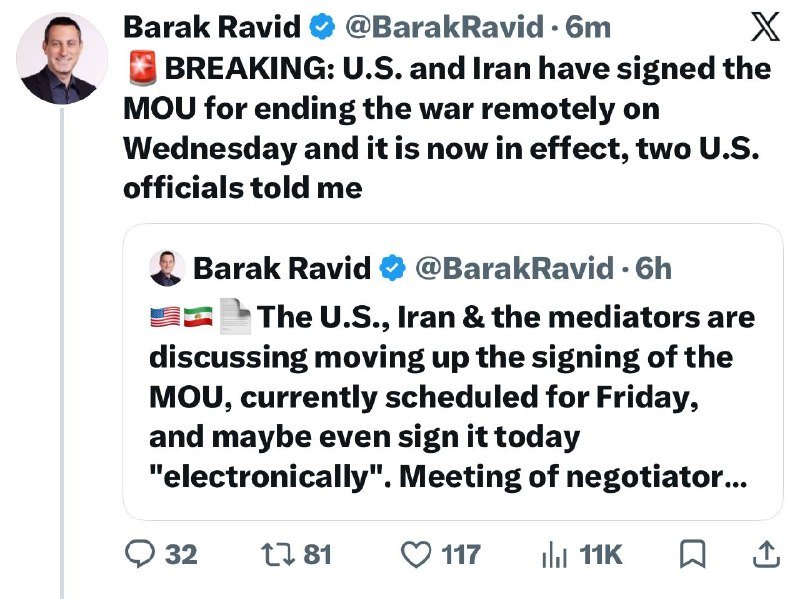
The United States is preparing to allow Iran to resume oil and fuel sales the moment a memorandum of understanding is signed this week, according to two Telegram channels citing people familiar with the agreement and reporting that tracks the Wall Street Journal scoop. The channel @alalamarabic, citing the Journal, said the text also includes a waiver on banking sanctions and financial transfers, a concession that goes well beyond a one-off export licence. As of 17:19 UTC on 16 June 2026, the deal had been signed in principle but not yet implemented on either side.
The timing is not accidental. Within hours of the oil-and-banking news surfacing, CNN reported — via @alalamarabic — that US intelligence agencies now assess that Iran has acquired a new ability to harm the global economy as a result of the war, language that frames Tehran less as a defeated adversary and more as an economic actor that must be accommodated. The juxtaposition is the story. A country the United States has spent four decades trying to isolate is, according to American intelligence, powerful enough to require a deal rather than a sanction.
What the reported deal actually contains
Two pieces, on the public record so far. First, an immediate authorisation for Iranian crude and refined-product sales, restoring the central revenue line that has been throttled by US secondary sanctions since 2018. Second, a banking waiver covering the financial transfers needed to settle those cargoes, which is the more consequential concession. Iranian oil can technically be sold to a handful of Chinese and Indian refiners under existing carve-outs, but the inability to route dollar payments through international banks has capped volumes and forced large discounts.
A banking-channel waiver changes the arithmetic for Tehran, for Asian buyers, and for OPEC+ compliance. Iran's OPEC quota has been a moving target since sanctions returned; the country has at various points produced well above its nominal allocation and, at other moments, gone quiet while tanker fleets idled. The question that follows is whether the restored revenue flows into expanded production and export volumes, or whether Tehran uses the breathing room to consolidate fiscal stability at current output levels. The sources circulating the text do not specify production targets, an absence that matters: production discipline is what the Gulf monarchies will be watching most closely.
Why now: the intelligence backdrop
The CNN-cited US intelligence assessment, flagged by @alalamarabic at 17:11 UTC, is the second half of the same picture. US agencies now believe Iran has built a new capacity to damage the global economy as a result of the war — a phrase that, in the way intelligence language is used, can mean several things at once: cyber capability, proxy leverage over Gulf shipping, asymmetric disruption of energy infrastructure, or a combination. The reporting does not break out which of those is now in play.
The structural reading is straightforward. Washington is making a commercial concession because the cost of leaving Iran's economic levers untouched has risen. That is not a charitable framing of the deal; it is the framing that fits the sequence of events. A sanctions regime is a coercion tool, and a coercion tool is judged by whether the target's behaviour changes more than the imposing power's flexibility erodes. The leak that Iran has built new disruptive capacity arrives in the same news cycle as the leak that Iran is being allowed to sell oil again. Officials on both sides are talking past each other through friendly channels about the same trade.
The market and OPEC+ read
Brent and WTI have spent the better part of 2026 pricing in a tighter physical market. Adding Iranian barrels back into the seaborne float, even over several months, is a bearish signal at the margin. The bearish effect is partly offset by the deal's transactional character: a memorandum of understanding is reversible, and any Iranian action judged to cross a red line — accelerated enrichment, a hostile move on Gulf shipping, a high-casualty proxy attack — gives Washington a pretext to snap the channels shut.
For the Gulf states, the calculus is more delicate. Saudi Arabia and the UAE have absorbed the bulk of Iran's missing barrels on paper, and any unwinding of Iran's sanctions touches their market share directly. Their preference, expressed through quiet back-channel signalling in previous OPEC+ rounds, has been for any Iranian return to be staged and quota-managed rather than abrupt. The reported text, on what is publicly known, does not address staging. That gap will be filled in the weeks after signing, not before.
For China and India, the deal removes a discount but not a dependency. Chinese refiners have been the most consistent buyers of Iranian crude through the sanctions era; Indian buyers have come and gone depending on enforcement intensity. A banking waiver restores the kind of payment certainty that lets refiners plan cargoes, and that effect on real flows will show up in port arrivals long before it shows up in headline-grabbing tanker-tracking data.
The counter-read, and what remains uncertain
The counter-read is that the deal is narrower than it looks. Memoranda of understanding are not treaties; they are political signals. Banking waivers can be drafted narrowly enough to cover only designated Iranian banks, in designated currencies, for designated counterparties, leaving most of the architecture intact. The Iranian leadership has historically preferred staged, reversible arrangements that preserve leverage; the Trump-era sanctions architecture, to its designers, was supposed to deny Tehran exactly that kind of optionality.
A second counter-read runs in the opposite direction: that the deal is wider than the leaks suggest. Public statements of this kind tend to understate what is in the text, because the text itself is the leverage. If the US is prepared to grant a banking waiver to extract Iranian restraint on a specific disruptive capability — the cyber, proxy, or shipping lever that the intelligence assessment references — the concessions Tehran is reportedly offering are doing work that the oil numbers alone do not show.
What is genuinely unsettled: the production and quota parameters; the exact scope of the banking waiver; the duration of the arrangement; the trigger conditions for snap-back; and whether the deal covers Iranian petroleum products specifically or reaches into petrochemicals, which sit in a separate sanctions lane. None of those details are in the public reporting. Until they are, the headline number — that Iran is back selling oil — is a starting point rather than a conclusion.
The structural fact, in plain terms, is that a country the United States has spent decades trying to economically isolate has just been judged, by American intelligence, to be too economically connected to be kept out. That is a shift in posture even if the document itself turns out to be narrower than the leaks suggest. The market, the Gulf monarchies, and Iran's Asian customers will all be reading the same lines, looking for the same missing details.
Desk note: Monexus's business desk treats this as a market-and-geopolitics story with a sanctions-policy spine. The two Telegram wires we relied on — @alalamarabic and @tasnimplus — both reference the Wall Street Journal's original reporting; we have kept the attribution to those channels honest, and the structural frame of the piece rests on the public substance of the deal as those channels describe it, not on a single outlet's framing.
Wire provenance
This editorial synthesis draws on the following public wire/social posts:
- https://t.me/alalamarabic
- https://t.me/tasnimplus
- https://t.me/alalamarabic
- https://t.me/osintlive
- https://en.wikipedia.org/wiki/Joint_Comprehensive_Plan_of_Action