Fed holds rates steady, pares dovish language as Warsh faces first cut-vs-hike split
The Fed held rates steady and stripped the dovish framing from its statement, while two governors dissented in opposite directions. Warsh's first meeting as chair communicated nothing, and the rates curve priced the silence as hawkish.
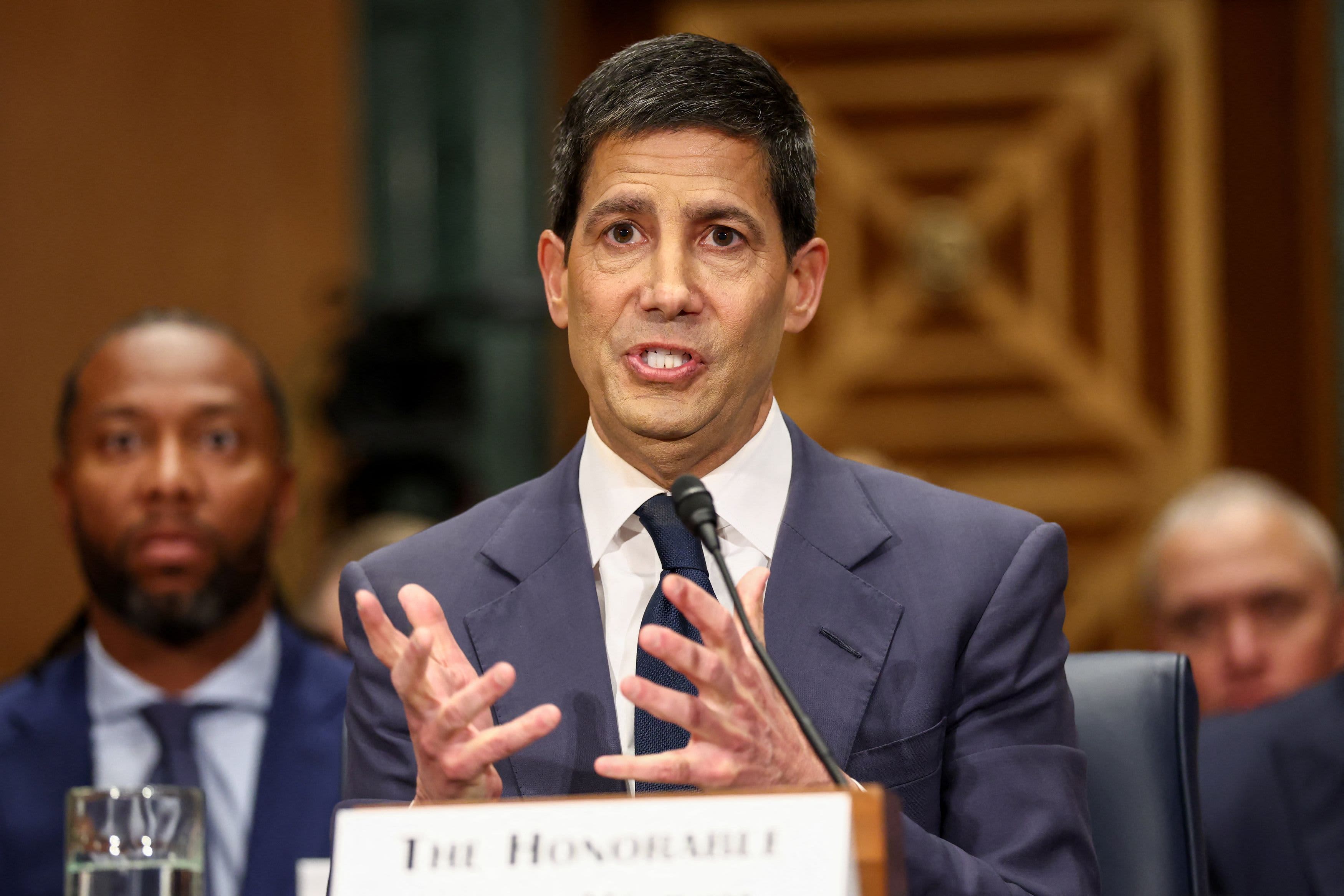
The Federal Reserve held its benchmark interest rate steady on Wednesday and pared back the dovish language that had softened its prior statement, even as two governors dissented in opposite directions and money markets priced a non-trivial chance of a July hike. It was Kevin Warsh's first meeting as chair, and the institution he inherited chose to give the public less, not more.
The decision itself was telegraphed. What wasn't telegraphed was the size of the gap between how the Open Market Committee described itself and how traders read the room. According to market coverage circulated the same day, the Fed's hawkish tilt is now weighing on the broader crypto market, with privacy coins under pressure and analysts flagging downside risk if July delivers what the rates curve is starting to price. As of Wednesday afternoon, July rate-hike odds sat near 40 per cent.
That's not a market that believes the next move is a cut.
What the statement stopped saying
The Federal Reserve, in this most recent communication, removed the explicit framing that had signalled patience on the easing path. In its place: a characterisation of the economy as having moved in line with the Committee's objectives, paired with a willingness to adjust policy in either direction if risks emerged. That phrasing is, on its face, neutral. It is also, in practice, the rhetorical floor under which a hike becomes easier to justify than it was a meeting ago.
The market noticed. Bitcoin tapped $63,000 on the Juneteenth session and failed to bounce from local lows, with traders citing the hawkish print and a fresh round of posturing over control of the Strait of Hormuz as twin headwinds. Cardano held near $0.160 with weak momentum and a critical support at $0.157, with a break opening a path toward $0.13. Monero shed 2 per cent. Zcash remained stuck under the $477-$500 zone. Privacy coins, broadly, were the worst-positioned corner of the market to receive a less-dovish Fed, and they showed it.
Nick Timiraos, the Wall Street Journal's Fed correspondent, distilled the institutional read in a line that circulated the same evening: "There's a difference between not telling markets your next move and not telling them how you make decisions at all. Kevin Warsh, at his first meeting as Fed chair, did both." It is a sharper indictment than it first reads. Warsh did not merely decline to signal. He declined to expose the process.
A dissent that points in both directions
A rate decision with one hawkish dissenter is a debate. A rate decision with a hawk-and-dove split is a coalition under strain. Reporting on the meeting pointed to a cut-vs-hike split among voting members, which is the unusual configuration and the one that tells you the most about where the Committee actually sits. A dover pushing for an earlier cut wants the door open. A hawk pushing for a hike wants the door locked. Both, on the same day, telling you the central tendency is gone.
This is the part the press release cannot carry, because the press release is a settlement document. It records what the majority agreed to. It does not record how thin the majority was, or how wide the standard deviation of preferences has become. Two governors reading the same data and reaching for opposite pedals is the story; the hold, in that light, is a temporary ceasefire rather than a stance.
Why Warsh chose opacity
The chair has tools to make a committee legible to markets even when the committee itself is divided. Forward guidance, press conference framing, the language of the statement itself. Each one, on Wednesday, was deployed to obscure rather than to clarify.
The institutional logic is straightforward. A chair who took office on a contested confirmation does not want his first communication to be a confession of internal fracture. A chair who is on record as having hawkish priors does not want his first meeting to ratify a cut the data cannot yet support. A chair who believes the prior Committee drifted into an excessively accommodative posture does not want to soften the language that drifted them there. Warsh's incentive set runs toward opacity, and the statement on Wednesday looks like a chair behaving according to his incentives.
The cost of that opacity, of course, accrues to whoever is trying to price the next six meetings. And so far, the price is a rates curve that gives July a 40 per cent probability of a hike, an equity bid that has thinned out at the margins, and a crypto market that traded the news as risk-off rather than as neutral.
The cut that won't come
Dovish framing in the prior statement was, in effect, an option. It priced in the possibility that the next move was a cut. Removing it does not price in a hike. What it does is un-price the cut, which leaves the rates market to do the work that the Committee will not.
That is what happened. Fed-funds futures shifted decisively toward the hawkish tail, and the curve flattened at the front end as traders concluded that whatever Warsh does next, easing is not it. The longer-dated complex held steadier, because at the two-year and ten-year horizon the story is about growth and the deficit, not about the next 75 days.
What the statement does not say
A central bank's statement is a negative-space document as much as a positive one. What is removed matters as much as what is added. In the June communication, the Committee stopped saying that it anticipated moving toward a more accommodative stance if the data cooperated. It kept the dual mandate. It kept the willingness to adjust. It dropped the direction of travel.
That is the structural frame, and it is the one that will hold regardless of whether July produces a hike, a hold, or, against the curve, a cut. Warsh now sits at the centre of a Committee that has fewer agreed-upon priors than it did a year ago. His first meeting communicated that clearly without saying it. Traders, as they usually do, finished the sentence.
The next test is the July print and the press conference that surrounds it. By then, two more CPI reports will have landed, the labour market data will have refreshed, and Warsh will have had eight weeks to decide whether to keep the door as dark as he left it on Wednesday. The market, for now, is pricing the door stays closed.
Sources
- CoinJournal (Telegram), XMR market update, 19 June 2026, https://t.me/s/CoinJournal
- CoinJournal (Telegram), ZEC market update, 19 June 2026, https://t.me/s/CoinJournal
- CoinJournal (Telegram), ADA market update, 19 June 2026, https://t.me/s/CoinJournal
- Cointelegraph, Bitcoin taps $63K on Juneteenth as July Fed rate-hike odds near 40%, 19 June 2026, https://cointelegraph.com
- Unusual Whales (X), Nick Timiraos quote on Warsh's first FOMC, 19 June 2026, https://x.com/unusual_whales
- Financial Times (Telegram channel), Fed coverage, https://t.me/s/financialtimes
- Crypto Briefing (Telegram channel), macro coverage, https://t.me/cryptobriefing
Desk note: Wire coverage led with the rate decision and the market repricing; this article layered in the prior FOMC statement language to argue that the dovish framing was stripped, and used Timiraos's line on opacity as the institutional counterweight to the cut-vs-hike dissent.