G7 vows more air defence for Ukraine, eyes licensed production as Kyiv pushes domestic missiles
G7 leaders promise more air defence systems and licensing of their production, while Ukraine's defence minister announces a domestic ballistic missile and tenders for arms purchases.
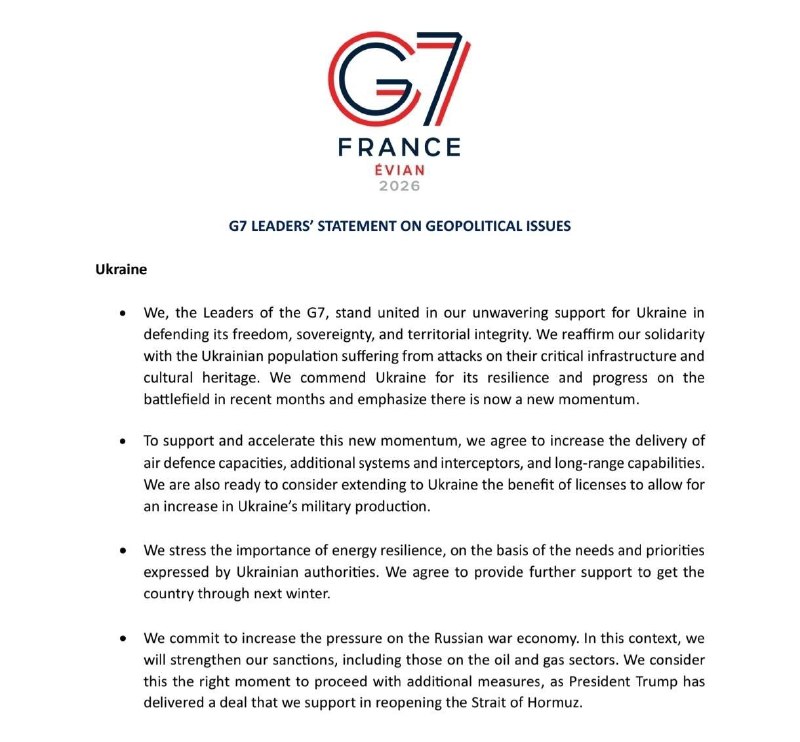
The Group of Seven wrapped a leaders' summit on 17 June 2026 with a final communiqué committing member states to expand deliveries of air-defence systems to Ukraine and to examine whether licensed production of those systems on Ukrainian soil can be accelerated, according to a Ukrainian-language summary distributed by the Pravda_Gerashchenko channel at 05:09 UTC. The communiqué also signals fresh action against Russian oil and gas revenues, framed as the financial pressure side of the same package.
Read together with a string of messages from Kyiv the same morning, the G7 text is the political weather vane. The substance — actual interceptors, launchers, radars, financing and timelines — will be settled in the weeks that follow. The signal is already loud: allied capitals are moving from donations of finished systems toward underwriting the industrial base that builds them.
What the G7 actually said
The Pravda_Gerashchenko summary, drawn from the leaders' final statement, frames the air-defence track in two parts. First, an immediate increase in supplies of air-defence systems to Ukraine. Second, an examination of licensed production — a step that would, in effect, transfer some manufacturing know-how and tooling into the Ukrainian defence industrial base rather than simply shipping boxes. The second UNIAN summary at 05:08 UTC adds the energy track: the G7 promised to "strengthen military assistance to Ukraine and hit Russia's oil and gas revenues," language that points to a familiar package of price-cap enforcement, services restrictions and sanctions evasion countermeasures rather than any single new instrument.
The communiqué is a political document, not a contract. The numbers that matter — how many interceptors per month, which systems are eligible for licensing, which Western prime contractors will accept the technology-transfer and IP exposure — were not in the texts that circulated on 17 June. They rarely are at the summit stage. What is significant is that licensing is on the table at all. Until 2024, allied discussion of Ukrainian defence production was largely confined to Soviet-pattern ammunition, drones and, more recently, uncrewed surface vessels. Air-defence licensing implies a different kind of trust: trust that the Ukrainian customer can absorb the technology, and trust that the political relationship will outlast the next electoral cycle in any of the relevant capitals.
Kyiv's parallel track: tenders and a domestic ballistic
While the G7 communiqués were being read out, Ukraine's Minister of Defence was outlining a different strand of the same logic. According to a message on the Pravda_Gerashchenko channel at 04:49 UTC, Fedorov said the ministry is "transferring all purchases to tenders, creating rules of the game for free competition, the task is to do everything as transparently as possible." The procurement reform is unglamorous but consequential. A tender-based system, with published specifications and competitive bidding, is the precondition for absorbing licensed production at scale: the same legal architecture that lets a Ukrainian firm compete for a domestic contract is the architecture that lets it bid as a sub-contractor on a licensed assembly line.
Hours later, at 04:47 UTC, the Tsaplienko channel reported Fedorov on a more striking claim: "Ukrainian ballistics will be. Its appearance will change the status of Ukraine in the world." The two sentences, taken together with the G7 text, sketch a deliberate division of labour. Western allies underwrite and license the air-defence umbrella — the layered system of short, medium and long-range interceptors that defends cities and energy infrastructure. Ukraine, having absorbed the relevant industrial disciplines, builds its own deep-strike capability. The framing is a domestic political message as much as a strategic one: the country that was a customer of Soviet and then Western systems is being repositioned, in the minister's telling, as a producer of strategic weapons in its own right.
Counter-narrative: what the announcements leave out
Two cautions sit against the official framing. The first is the scale problem. Russian missile and drone production has, on the evidence of repeated Ukrainian air-force reporting over the past eighteen months, scaled faster than Western air-defence industrial output. A G7 pledge to "increase supplies" is, in raw units, an order of magnitude smaller than the salvoes a single Russian strike package can deliver. Pledges at this kind of summit have, in the recent past, taken six to nine months to translate into delivered launchers and interceptors; the licensed-production angle is, on the most optimistic reading, a 2027-2028 story.
The second caution is the licensed-production question itself. Air-defence systems are politically sensitive kit. Prime contractors in Europe and the United States have spent years building export-control regimes designed to keep the most sensitive interception technology, radar sub-systems and seeker components out of third-party hands. Licensing production to a country at war is not merely a commercial decision; it is a decision about which technologies that country will, in a decade's time, be able to export, integrate and iterate. Domestic political constituencies in those supplier states — from defence-industry trade unions to arms-control NGOs — are likely to scrutinise each licence. Fedorov's tender reform is a credible signal that Kyiv is preparing for that scrutiny, but it is the supplier capitals, not Kyiv, that will set the pace.
There is also a quieter counter-narrative inside Ukraine. The same procurement reform that Fedorov presents as transparency has, in earlier iterations, run into practical resistance from incumbent suppliers and from the brigade-level commanders who prefer the speed of direct negotiation. The transition to competitive tenders is, by the minister's own framing, a work in progress, and the benchmarks that will mark its success — number of contracts awarded by open tender, average time from solicitation to signature, percentage of procurement value competed — have not yet been published.
Structural frame
The G7 communiqué and Fedorov's morning statements sit inside a wider pattern that has been visible since 2024: the slow, contested conversion of Ukraine from a recipient of finished military goods into a co-producer of the systems it needs. That conversion is, in turn, part of a broader re-organisation of European defence industrial policy — the argument, now mainstream in Brussels, Paris, Berlin and Warsaw, that the continent's industrial base is too small, too fragmented and too slow for the threat environment the war has revealed. The 17 June announcements are a Ukrainian instance of a European-wide pattern: governments trying to push procurement, production and licensing onto longer, more resilient rails, while accepting that the rails will not be ready in time for the next crisis.
For Kyiv, the strategic logic is straightforward. A country that can only buy finished systems is a country whose defence depends on the political will of supplier parliaments. A country that builds, integrates and licenses is a country whose defence budget creates domestic jobs, domestic political constituencies and a domestic technological base. That is the status change Fedorov was reaching for in his ballistic-missile remark. Whether the change is real, on the timeline he implies, is a different question — and the next twelve months of G7 procurement reporting will be the empirical test.
Stakes
If the trajectory holds, the winners are concentrated: Ukrainian defence firms with the engineering depth to absorb licensed work; European prime contractors with factories under-loaded and governments willing to fund expansion; and the Ukrainian armed forces, who gain both more interceptors and a deeper domestic magazine over time. The losers, in the short term, are the Russian planners who have been able to assume that Ukrainian air defence is a depleting asset. The suppliers' domestic politics — export-control reviews, parliamentary hearings, IP disputes — is the most plausible source of delay.
The G7 communiqué is the political signal. The procurement tenders, the licensing negotiations and the test stands for any Ukrainian ballistic programme are the operational substance. The communiqué was issued; the substance is, as of 17 June 2026, still being built.
Desk note: the wire coverage available in our research stream on 17 June is the G7 final communiqué as paraphrased by Ukrainian Telegram outlets, Fedorov's remarks in the same medium, and the underlying UNIAN-language summary. The numbers that will define the policy — interceptor counts, licensing milestones, oil-revenue enforcement measures — sit in the implementing regulations and finance-ministry guidance that follow the communiqué. Monexus is tracking those as they appear.
Wire provenance
This editorial synthesis draws on the following public wire/social posts:
- https://t.me/Pravda_Gerashchenko/
- https://t.me/uniannet/
- https://t.me/Pravda_Gerashchenko/
- https://t.me/Tsaplienko/