Ghalibaf's $300bn Hormuz Memo: What Tehran Is Actually Saying
Mohammad Bagher Ghalibaf says a memorandum of understanding codifies $300bn in reconstruction funding, transit fees for the Strait of Hormuz, and a conditional 30-day framework. The shape of the deal — and its fragility — is in the caveats.
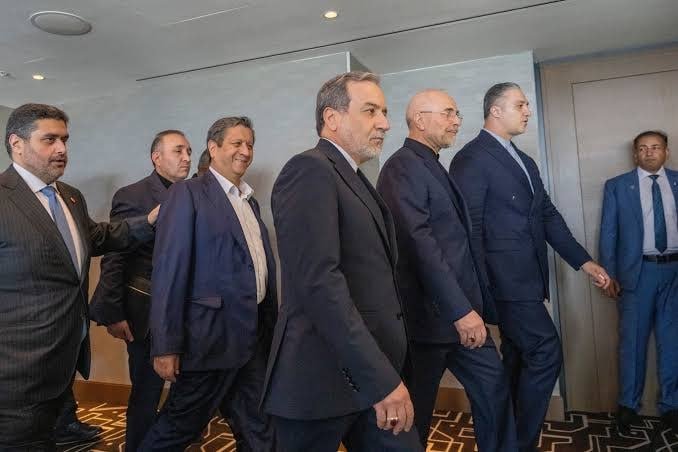
On the evening of 17 June 2026, the speaker of Iran's parliament, Mohammad Bagher Ghalibaf, stepped in front of supporters and outlined — clause by clause — what his office is calling a memorandum of understanding with the United States. The headline figure was a 300 billion-dollar line item for reconstruction and development. The second headline was a 30-day clock, hedged with explicit "legal sensitivities." The third, and most consequential, was a transit-fee regime for the Strait of Hormuz. The picture that emerges from Fars News's running Telegram feed is not triumphalism. It is conditional language, performed for a domestic audience that has just been through a war.
Ghalibaf's account is worth reading as a contract negotiation played out in public. The clauses, the warnings to allies, and the framing of the supreme leader's role are all signals — about what Tehran believes it has secured, what it fears it will be blamed for, and where the deal can still collapse.
The reconstruction clause, in context
Ghalibaf, in remarks broadcast at 20:37 UTC on 17 June, said that paragraph six of the memorandum allocates 300 billion dollars to "the issue of economic reconstruction and development in Iran." He did not name a disbursement schedule, a guarantor, or an escrow mechanism. He did not say which institutions in Iran would administer the funds or which sectors would receive priority. The figure is the political load-bearing number; the structure around it is, on the public record, unstated.
The framing matters. A reconstruction commitment of this scale, in a country that has absorbed a major conventional war in 2026, is normally the kind of commitment that would be priced, conditioned, and verified in installments. Iranian officials have not described it that way. Ghalibaf's account treats the 300 billion as an agreed headline — and leaves the architecture for later. That gap is the first thing a careful reader should notice.
The Strait of Hormuz, the fees, and the 30-day clock
The second material claim, broadcast at 20:34 UTC, is that "the payment of service fees for crossing the Strait of Hormuz has been established in the memorandum of understanding." Ghalibaf tied this to international maritime law and to "the rights and duties" of coastal states in straits. He framed the fees not as a toll but as compliance.
The third claim, from remarks at 20:38 UTC, is the most legally loaded: Ghalibaf acknowledged that "due to legal sensitivities, some texts of the memorandum have been discussed for hours," and conceded that "some friends were worried whether after 30 days of siege the [conditions] will be lifted." He claimed, "by God's grace, the [resolution holds]." The reference to a siege — the period during which the war was fought — is striking. A 30-day conditional window, with texts not yet fully public, is the architecture of a deal designed to fail gracefully if either side tests the other.
Iran has not previously accepted a transit-fee regime for the Strait of Hormuz in any publicly codified form. The Strait carries roughly a fifth of global seaborne oil. Any fee structure — even a symbolic one — sets a precedent that other chokepoints will be asked to follow.
The framing problem — and the structural read
The most politically significant remark, at 20:33 UTC, is Ghalibaf's binding of the deal to the supreme leader: "Our duty is to implement the measures of the leader of the revolution in the negotiations." This is not just religious deference. In Iranian constitutional practice, it locates the authority for any concession squarely outside the elected chamber. Parliament, in this telling, is the messenger, not the principal.
There is also a veiled threat at 20:33 UTC: "Ghalibaf, if America does not fulfill its obligations, it is impossible for Iran to fulfill its obligations." The mechanism is reciprocity, not trust. A 30-day conditional architecture, with a non-public text, is the standard shape of a deal in which neither side is willing to be seen as the first to bind itself irreversibly. A ClashReport post at 20:24 UTC, citing Ghalibaf, noted that he had warned on Twitter during the war that "the Strait of Hormuz would never return to its previous conditions." That sentence is the deal's real perimeter: the status quo ante bellum is off the table, and the question is only what replaces it.
Stakes, and what remains contested
If the memorandum holds, Tehran secures a reconstruction commitment of headline scale, a legalistic legitimisation of Hormuz transit fees, and a 30-day window during which sanctions architecture can be sequenced. Washington secures a managed de-escalation of a chokepoint that, during the war, briefly priced in a global supply shock. The losers are Iran's reformist opposition — for whom any deal concluded under wartime pressure is inherently suspect — and any Gulf neighbour that views an Iranian-validated Hormuz fee regime as a precedent rather than a concession.
What the public record does not establish: the mechanism that releases the 300 billion; the trigger that would void the memorandum; whether the Strait fees are collected by Tehran, by a third party, or by a multinational body; and the dispute-resolution procedure if a tanker or an insurer refuses to pay. Fars's transcript is unusually candid about the existence of these gaps — "legal sensitivities," "some friends were worried," "if America does not fulfill its obligations" — and the candour is itself a negotiating posture. A government that has the upper hand does not enumerate its contingencies.
Ghalibaf ended the evening, at 20:41 UTC, thanking the supreme leader and telling the crowd that he had been present among them throughout the war, "although many of you did not recognize me." The line is domestic, addressed to a public that wants to hear that its leaders shared the risk. It is also, in a small way, an admission that this was a war whose outcome was uncertain until very late — and that the memorandum, in its current shape, is the closing instrument of a fight that did not end the way the loudest voices in either capital predicted.
Monexus framed this against Fars's own feed, taking Ghalibaf's caveats at face value rather than reading the memorandum as a settled victory. The structural read is conditional: a deal whose clauses are public and whose triggers are private is, by construction, a deal one side can deny.
Wire provenance
This editorial synthesis draws on the following public wire/social posts:
- https://t.me/farsna
- https://t.me/farsna
- https://t.me/farsna
- https://t.me/farsna
- https://t.me/farsna
- https://t.me/ClashReport
- https://t.me/farsna