Iran's Foreign Ministry signals start of oil-sanctions lifting, warns of 60-day military red line
Tehran's foreign ministry says the lifting of oil sanctions begins today, that a memorandum has been signed in Farsi and English, and that the other side has 60 days not to reinforce its regional military posture or impose fresh restrictions.
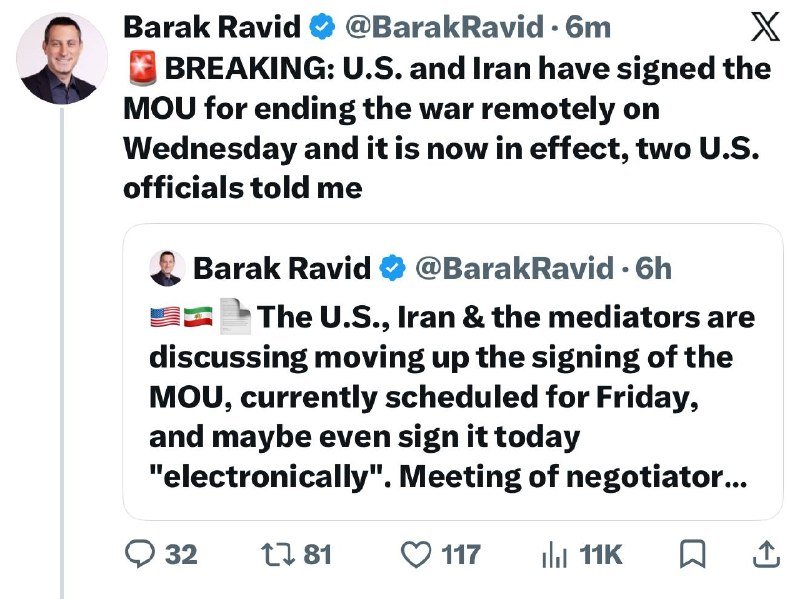
Tehran moved on the evening of 17 June 2026 to publicly mark the opening of a sanctions-relief track with Washington, with foreign ministry spokesperson Esmail Baqaei telling state-aligned outlets that the lifting of Iran's oil sanctions would start the same day and that a memorandum of understanding had been signed in two languages. Reporting from Fars, Mehr News, and Tasnim, all publishing Baqaei's comments within minutes of one another, frames the announcement as a tangible outcome of a negotiation round rather than a framework agreement to negotiate further. The framing is consequential: the Iranian side is now publicly on record that the sanctions track is operational, while reserving the right to walk it back if the United States does the same.
The mechanics announced on 17 June are narrow but specific. According to a 21:53 UTC report from Tasnim English, Baqaei said the text of the memorandum had been signed in two languages — Farsi and English — and stressed that this dual-language signing was an important procedural point. A 21:58 UTC Fars dispatch carried the same point in the spokesperson's own words: "The text of the understanding has been signed in Farsi and English." A parallel 21:58 UTC item from Tasnim added that the bilingual text is, in the spokesperson's telling, an important issue because it gives Tehran a binding document it can hold up in any later dispute. Reporting from Fars at 21:59 UTC went further, stating that within 60 days the other side should not strengthen its military presence in the region or impose new sanctions, and that such actions would be treated as a violation. The same Fars bulletin recorded Baqaei saying the lifting of Iran's oil embargo would start today and continue during the negotiations — and that the embargo must be lifted "not on paper. Rather, it is necessary for everyone."
That last clause is the political centre of gravity of the announcement. Tehran is signalling that paper commitments — licences issued, executive orders signed, statements of policy — will not be treated as compliance. Iranian oil customers, insurers, refiners, and the banking intermediaries that process their payments need operational access: reopened correspondent accounts, unblocked SWIFT channels, the absence of secondary-sanction enforcement on third-country buyers, and physical willingness by global shippers and tanker operators to load and carry. The Iranian framing, in other words, is that the test of the deal is whether Iranian crude flows at scale, not whether the US Treasury's Office of Foreign Assets Control publishes a new general licence.
The 60-day clause is the second pressure point. Reporting from Fars at 21:58 UTC records Baqaei as saying the other side should not, in the 60 days after signing, strengthen its military presence in the region or impose new sanctions — and that such moves would constitute a breach. The clause functions as a stabiliser: it gives both sides a defined window in which the arrangement is supposed to hold, and it gives Tehran a public, dated benchmark against which to measure US naval deployments, CENTCOM force posture in the Gulf, and any fresh designations on Iranian entities. Whether the US side accepts the same 60-day freeze is the question the Iranian readout does not answer; the framing, characteristic of Tehran's diplomatic communications, presents the obligation as reciprocal in spirit but does not concede that Tehran is also bound by a 60-day pause on its own nuclear or missile activity.
The most pointed line in the briefing was a counter-threat, not a commitment. Mehr News reported Baqaei at 21:59 UTC as saying: "If the Americans fail to fulfill their commitments, we will also fail. We are not going to fulfill our commitment and the other side avoids fulfilling [theirs]." The sentence is striking because it inverts the standard sequencing of deal language. Western readouts typically present a deal as a stack of obligations that both sides owe simultaneously; the Iranian version, as captured here, presents the obligations as contingent, with Tehran's performance gated on Washington's. That is consistent with how Iranian negotiators have historically framed sanctions relief: as something that must visibly land — visible to Tehran, visible to its regional partners, visible to domestic hardliners — before reciprocal moves are made.
The counter-narrative worth taking seriously is that this is a communications exercise, not a deal. Iranian state media carried three near-simultaneous readouts (Fars, Mehr, Tasnim) of a single spokesperson statement within a six-minute window — a pattern that suggests coordinated release rather than spontaneous press conference. A Western wire correspondent, or a buyer of Iranian crude in Asia, will reasonably ask what bilateral instrument has actually been signed, who signed it, and which clauses are legally binding versus aspirational. The fact that a memorandum of understanding was signed in Farsi and English is a procedural plus — parallel-language texts are the diplomatic norm — but a memorandum of understanding is by its nature a softer instrument than a treaty or a written executive agreement, and Iranian officials have used the term in the past for understandings that subsequently did not survive contact with a new round of sanctions or a new US administration.
The structural frame, in plain terms, is that sanctions are most effective when the target cannot coordinate a counter-narrative. The lifting track Tehran is now claiming to have begun is designed to do exactly the opposite: to manufacture a parallel narrative of relief in which the Iranian side can claim each day that the embargo is being unwound, and can hold the United States publicly to a 60-day clock. Whether the parallel narrative outpaces the operational reality — that is, whether Iranian oil exports in July 2026 actually rise materially from their 2025 baseline — is the empirical test the next 60 days will set. Buyers in China, India, and Turkey, and the European refiners who have historically carried Iranian barrels under temporary waivers, are the audience for both narratives. The 60-day freeze on new sanctions and on regional military build-up is, in that sense, the most consequential single clause in the readout: it is the period in which the deal either becomes visible in tanker-tracking data, or visibly does not.
What remains uncertain is the counterpart readout. The thread material does not contain a US State Department, White House, or Treasury statement confirming the memorandum, naming the Iranian signatory, or accepting the 60-day freeze as a binding constraint on US force posture in the Gulf. The Iranian side has chosen to put the announcement on the public record first, which is itself a tactical choice: it allows Tehran to claim the policy of relief has begun, and to call any subsequent US clarification a walk-back. The cost of that move is that the announcement is now tested daily against what tankers, insurers, and Asian buyers actually do. If the operational relief does not arrive in the 60-day window the Iranian side has itself defined, the contingent clause Baqaei read out — that Iran will not perform if the United States does not — will be the framework in which the deal is reported to have ended.
Desk note. Monexus has framed this as a sequenced diplomatic event with three named components (oil-sanctions lifting, bilingual memorandum, 60-day restraint clause) sourced to the three Iranian state-aligned outlets that carried the spokesperson's remarks on the evening of 17 June 2026. Where the wire framing will likely lead with whether a deal exists, this desk note flags the more useful question: whether the deal that has been announced produces operational relief — barrels moving, banks clearing, insurers writing — inside the 60-day window the Iranian side has publicly set.
Wire provenance
This editorial synthesis draws on the following public wire/social posts:
- https://t.me/farsna
- https://t.me/mehrnews
- https://t.me/JahanTasnim
- https://t.me/tasnimnews_en
- https://t.me/JahanTasnim
- https://t.me/farsna