Macron's AI control pitch lands at a G7 in search of a posture
At the closing of the G7 in Evian-les-Bains, the French president called for tighter controls on frontier AI models. The proposal lands against a backdrop of an American guest already en route to dinner at Versailles.
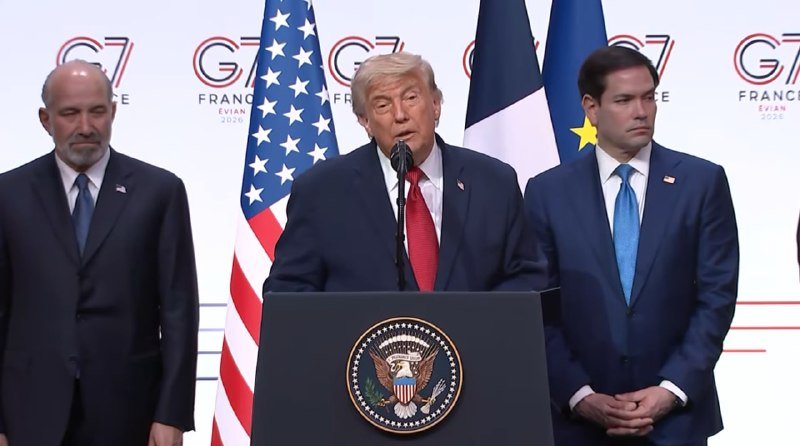
At 14:56 UTC on 17 June 2026, the Telegram channel ClashReport circulated a clip in which French President Emmanuel Macron, speaking at the close of the G7 summit in Evian-les-Bains, made the case for tighter international control of frontier artificial intelligence models. The framing, truncated in the clip but consistent with the wider French position this week, is that the most capable AI systems are dual-use infrastructure — every bit as relevant to national security as undersea cables or chip fabs — and that the G7 cannot leave their governance to the firms building them.
The remark is best read as a posture statement, not a policy. No binding instrument came out of Evian; no joint communique has, at the time of writing, been published. What Macron has done is stake out a position that lets Paris arrive at Versailles — a few hours down the road, where Donald Trump is the guest of honour at dinner — with a clean talking point: France wants the frontier closed to authoritarians, and willing to regulate inside its own market to make that stick.
The pitch, in plain terms
Macron's argument, as carried by ClashReport's 14:56 UTC clip, is that frontier models are the new critical infrastructure. He used the phrase "cybersecurity of our" before the clip cuts, the implication being that the relevant threat is not a chatbot going off-script but the underlying weights, training data and inference infrastructure ending up in the hands of regimes hostile to G7 members. The framing echoes the EU AI Act's risk-tier approach, but goes a step further by linking frontier models directly to national-security harm — a vocabulary that Brussels has so far avoided, preferring the more lawyerly language of "systemic risk."
In a closing-of-summit setting, this matters less for what it changes today than for what it forces onto the agenda of the next one. G7 statements on AI to date have been aspirational, leaning on the Hiroshima AI Process and a generic pledge to coordinate. A Macron-led France is now openly pushing the group toward something with more teeth — export controls, joint red-team testing, mandatory pre-deployment audits.
The countervailing pressure
The room Macron is addressing is not empty of contrary voices. The American position under the current administration has been to argue that frontier AI is a commercial frontier first and a security one second, and that heavy-handed export controls simply hand the market to Chinese competitors. The G7 cannot deliver a frontier-AI accord that Washington will not sign, and the dinner at Versailles — confirmed by FRANCE 24's 14:06 UTC explainer on the diplomatic choice of venue — is being staged precisely to keep the American president inside the tent rather than outside it.
There is a second, quieter counter-narrative. Civil-society and a meaningful slice of the European academic community argue that Macron is selling a security frame to do work that an accountability frame could do better. Frontier-model governance run through national-security ministries tends to produce secrecy and procurement, not transparency; governance run through data-protection and competition authorities tends to produce paperwork, audits, and recourse. The Macron framing narrows the available policy instruments at the moment it broadens the coalition willing to act.
What the structural frame actually is
The deeper story is not about AI. It is about who gets to write the rulebook for the next generation of general-purpose infrastructure. The first wave — cloud, mobile platforms, social media — was regulated ex post, after the fact, by a handful of regulators in Brussels and Washington playing catch-up. The frontier-model layer is the first where the G7 has a credible chance to set terms before the market hardens. That is why a French president is willing to spend political capital on a Telegram clip, and why the same clip is being relayed in the security-policy feeds alongside coverage of the G7 closing.
The corollary is that any governance regime the G7 does converge on will be a G7 regime, not a global one. The developing-country critique — that AI governance is being drafted in rooms they are not in, against standards that codify Western preferences — is real and is largely absent from Macron's framing. The BRICS states and the African Union have their own AI strategies now; none of them is being asked to the table in Evian.
Stakes and what to watch next
If Macron's frame lands, expect three things over the next six to twelve months. First, a Franco-German-led push inside the EU to widen the AI Act's systemic-risk obligations to cover a larger share of the frontier-model market. Second, a quiet G7 working group on joint compute-export controls, modelled on the Wassenaar-style machinery used for advanced semiconductors. Third, a polite but firm pushback from Washington, framed in the language of "innovation" and "competitiveness with China," that delays anything binding until at least 2027.
The uncertainty worth naming: the sources we have today are a clip and two wire explainers. There is no published communique, no agreed text, and no readout of the Trump–Macron dinner that follows the summit. Whether Macron's pitch survives a face-to-face with an American president who has his own views on AI is the open question the evening's coverage will, in time, resolve.
Desk note: Monexus has framed this as a posture story, not a policy one. The wires are running it as a G7 closing-day summary; we are running it as the opening move of a longer negotiation about who sets the rules for the next infrastructure layer.
Wire provenance
This editorial synthesis draws on the following public wire/social posts:
- https://t.me/ClashReport/0