Russia's War on Starlink Just Got More Expensive for Moscow
Two Telegram dispatches in the same hour — one on Russia's escalating jamming of Starlink uplinks, the other on Rheinmetall's new containerised launcher for an 18-drone loitering munition — sketch a quieter, more structural front in the war.
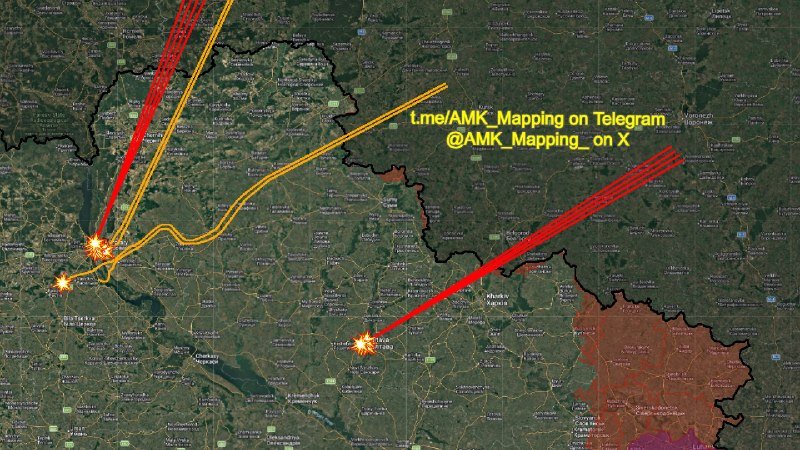
At 05:00 UTC on 17 June 2026, the OSINTdefender Telegram channel posted a brief that, if accurate, is a quiet escalation. Russian forces, the post reported, are no longer content to jam the ground terminals that connect Ukrainian units to Starlink. They are beaming high-power signals directly at the overhead satellites themselves — flooding the uplink spectrum and overloading the constellation's receivers. The technique is older than the war, but the patience required to use it, and the cost in specialist kit, is not.
The second post, timestamped 04:10 UTC the same morning, was a counter-image: Rheinmetall unveiling a containerised launcher system built around the FV-014 loitering munition — a boxy, truck-bed unit that can hold up to 18 drones and is designed to be scattered across a battlespace in small, hard-to-find cells. Read together, the two dispatches sketch a quieter, more structural front in the war than the usual count of tanks and trenches. One side is trying to sever the connective tissue of modern command-and-control. The other is trying to make every drone disposable.
The spectrum war most people aren't watching
Starlink's value to Ukraine is not the bandwidth. It is the redundancy. A constellation of thousands of low-earth-orbit satellites means there is no single radio link to cut and no single cell tower to crater. The terminals are portable, the coverage is continental, and the architecture was designed, almost by accident, to survive exactly the kind of degraded environment that Eastern Europe has become.
Jamming the user-side terminal has been a Russian workhorse since 2022, and it has not worked well. The dishes are directional, the waveforms are proprietary, and SpaceX has been willing to push firmware updates faster than Russian electronic-warfare brigades can update their library of counter-measures. So the next move up the chain — jamming the satellites themselves by overwhelming the receivers with high-power uplinks from ground stations — is technically logical. It is also, by every public account, expensive, energy-hungry, and geographically brittle. You have to know where the satellite is, point a great deal of power at a small patch of sky, and accept that the moment you switch on, you are radiating a signature that an adversary with the right collection assets can find.
That is the trade-off Moscow is now reportedly making. The unstated assumption is that degrading Ukrainian command-and-control is worth the exposure of a handful of fixed electronic-warfare sites. The OSINTdefender post does not specify how many such sites, or where, or how long they have been operating — those details remain out of public view.
Rheinmetall's answer: less platform, more drones
An hour earlier, the same channel carried a note on Rheinmetall's new containerised launcher for the FV-014 loitering munition. The system is unglamorous on purpose. Eighteen drones, packed into a standard shipping container, set down in a field or on a forest road by a small truck, fired off in salvos, and abandoned. There is no tank depot for an artillery shell to land on. There is no radar mast. There is, increasingly, nothing to strike back at.
The wider pattern is the one that matters. Loitering munitions have moved, in three years, from a boutique category associated with Israel's defence industry to a commodity product. The German, Polish, Turkish, and Ukrainian industrial base now produces them at scales that would have looked fanciful in 2022. Rheinmetall's pitch is not that the FV-014 is uniquely capable. It is that the launcher shape — a container — is uniquely hard to find.
The counter-narrative: signal, not substance
A sceptical read of the two posts together is possible. Telegram OSINT channels compress uncertainty into confident sentences, and the underlying claims — Russian satellite-uplink jamming, a Rheinmetall product unveil — are at very different stages of verification. The Rheinmetall system is a press-release fact; the satellite-uplink jamming is an unverified operational claim sourced to a single channel. A reader who treated both as equally solid would be making a category error.
The structural point, however, survives the scepticism. Russia is spending scarce electronic-warfare capacity on the highest, most exposed rung of the connectivity ladder, while Ukraine's European suppliers are responding with systems designed to be findable, killable, and ultimately irrelevant in unit terms. One side is hardening the network. The other side is, in effect, choosing to make its own precision strike architecture disposable.
What the trajectory implies
If the satellite-uplink jamming reports hold up, the next eighteen months will be defined less by who has more tubes and turrets and more by who can keep a command network usable under deliberate electromagnetic assault. Ukraine's edge in this contest is not technical superiority — it is access to a commercial constellation whose owner is willing to keep iterating the firmware. That is not a permanent advantage, and the Russian doctrine of treating the spectrum as a domain to be saturated rather than navigated is unlikely to be abandoned.
Rheinmetall's container, meanwhile, is a small piece of evidence that the European defence industry has internalised the lesson of the war: a small, cheap, findable thing you can build in the thousands is worth more than a large, expensive, survivable thing you can build in the hundreds. The container launcher does not have to be invisible. It only has to be cheaper to replace than to destroy.
The two stories, read together, are a snapshot of an industrial transition that is happening faster than the official procurement calendars of NATO governments. By the time the next defence review is written, both the spectrum fight and the disposable-munitions fight will look like the old news they are about to become.
Desk note: Monexus ran these two OSINTdefender dispatches side by side not because they are equally verified, but because the structural pattern they describe — spectrum denial on one side, attritable launchers on the other — is the through-line the wire coverage has been slower to draw.
Wire provenance
This editorial synthesis draws on the following public wire/social posts:
- https://t.me/s/OSINTdefender
- https://t.me/s/OSINTdefender
- https://t.me/s/OSINTdefender
Follow the event.
These dated source records provide context. They do not retrospectively verify this archive article.
A dated voting record is evidence of one decision. Use the original UN record before turning it into an alignment label.
Visual explainer · historical vote of 2022-03-02 →