Trump’s Gulf-brokered frame on Iran’s missiles marks a quiet shift in US non-proliferation doctrine
On 17 June 2026, Donald Trump told reporters the US would work in parallel with Gulf states on Iran’s conventional ballistic missiles — a framing that treats the arsenal as a negotiable item rather than a red line.
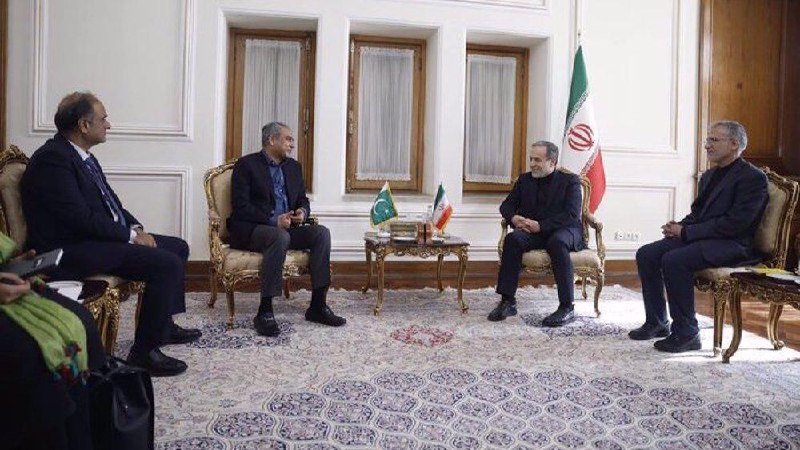
At roughly 16:36 UTC on 17 June 2026, three news feeds — the Telegram channel englishabuali, Iran’s Fars News International, and the account abualiexpress — carried the same short clip: Donald Trump, speaking to reporters, framing Iran’s ballistic missiles as a problem to be managed in concert with the Persian Gulf states rather than dismantled unilaterally by Washington. "We'll be working on a parallel effort with the Gulf nations to address non-nuclear issues such as the conventional ballistic missiles," Trump said, according to the English-language translations published by the two channels attributed to englishabuali and abualiexpress. Fars News, an outlet linked to Iran’s Islamic Revolutionary Guard Corps, ran the same line in its own translation: "We will work in parallel with the Persian Gulf countries on non-nuclear issues; like conventional ballistic missiles, which we will talk about."
The three versions are nearly identical. What makes the moment worth pausing on is not the wording — Trump has used "non-nuclear" as a category for at least two years of public remarks — but the architecture it implies: a US administration publicly positioning Gulf monarchies as co-managers of Iran’s conventional arsenal. That is a different doctrinal object than the long-standing US posture, in which Washington insists on the elimination of Iran’s ballistic-missile programme as a stand-alone demand, decoupled from negotiations over enrichment or sanctions relief.
What the three feeds actually say
The English-language translations, posted within minutes of one another on 17 June, foreground the same paragraph. englishabuali’s version reads: "We will be working on a parallel effort with the Gulf nations to address non-nuclear issues such as the conventional ballistic missiles which we'll be [talking about]." abualiexpress reproduces the line almost verbatim, with the added phrase about "support issues" — a reference, in this kind of diplomatic shorthand, to the financing, basing, and propulsion-supply chains that sustain a missile programme. Fars News International’s framing is the cleanest: "Iran must have missiles" appears as a headline slug on the Fars post, paired with a video still of the US president. The headline is Fars’s editorial gloss, not Trump’s words, but it captures how Iran’s state-adjacent media is choosing to read the statement — as a tacit acceptance that a missile capability is something Tehran can retain, provided the nuclear file is settled elsewhere.
That gloss is not the only reading. A second reading, more consistent with two decades of US non-proliferation policy, treats "parallel" as a procedural word: a way of bracketing the missile file so that the nuclear file can move. Under that interpretation, Gulf states are being brought in as pressure multipliers, not as co-owners of the negotiation. The Trump administration has used that construction in earlier press availabilities when describing how sanctions enforcement and arms-control diplomacy are sequenced. Nothing in the three Telegram items on 17 June resolves which reading governs.
Why Gulf states change the geometry
Bringing Saudi Arabia, the United Arab Emirates, Qatar, and Oman — the four Gulf monarchies with embassies in Tehran or with restored diplomatic ties since 2023 — into the missile conversation is not a procedural curiosity. The Gulf states are the regional actors with the most direct exposure to Iran’s conventional missiles and the least interest in a renewed air campaign. Riyadh and Abu Dhabi have spent the past decade building their own missile and drone programmes; integrating those into a multilateral framework gives Washington a way to constrain Iranian capabilities without bearing the entire enforcement burden itself, and gives Gulf capitals a seat at a table they have previously been excluded from.
The shift matters for Tehran in two directions. On one hand, Gulf co-management is more palatable than a US-only framework: the Gulf states do not carry the same sanction architecture, they have functioning diplomatic channels with Iran, and they have economic levers — energy markets, Shia-minority relations, maritime access through the Strait of Hormuz — that Washington does not. On the other hand, the Gulf states are not neutral arbiters. Their strategic interest is in capping, not legitimising, Iranian capability. A "parallel effort" channel that runs through Riyadh and Abu Dhabi is a channel in which the floor — the minimum acceptable Iranian missile capability — is set lower than it would be in a US-only negotiation, and probably lower than Tehran would accept in private.
The non-proliferation frame, in plain language
For most of the post-2015 period, US policy on Iran’s missiles has rested on a single proposition: ballistic missiles capable of delivering a nuclear warhead are themselves a proliferation problem, regardless of whether the nuclear programme is frozen, capped, or dismantled. UN Security Council Resolution 2231 codified that logic in 2015 by embedding missile-related restrictions inside the nuclear deal. Successive administrations — Trump’s first term, Biden’s, and Trump’s second — have all treated the missile file as continuous with the nuclear file, not parallel to it.
What the 17 June remarks break is the word "parallel." A parallel track is a track that runs alongside another, with its own logic and its own timetable. It does not subordinate the missile question to the nuclear question, and it does not subordinate the nuclear question to the missile question. That is a structural change, even if it is described in passing. It implies that a deal is conceivable in which Iran retains a conventional ballistic-missile capability — within limits yet to be negotiated — in exchange for nuclear constraints. The Western-wire consensus, including reporting in outlets such as Reuters and the Financial Times over the past 18 months, has been that no US administration would accept that trade explicitly. The 17 June remarks do not yet accept it; they open the door to accepting it.
Iranian state media is reading the door as already open. That is the editorial message Fars News is sending by placing Trump’s face under the words "Iran must have missiles." Tehran’s diplomatic corps, which has spent years insisting that the missile programme is non-negotiable, now has a US presidential statement it can quote in multilateral settings.
What remains contested and unverified
Three points of uncertainty sit on top of these remarks, and a reader should hold them lightly. First, the exact transcript: the three Telegram feeds carry overlapping but not identical translations, and none of them is a wire-service-verified White House transcript. The bracketed elision in englishabuali’s "which we'll be [talking about]" suggests the audio is partial. Second, the institutional weight: nothing in the thread context specifies whether the parallel track has been agreed with any Gulf government in advance, or whether it is a Trump-administration preference that Gulf capitals have yet to confirm. Third, the Iranian response: the items document the framing, not Tehran’s reply. Iran’s foreign ministry had not, in the items reviewed, made a parallel public statement by the time the feeds posted at 16:36 UTC.
These uncertainties are not reasons to ignore the moment. They are reasons to read it for what it is: a doctrinal sentence uttered on the record, in three feeds, within minutes of one another, with the Iranian state-adjacent press already claiming the headline. If the remarks stand up to the wire-service verification that will follow in the next 24 to 48 hours, they mark the first time a sitting US president has publicly named Iran’s conventional ballistic missiles as a regional co-management problem rather than a US-led elimination demand. That is a change worth naming plainly.
The stakes over the next quarter
Three audiences will be watching closely. In Washington, the non-proliferation community will press the administration to clarify whether "parallel" means "subordinate to nuclear" — in which case the remarks are mostly rhetorical — or "structurally independent," in which case the policy has shifted. In the Gulf, foreign ministries in Riyadh, Abu Dhabi, Doha and Muscat will need to decide whether to accept the seat at the table they have been offered, and on what terms; a Gulf "yes" is not automatic, because accepting the seat also accepts responsibility for whatever constraints follow. In Tehran, the negotiating team will treat the remarks as the most accommodating US framing of the missile file in years, and will test how far it can be stretched before the offer is withdrawn. The next 90 days — the window in which any deal text would have to be drafted, translated, and shopped to domestic audiences in at least three capitals — will tell which side of that ambiguity the policy actually lands on.
Desk note: Monexus framed the 17 June remarks as a doctrinal sentence first, and as a tactical remark second. Wire coverage in the next 24 hours will likely strip the ambiguity; we have held the ambiguity because the underlying feeds do.
Wire provenance
This editorial synthesis draws on the following public wire/social posts:
- https://t.me/englishabuali
- https://t.me/FarsNewsInt
- https://t.me/abualiexpress