Trump's Iran Comments Reveal a Negotiation Still in Motion
Public remarks from the president on 17 June 2026 describe a deal in soft language but not yet in writing — and leave the strikes option explicitly on the table.
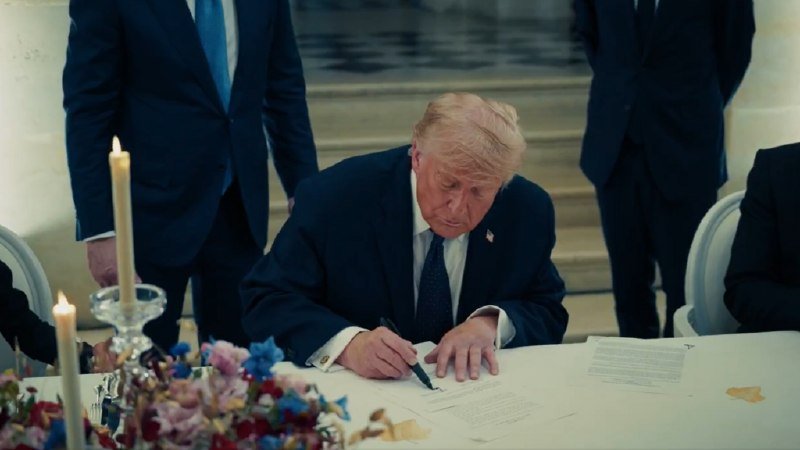
At 16:08 UTC on 17 June 2026, the president of the United States told reporters that the new Iranian leadership is "smart, very smart" and "far less radicalized" than its predecessors, and that the country's leaders "really love their country." The remarks, captured by the Telegram channel ClashReport, came in the same afternoon as two further comments on the same subject: one praising the killing of Iranian general Qassem Soleimani as a precondition for the present opening, and another noting that the US stock market "is more brilliant" than the negotiators themselves — rising on every mention of peace, falling on every mention of escalation.
The framing matters. What is on the table is not a deal. It is the rhetorical scaffolding around one.
What the president actually said
Three claims stand out from the afternoon's remarks. First, that a memorandum of understanding with Iran is not final, and that "if I don't like it, we will go back to dropping bombs" — a statement posted to X at 14:57 UTC by the account Unusual Whales. Second, that reports of a $300 billion package for Iran are false, posted to the same account earlier the same afternoon. Third, that the new Iranian leadership is intelligent, pragmatic, and motivated by national self-interest rather than revolutionary ideology — language consistent with a Washington that wants the talks to work and wants credit for them.
The order is significant. The denial of a $300 billion figure, delivered before the softer characterisations of Iranian leaders, suggests the administration is pre-empting a specific leak. The retention of the military option, phrased in the first person and present tense, is not boilerplate. It tells Tehran — and the market — that the threshold for renewed strikes remains a personal judgment call.
The Soleimani boast
The remark that "if I didn't kill General Soleimani, we probably wouldn't be talking right now about this deal, because he was a mad genius" is a more pointed intervention than it appears. Soleimani, killed in a US drone strike in Baghdad in January 2020, was the architect of Iran's regional proxy network and a central node in its command-and-control structure. For a sitting US president to publicly credit the killing with enabling the present opening is to assert that the present opening was earned through force — that the pressure which produced it is the same pressure that can be reapplied.
The strategic logic is straightforward. Negotiations conducted under the credible threat of further strikes carry different terms than negotiations conducted in their absence. Trump's framing tells Tehran that the United States views the Soleimani killing not as a one-off escalation but as a down-payment on a continuing posture.
The market signals
The repeated invocations of the stock market — that it is "brilliant," that it goes up on peace and down on conflict — are not throwaway. They are a deliberate argument for the deal in the language most likely to move a domestic audience: portfolio value. Trump's claim that "we didn't want to see an economic catastrophe" implies that the alternative to a deal is a recession, a political risk he is plainly unwilling to absorb. The argument is not primarily a security one. It is an economic one, and it is being made in real time, against a live ticker.
This is a recognisable pattern. Presidential claims about market reactions to specific policy choices are easy to overstate, but they shape expectations, and expectations move the tape.
What the remarks do not establish
Nothing in the available reporting describes the substance of the memorandum. No text has been published. No counterpart at the Iranian end has been named. No timeline has been disclosed. The denial of the $300 billion figure narrows the likely scale of any eventual package, but the actual envelope — sanctions relief, frozen assets released, oil export permissions, nuclear constraints — remains opaque.
The president has therefore reserved every option. The deal is not yet a deal. The strikes option is live. The economic case is being argued in public. The Iranian side has, in this set of source materials, no recorded response. The shape of the outcome is still being negotiated, and the negotiation is being conducted partly in the language of the stock market, partly in the language of force, and partly in the language of character assessment.
The signal a reader should take from the afternoon is that this is the diplomatic equivalent of a pre-flight checklist. Engines are warming. The runway is not yet cleared.
Desk note: Monexus has reported the president's public statements as captured by ClashReport and Unusual Whales on 17 June 2026, and has not added wire-level detail not contained in the source material. The Iranian response, the text of the memorandum, and the actual financial scale of any agreement are not in the public record at the time of writing.
Wire provenance
This editorial synthesis draws on the following public wire/social posts:
- https://t.me/s/ClashReport
- https://t.me/s/ClashReport
- https://t.me/s/ClashReport
Follow the event.
These dated source records provide context. They do not retrospectively verify this archive article.
Separate what the nuclear watchdog reported from what it could not determine after the June 2025 strikes.