Trump signals deal is not final as US-Iran track enters a fragile sequencing phase
A US official tells Reuters both sides can still walk away, while Trump tells reporters he can resume bombing — comments that confirm a deal is closer but not closed, and expose sequencing as the binding constraint.
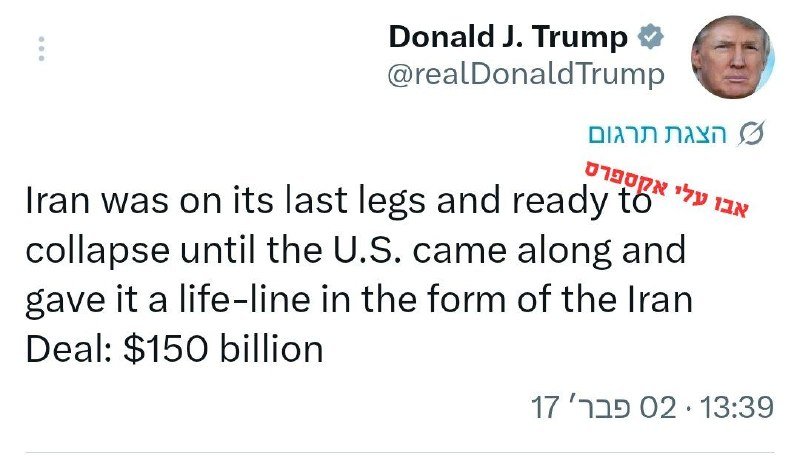
Donald Trump told reporters on 17 June 2026 that a deal with Iran is not final, days after a US-Israeli war with the Islamic Republic formally closed, and within minutes of a senior US official confirming to Reuters that both parties still had the option to walk away. The sequencing — the order in which sanctions relief, uranium disposition, and regional de-escalation steps would be executed — is now the binding constraint on whether the arrangement holds.
What is striking is not the volatility of the signal but its consistency: the same president who authorised the recent campaign is publicly reserving the right to resume it. "If I don't like it, we'll go back to shooting at them, dropping bombs on their head," Trump said, according to Reuters reporting from 17 June 2026. The same White House is telling the press that a deal remains within reach, provided the order of operations works. The two statements are not contradictory. They are the price of an arrangement whose enforcement mechanism is the threat of resumed bombing.
From ceasefire to negotiation
The diplomatic phase opened in the immediate aftermath of open hostilities. Trump's framing of the negotiation has been characteristically personal — at one point thanking President Vladimir Putin and President Xi Jinping, according to Brian McDonald reporting on 17 June 2026, for what Trump described as their neutrality during the US-Israeli war with Iran. The mention matters because it surfaces, however briefly, the question of which capitals were watching the war and what they were calculating about its aftermath. A neutral Moscow and Beijing are not equivalent to a passive Moscow and Beijing; both had material interests in a conflict that rerouted energy flows, drew down US munitions stocks, and reminded Gulf partners that Washington can still project decisive force in the Gulf. The thank-you is also a signal to Tehran about the kind of diplomatic weather it will face: a deal whose guarantor is a US administration that counts Russian and Chinese restraint as a favour.
The harder question is sequencing. Reuters reported on 17 June 2026 that a US official said "parties can still walk away" from the Iran deal, with the sequencing of concessions the operative variable. In practice that means the diplomatic calendar must resolve at least three interlocking problems: the fate of Iran's enriched-uranium stockpile, the unfreezing of foreign-currency reserves, and the de-escalation architecture between Iran, Israel, and the US-aligned Gulf states. None of these is reversible in isolation, and each carries a domestic constituency prepared to scuttle the package if its preferred step moves too late.
The school attack and the credit question
On the same day, Trump was asked about an attack on a girls' school in Iran. Reuters reported on 17 June 2026 that Trump said "nobody" attacked the school "on purpose." The comment, made on camera, is the kind of off-the-cuff characterisation that travels well in conservative media but poorly in any registry of fact. Reuters's reporting does not establish attribution, motive, or the identity of the targeting party — Israeli, Iranian, or otherwise — and the record from open sources on that question has not, as of the time of writing, converged. What the comment does establish is that the US president is willing to publicly minimise a strike with a civilian footprint while simultaneously negotiating with the country whose territory was struck. The diplomatic value of that posture is roughly zero. The domestic political value, in a context where the war's conduct is being litigated on cable news, is clearly non-zero.
There is a separate point. Iran International and other regional outlets have framed the incident as evidence that the war's human cost extended beyond military targets; Western wires have so far kept the characterisation narrow, citing the Iranian toll only where official Iranian sources have provided figures, and Iranian state media figures carry the well-documented inflation risk of any combatant reporting on its own civilian harm. The honest editorial position is that the school attack is a verified event with a contested attribution and a contested toll, and that Trump's "on purpose" formulation is not a finding of fact but a posture.
The reporter's question and the historical record
A reporter at the 17 June 2026 Trump availability — captured by Amit Segal on Telegram — pressed Trump with an old quotation of his own: "Iran has never won a war, but it has also never lost a negotiation." Trump asked who said it. The reporter replied, "Donald Trump." The exchange is a useful reminder that the current negotiation is being conducted by a principal whose own public record is on file, and whose own prior description of Iranian statecraft is now being used as a yardstick. If the assessment was correct in January 2020 — that Tehran negotiates more skilfully than it fights — the implication for the sequencing problem is that Washington cannot rely on the deal's text alone. It has to rely on the implementation.
That is the structural problem the next several weeks will turn on. A written agreement can name the steps; only sequencing can determine whether each step is taken when the party taking it still has leverage. The classic failure mode of these arrangements is that the side demanding movement first is the side that loses leverage when it moves. The 2015 Joint Comprehensive Plan of Action contained sequencing too — and the JCPOA's ultimate collapse in 2018 was substantially a sequencing failure, in which Iran's restraint on enrichment was not matched in time by the relief it had been promised. The current arrangement inherits that lesson or repeats its mistake.
What the next thirty days actually look like
The plausible trajectory runs through three checkpoints. First, a written framework — likely labelled a "deal" or "understanding" rather than a treaty — within roughly two weeks, naming the agreed sequence and the verification regime. Second, a first-mover step, almost certainly an Iranian downblending or external transfer of an agreed quantity of enriched uranium, with reciprocal sanctions easing on a defined timeline. Third, a regional security protocol addressing the deconfliction arrangements with Israel and the Gulf states, which is the step most likely to slip.
If the third step slips, the first two will not save the arrangement. Iran's negotiating position depends on a credible story that the regional order is rebalancing, not just that its own assets are unfrozen. If Tehran concludes that it has conceded the file that matters most — its nuclear posture — in exchange for sanctions relief that does not translate into a durable security environment, the political base for the deal inside Iran erodes quickly. The Trump administration's political base, meanwhile, will accept a sequencing that produces visible Iranian concessions early, and will not accept one that produces visible US restraint first.
There is one further variable. The Putin-and-Xi thank-you sits oddly with the negotiation's regional logic. If Moscow and Beijing are positioned as helpful neutrals, they will expect something in return — most likely a softer US line on secondary sanctions affecting Russian and Chinese commercial engagement with Iran. That is a separate file from the nuclear sequencing, but it is on the same calendar. A deal that resolves the nuclear file while opening a sanctions perimeter for Chinese oil purchases and Russian defence sales would be, in effect, a much larger deal than the one being described publicly. There is no evidence yet that this is in train. There is also no evidence that it is not.
The honest summary is that the deal is real, and that it is unfinished. The US has the leverage to bomb, the willingness to use it, and a president willing to say so on camera. Iran has the leverage to delay, the historical pattern of out-negotiating stronger adversaries, and a leadership that knows the cost of moving first. The next move is sequenced. The next move is everything.
Monexus framed this as a sequencing story rather than a deal-or-no-deal story — the Reuters official's confirmation that both sides retain the option to walk is the operative fact of the day, not the president's theatrical threat. Where Western wires lead with the volatility of the signal, the underlying mechanism — a written framework pending, an implementation calendar pending, a regional architecture pending — is more stable than the press cycle suggests.
Wire provenance
This editorial synthesis draws on the following public wire/social posts:
- https://x.com/brianmcdonaldie/status/2067300894459166720
- https://t.me/amitsegal/2067299593403203584
- https://x.com/Reuters/status/2067303844829175809
Follow the event.
These dated source records provide context. They do not retrospectively verify this archive article.
Separate what the nuclear watchdog reported from what it could not determine after the June 2025 strikes.