Trump's Iran Deal Is a Memorandum, Not a Treaty — and That Should Worry Everyone
A 17 June 2026 Oval Office exchange revealed the deal's fragility: the president reserves the right to resume bombing if he changes his mind.
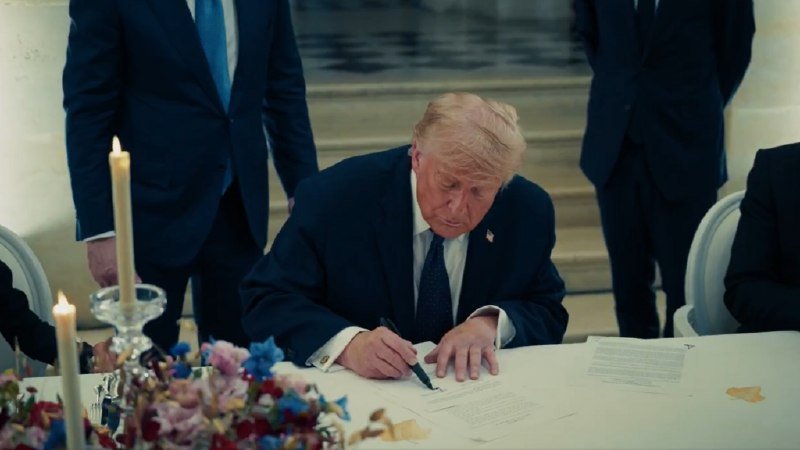
At 14:57 UTC on 17 June 2026, Donald Trump told reporters in the Oval Office that the Iran memorandum of understanding "is not final" and warned that, if he did not like it, "we will go back to dropping bombs." The statement landed less than an hour after he denied a $300 billion figure attributed to the framework and roughly an hour before he announced that sanctions on Tehran would be removed "once they behave" and that the U.S. has "space cameras" monitoring Iranian nuclear sites. The package of remarks, delivered inside a single afternoon, captures the structural condition of American leverage over Iran in 2026: the White House is bargaining in real time, with a memorandum rather than a treaty, in front of cameras.
The thread that runs through 17 June is that the deal, such as it is, has not hardened into a binding instrument. A US official told Reuters at 17:50 UTC that parties "can still walk away" and that "sequencing will be key." That is a diplomatic way of saying the document commits no one to anything irreversible, on either side. The president reinforced the point himself: Iran, he said, will "never have a nuclear weapon," but the architecture to enforce that promise remains a unilateral reservation, not a treaty clause.
What was actually announced
Three things, by the White House's own account. First, the framing: an MOU, signed or initialled, but explicitly provisional. Second, a conditional sanctions track — lifted "once they behave," a standard that the president reserves to himself. Third, a verification boast — orbital imaging of Iranian nuclear sites — offered as a substitute for the on-the-ground inspection regime that the 2015 Joint Comprehensive Plan of Action traded for sanctions relief. The president did not disclose whether the International Atomic Energy Agency retains its previous access or whether the MOU obligates Iran to dilute existing stockpiles of 60%-enriched uranium.
The $300 billion figure reported elsewhere — and described by Trump as "false" at roughly 15:17 UTC — points to the financial scale under negotiation. Whether the actual number is a fifth of that or twice it matters less than the fact that the sum is unsettled and that markets are pricing an MOU whose monetary spine has not been published. Tehran, for its part, has every incentive to keep the number live: an unfrozen asset pool is leverage in the sanctions-easing period that follows.
The reporter's reminder
A pointed exchange occurred at 17:47 UTC, captured by Israeli reporter Amit Segal. A journalist quoted Trump back to himself — "A wise man once said, in January 2020: 'Iran has never won a war, but it has also never lost a negotiation.'" The president, briefly, did not recognise the line. The reporter identified the author: Donald Trump. The line matters because it sets a benchmark the current agreement will be measured against. Iran walked out of JCPOA negotiations in 2015 with sanctions relief and an inspection regime; it walked into 2026 with centrifuges running and a 60% stockpile. Whatever the MOU delivers, it is being compared to a template Trump himself once endorsed.
Why a memorandum, not a treaty
The choice of instrument is the most under-discussed element of the day. A treaty would require Senate advice and consent under Article II of the US Constitution, exposing every sanctions-easing schedule, every enrichment cap, every snapback mechanism to committee markup and a supermajority vote. An MOU does not. It binds the executive branch for the duration of the administration and is revocable at the same speed at which it was made. A US president who openly reserves the right to "go back to dropping bombs" is, in practical terms, building in his own opt-out. Tehran understands this; Israeli planners understand this; Gulf state interlocutors understand this. The deal is, structurally, a ceasefire agreement with an exit clause.
This is the bargaining dynamic the Oval Office is operating in: maximum pressure, narrowly relaxed, with a public reservation that the relaxation is revocable. The advantage is speed. The cost is durability. Whatever is agreed in June can be unwound in October, and both sides are pricing that asymmetry into their asks.
Stakes
If the MOU holds for a full year, Iran's hard-currency position improves, Chinese and Indian refiners regain discounted barrels, and the regional arms race that followed the 2025 strikes slows. If it collapses, the verification architecture in place is weaker than JCPOA: no sealed cameras at Natanz and Fordow, no continuous IAEA monitoring, no automatic snapback at the UN Security Council. The "space cameras" boast is not a substitute. It is, at best, a tripwire.
The deeper risk is reputational. American negotiating partners — the Gulf monarchies, Egypt, Turkey, the European Three — are watching a superpower make and unmake commitments in public. Each cycle burns credibility. The MOU's principal beneficiary may turn out to be the country with the most patient negotiating posture: the one Trump himself, in 2020, conceded had never lost a negotiation.
What remains uncertain
The MOU text has not been published. The $300 billion figure is contested. The sequencing question — what Iran does first, what the United States does first, what each side gets to keep if the other side balks — is, per the US official, the only thing the parties currently agree is the only thing that matters. None of the reporting on 17 June identifies the specific Iranian counterparty who initialled the document on Tehran's behalf. The IAEA has not, as of this writing, confirmed continuity of inspections. These are not minor gaps. They are the deal.
Desk note: Monexus has framed the 17 June package as an MOU, not a treaty, and resisted the wire's tendency to call it a "deal" without qualification. The president's own words — that the document is not final and that bombing remains on the table — were treated as load-bearing facts, not as colour.
Wire provenance
This editorial synthesis draws on the following public wire/social posts:
- http://reut.rs/4uGifvC
- http://reut.rs/4xyuhKf
- http://reut.rs/4eOMfAQ
- https://t.me/amitsegal
- https://x.com/polymarket/status/2038
- https://x.com/polymarket/status/2037
- https://x.com/unusual_whales/status/2036
- https://x.com/unusual_whales/status/2035
Follow the event.
These dated source records provide context. They do not retrospectively verify this archive article.
Separate what the nuclear watchdog reported from what it could not determine after the June 2025 strikes.