Trump's Iran MOU theatre, and the Anthropic paradox the White House won't address
The president insists the Iran deal is fake news and very real in the same afternoon — while his own administration picks a fight with the AI lab least aligned with Beijing.
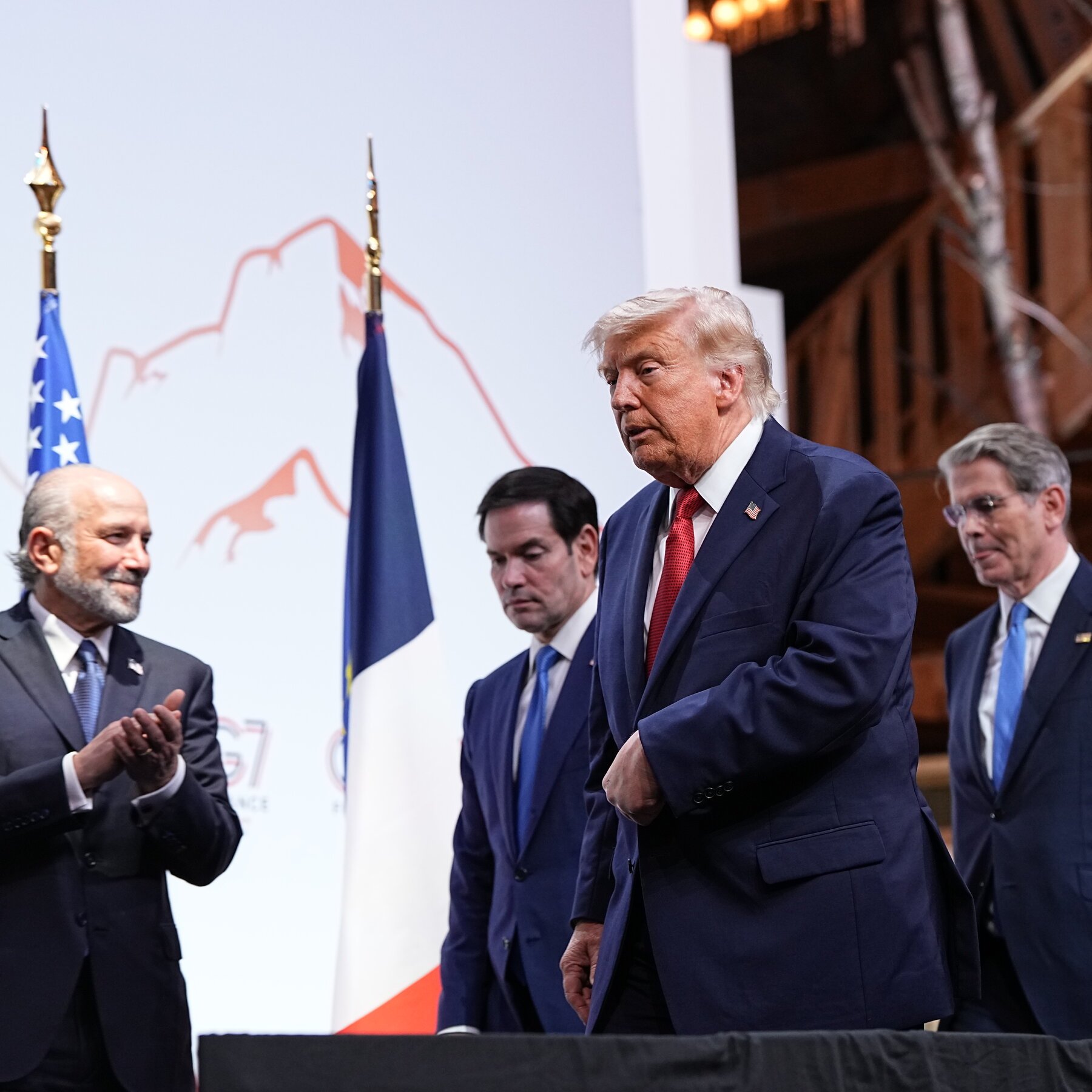
On the afternoon of 17 June 2026, Donald Trump stood at a podium and performed a familiar ritual: he denied his own policy. Reports of a $300 billion fund tied to a prospective Iran agreement, he told reporters, were false. The United States, he insisted, would not be investing in it. Then, in nearly the same breath, he confirmed that an MOU with Tehran was active, that Iran would never be permitted a nuclear weapon, and that the agreement remained contingent on his personal approval — with the implicit threat that rejection would mean a return to aerial bombardment. "You never know with deals," he said when asked whether signature would come Friday. The sequence is the story. America is conducting nuclear diplomacy in a register that no negotiator, ally, or adversary can price.
The dissonance is not an accident. It is the operating mode. By publicly disclaiming the financial architecture of any deal while preserving the option to sign one, the White House is constructing what might be called deniable diplomacy — a posture in which Tehran, the Gulf monarchies, and European signatories are invited to underwrite a framework that domestic audiences can be told does not exist. The contradictions arrive on a single news cycle, and the press, dutifully, transcribes each one as if they were independent data points. They are not. They are the point.
The MOU that does and does not exist
At 14:51 UTC on 17 June 2026, when asked whether the Iran deal would be signed Friday, the president replied with studied ambiguity: "You never know with deals." Six minutes later, at 14:57 UTC, he sharpened the threat: the MOU is "not final," and "if I don't like it, we will go back to dropping bombs." At 15:17 UTC he dismissed the financial scaffolding entirely, calling the $300 billion figure "false." Three statements, three registers — caution, menace, denial — bound to a single object. Reporting this as "Trump updates on Iran" misses the structure. The structure is that no individual statement is authoritative, and the entire set is meant to be unquotable as a position.
This is not the first time the administration has used a presidential megaphone to keep an adversary off-balance while denying allies — and markets — a fixed reference. It is, however, the first time the technique has been deployed this openly with respect to a nuclear MOU whose content, financial mechanism, and signature date are all simultaneously unconfirmed. Tehran is being asked to bargain against a moving target that the United States itself reserves the right to disown. The diplomatic utility is real; so is the instability.
The Meloni question
In the same news cycle, at 08:40 UTC, Trump met Italian Prime Minister Giorgia Meloni for their first known bilateral since their public clash over Pope Leo XIV and the Iran operation. Rome is a NATO ally with substantial Mediterranean exposure to any escalation; the Vatican, separately, has become a vocal interlocutor on the morality of strikes against Iranian assets. A meeting described by wire services as a "reset" is also, structurally, a vote of confidence from a European leader whose coalition has been the administration's most reliable partner on irregular-migration policy and on recalibrating the EU's relationship with Beijing. The timing suggests Rome is choosing to keep the channel open. The leverage flows the other way: Italy needs predictability on the southern flank, and predictability is precisely the commodity the White House is currently refusing to supply on Iran.
The Anthropic question the White House would rather not answer
If the Iran file is theatre, the Anthropic file is the more revealing contradiction. At 15:10 UTC, news circulated that Anthropic employees were claiming the Trump administration is unfairly targeting the company. The framing is delicate: Anthropic is the U.S. frontier-AI lab most associated, in industry and policy circles, with caution on frontier-model exports and on the diffusion of advanced compute to jurisdictions of concern — a position that, on its face, should make it a partner rather than a target. The complaint from staff, that the administration is moving against them, is therefore a complaint about a posture that is structurally aligned with stated White House priorities. The most plausible read is not that the policy substance has changed, but that the political geometry has: a company whose leadership is treated as friendly to Beijing-coded critics becomes a target regardless of what its models actually do.
This is the deeper tell. The same administration that depends on American frontier-AI leadership to outpace Chinese compute and tooling is willing to treat a model-development partner as an adversary for reasons that have more to do with domestic coalition politics than with technology strategy. The Iran MOU and the Anthropic pressure sit on the same shelf: in both cases, the U.S. position is defined less by what the policy does than by which domestic actor can credibly claim credit or inflict cost. That is not strategy. It is performance dressed as strategy, and the cost of confusing the two is measured in months, not cycles.
What remains uncertain
The sources do not specify the contents of the Iran MOU, the architecture of any fund, the location or participants of the Meloni meeting beyond its existence, or the formal mechanism by which the administration is allegedly pressuring Anthropic. Each claim in the public record therefore carries a different epistemic weight, and a reader should treat the Iran statements as verbatim but contextual, the Meloni meeting as confirmed but thin on detail, and the Anthropic allegations as employee-reported rather than independently verified. The 17 June picture is a snapshot of posture, not a picture of substance — which is, in the end, the substance of the posturing.
This article is a staff-writer opinion piece. Monexus reads the day's wire as a sequence of postures, and the day's postures as a sequence of choices; today, the choices on Iran and on Anthropic are pointing in opposite directions from the same podium.
Wire provenance
This editorial synthesis draws on the following public wire/social posts:
- https://t.me/unusual_whales/178529
- https://t.me/polymarket/204118
- https://t.me/unusual_whales/178527
- https://t.me/polymarket/204116
- https://t.me/polymarket/204114
- https://t.me/polymarket/204108
Follow the event.
These dated source records provide context. They do not retrospectively verify this archive article.
Separate what the nuclear watchdog reported from what it could not determine after the June 2025 strikes.