Trump's quiet Ukraine optimism, and the limits of doing "pretty well"
The president says Kyiv is "holding its own" with American kit. The harder question is whether that frame survives contact with the battlefield, and the sanctions clock he has yet to set.
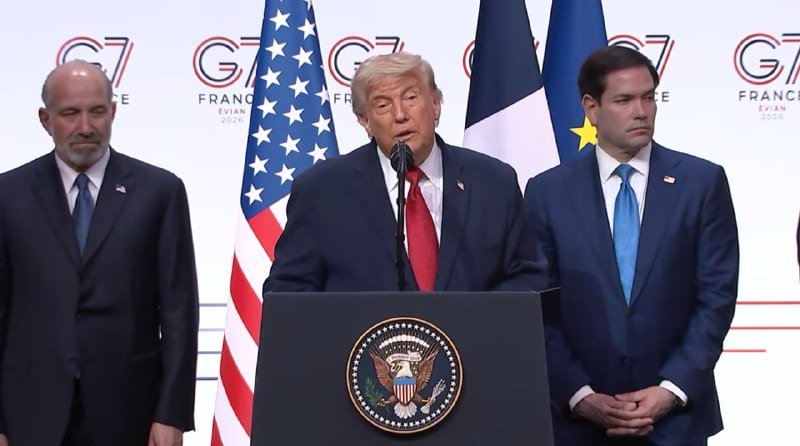
On 17 June 2026, at roughly 19:35 UTC, President Donald Trump told reporters that Ukraine is "doing pretty well" against Russia, that Moscow fields "a much bigger military," and that Kyiv is nonetheless "holding their own" with "great equipment, including ours" [noel_reports, 17 June 2026, 19:39 UTC; osintlive, 17 June 2026, 19:35 UTC]. He did not announce a new sanctions package. When asked what he would do on sanctions, the answer, by his own telling, is still pending. The contrast between the verdict and the policy is the story.
For a White House that has spent months oscillating between ultimatum and accommodation toward Moscow, "pretty well" is a notable frame. It concedes the size differential in plain English, credits American kit, and avoids the boosterish "winning" language that has tripped previous administrations. It also asks the listener to treat a grinding attritional war as something a stable equilibrium can contain. That is the optimistic read. The sceptical read is shorter: optimism, in this White House, has often preceded reversals.
What Trump actually said
Five separate channels logged the same exchange within twenty minutes of each other, which suggests a pool spray rather than a one-on-one [operativnoZSU, 17 June 2026, 19:29 UTC; ClashReport, 17 June 2026, 19:19 UTC; Tsaplienko, 17 June 2026, 19:27 UTC]. The substance is consistent: Ukraine is performing; Russia has the manpower and mass advantage; American equipment is part of the reason Kyiv is still in the fight. Trump added, "Don't forget," a reminder that US matériel flows remain the variable, not the constant. Ukrainian-facing channels quoted the line directly; the wording carries the cadence of something Trump has said before, with minor variation, since returning to office.
The conspicuous absence is a sanctions trigger. Trump has at various points tied escalation against Russia to specific battlefield or negotiating benchmarks. The 17 June remarks carry the texture of a check-in rather than a decision. The president was asked about his sanctions plan; the answer he gave was about the war, not the policy lever. Whether that is sequencing — confidence first, pressure later — or a deferral is not clear from the available reporting.
The optimistic reading
Taken at face value, the remarks fit a coherent theory of the case: the front has stabilised, Russian offensive potential is being absorbed faster than Moscow can regenerate it, and the marginal American input — air-defence interceptors, long-range strike permission, intelligence sharing — is enough to keep the differential manageable. In this reading, "pretty well" is not spin. It is the read of a president who has access to operational briefings and is choosing to understate rather than oversell.
There is supporting logic for that view. Ukrainian deep-strike operations into Russian rear areas have, in recent reporting cycles, imposed real cost on Russian logistics and aviation infrastructure. Western matériel flows have not collapsed. European industrial output is gradually replacing some of the categories the US has been slower to supply. None of this means Ukraine is winning in the colloquial sense; it means the trajectory on the ground is not the trajectory Vladimir Putin's mouthpieces describe.
The structural objection
The structural objection is that "pretty well" is a phrase calibrated for a press pool, not a battlefield. It does not name a city, a sector, or a metric. It does not specify whether the equipment referenced is arriving on schedule, whether interceptor stockpiles are adequate, whether mobilisation is producing the trained manpower needed to hold a line of contact that lengthens every kilometre the front shifts. It does not address the financial pressure on Kyiv's budget, which has been the silent crisis of 2026 for any reader who follows the IMF programme.
There is also the question of what "doing pretty well" licenses politically. If the war is being managed rather than being won, the domestic argument in the United States tilts toward asking why American taxpayers are subsidising a stalemate. That argument exists on both sides of the aisle. If, on the other hand, the war is being won, the argument inverts. The president's choice of vocabulary — uncommitted, mid-register, deliberately short of "winning" — leaves the political case half-built.
Stakes and what to watch next
The near-term stakes are concrete. A new sanctions package, or the visible preparation of one, would harden the optimistic frame into something with weight. The absence of one keeps the frame vulnerable to a single bad week on the ground. Ukrainian commanders have spent four years learning not to read White House adjectives as policy; that wariness is now extending to American allies and to financial markets pricing Russian sovereign risk.
What remains genuinely uncertain is whether 17 June marks the high-water mark of presidential patience or the bottom of a patience curve that resets upward. The sources agree on what was said. They do not agree, because they cannot, on what the president intends to do when the next news cycle demands a decision. The optimistic reading and the sceptical reading are both defensible from the same record. That is precisely why the next move — sanctions or silence — will matter more than the words that preceded it.
Desk note: This publication framed Trump's remarks as policy theatre conditioned by an unanswered sanctions question, rather than as a definitive read on the battlefield. Wire coverage of the exchange leaned on the verbatim quote; the analysis above treats the quote as data about the political centre of gravity, not as a forecast.
Wire provenance
This editorial synthesis draws on the following public wire/social posts:
- https://t.me/noel_reports
- https://t.me/osintlive
- https://t.me/operativnoZSU
- https://t.me/Tsaplienko
- https://t.me/ClashReport