The line Israel is drawing in southern Lebanon
Residents of Hadath and other southern Lebanese towns are returning home to a landscape in which the IDF has published a map claiming to operate up to ten kilometres inside the border — a unilateral redraw that will shape the next phase of the ceasefire.
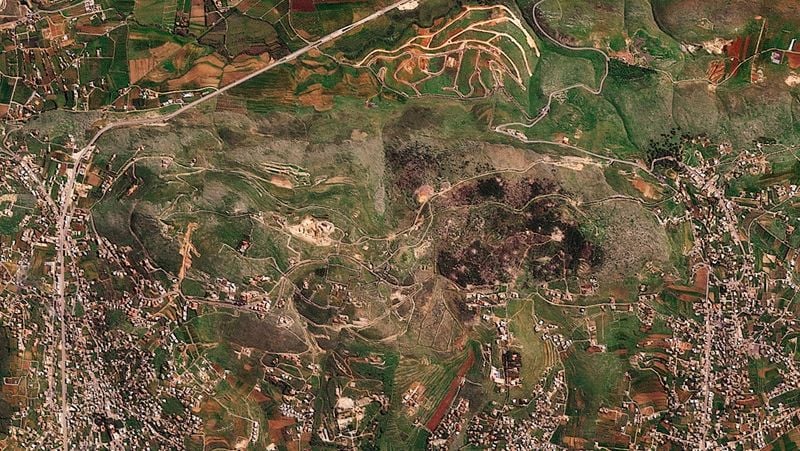
On the morning of 18 June 2026, convoys of cars carrying returning residents began snaking back into the southern Lebanese town of Hadath, escorted by Lebanese army vehicles and Red Cross-branded ambulances, after weeks of intense combat along the frontier with Israel. The scenes, broadcast from the town by Lebanon's Gaza Alanpa channel and corroborated by Iran's Tasnim news agency, were the first visible sign of a population coming home to a frontier that, on paper at least, has just been redrawn. Hours earlier, the Israel Defense Forces had published a map of a so-called "security zone" in southern Lebanon, claiming its forces were operating up to approximately ten kilometres inside Lebanese territory — a unilateral demarcation that goes well beyond the ceasefire understanding that paused large-scale fighting in late 2025.
The Hadath return is the first concrete test of whether the pause will hold in a form that resembles its original terms, or whether the IDF's expanded operational footprint has effectively converted the ceasefire into something closer to a slow-motion occupation. The map matters because, in southern Lebanon, the line on a page is also a line on a road, a school catchment, an olive harvest and a pharmacy run. If the IDF is genuinely deploying ten kilometres north of the Blue Line, the civilian geography of dozens of border villages is being rewritten without a treaty, a UN Security Council resolution, or even a public exchange of letters between Beirut and Jerusalem.
A population returns to a different map
The convoy into Hadath, documented by the Gaza Alanpa Telegram channel at 10:44 UTC on 18 June, was framed by its broadcasters as the first organised return to a town that had been a frontline. Residents were accompanied by Lebanese army units and ambulance teams; the framing was explicitly that of a civilian population reclaiming a town after the "resistance's confrontation with the occupation forces" — language that places the episode firmly in the political grammar of Hezbollah and its allies, but that also reflects a basic humanitarian reality. People are going home.
Iran's Tasnim news agency, in a parallel post at 10:25 UTC, presented the same return as part of a broader pattern of Lebanese residents filtering back into the border strip. Tasnim's choice to amplify the story is itself part of the story: Tehran's English- and Arabic-language outlets have consistently framed southern Lebanon as a Hezbollah recovery narrative, and they have a political interest in showing a population that returns willingly to villages from which Iranian-aligned forces were not dislodged. None of that is fabricated. But the images, when stripped of their narration, show Lebanese soldiers and ambulances doing the work of bringing civilians back across a contested line — a work that, in any other border dispute in the region, would be the joint responsibility of the Lebanese state and a UN interim force.
The UN Interim Force in Lebanon (UNIFIL) does not appear in the available reporting as a coordinating actor for the Hadath return. That absence is itself a data point. UNIFIL's mandate has been contested by Israel for the better part of two decades, and the current arrangement leaves the Lebanese army as the de facto face of civilian re-entry into the south — a role the LAF has played unevenly in past ceasefires, and one it cannot play at all in areas the IDF has declared part of its security zone.
What the IDF actually published
The Watchful Witness channel, summarising IDF material at 10:10 UTC on 18 June, described the publication of a map showing IDF operations extending to "approximately 10km" inside Lebanese territory. The claim, attributed to the IDF, was not paired in the available reporting with a corresponding Lebanese government statement, a US-brokered understanding, or a UN acknowledgement.
A ten-kilometre operational band is not a buffer zone in the technical sense used in the November 2024 ceasefire arrangement. That arrangement, mediated by the United States and France, envisaged an Israeli withdrawal contingent on the deployment of the Lebanese army to the border area and on the disarmament of non-state armed groups — primarily Hezbollah — north of the Litani River. The IDF's published map, as reported, does not assert permanent annexation; it asserts a continuing operational envelope. But in southern Lebanese geography, an operational envelope of ten kilometres swallows dozens of villages, the entire Tyre suburbs corridor, and a large part of the Bint Jbeil district's agricultural land.
Israel's official position, repeated by successive governments and IDF chiefs of staff, is that direct operations are required until there is credible assurance that Hezbollah has been prevented from re-establishing a rocket and drone infrastructure along the border. That is a legitimate security claim, and it is one that the post-7 October threat picture — Hezbollah's cross-border fire on 8 October 2023 and the subsequent campaign — has given Israeli decision-makers political cover to assert more aggressively than in any period since 2000. But the asymmetry is real: a non-state armed group, however destabilising, is not the same legal entity as a sovereign neighbour, and an Israeli security zone unilaterally declared inside Lebanese territory is, in international-law terms, an occupation in all but name.
The counter-narrative from Beirut and Tehran
The Lebanese framing, as carried by Gaza Alanpa and Tasnim on 18 June, is unambiguous: the IDF map is an Israeli violation of sovereignty dressed up as a security measure. The Lebanese state's preferred language for this kind of operation is "occupation forces," and the return of residents to Hadath is presented as a partial repudiation of the IDF's claim to control the area. From Beirut's perspective, the test of the next phase is whether the Lebanese army can deploy into the zone the IDF has drawn — not just the original Blue Line strip — and whether the United States and France will compel Israel to revert to the ceasefire's narrower perimeter.
Iran's interest is more layered. Tehran's regional position depends on Hezbollah retaining some form of military and political viability in the south; a security zone that physically separates the movement from the border is a structural defeat, even if Hezbollah's leadership cadre and rocket inventories survive. Tasnim's coverage of the Hadath return, with its emphasis on civilians going home under army and ambulance escort, is therefore a soft-power counter to the IDF map — a way of asserting that life is returning to a geography that Israel claims to control.
Both counter-claims deserve airtime. They are not invented. But they are also not neutral. The Lebanese state's framing elides the fact that Hezbollah rearmed and rebuilt in the border area through 2023 and 2024, and the Iranian framing assumes a continuity of resistance infrastructure that the IDF's map is, in part, designed to disrupt. The honest read of the situation is that all three parties — the IDF, the Lebanese state, and Hezbollah via its media mouthpieces — are describing the same geography in three incompatible ways, and that the civilians in Hadath are the ones driving through it.
The structural pattern: redraws by map
What is happening on the border is part of a longer regional pattern in which a stronger local actor issues a map and waits to see whether the international order pushes back. The Israeli map of southern Lebanon sits alongside, and rhymes with, the Israeli map of Gaza's humanitarian zones, the Israeli buffer strip in the Golan, and the long history of unilateral demarcation in the West Bank. In each case, the mechanism is the same: a security justification is asserted, a line is drawn, the line is treated as a working fact on the ground, and the international community is presented with the choice of either contesting the line at a cost it has historically been unwilling to pay, or letting the line harden.
For Lebanon, the cost of contestation is the re-escalation of a war whose last phase, in 2024, displaced roughly a million people and devastated whole districts. For the United States and France, the cost is the political exposure of the ceasefire they brokered. For the United Nations, the cost is the further erosion of UNIFIL, the only international force currently monitoring the line. The default option, in other words, is acceptance — and the IDF's map is, in part, an instrument designed to make acceptance the path of least resistance.
That instrument only works if the people who live under it are not visibly present. The Hadath return, modest as it is, complicates the instrument. A population that has come back to a village inside the declared zone makes the zone harder to administer, easier to film, and harder to present to European and Arab capitals as a routine security measure rather than an occupation.
Stakes, time horizons and what remains uncertain
If the IDF's ten-kilometre operational band holds, the consequences are concrete and traceable. The Lebanese state's sovereignty over the border strip is effectively suspended for the duration of the deployment. UNIFIL's already-reduced footprint becomes more symbolic. Hezbollah's ability to project fire into northern Israel from positions south of the Litani is degraded, which is the operational point. The Lebanese government will face an internal political crisis if it is seen to have consented to the arrangement, and an external one if it is seen to have been overridden.
The time horizon is not specified in the available reporting. The IDF has not, on the basis of the three source items, published an end-state for the zone or tied it to a verifiable disarmament benchmark. That is the central uncertainty. The map, in other words, is a claim about the present, not a roadmap out. The Lebanese return to Hadath is a claim about a different present — one in which civilians live in the zone rather than flee it. The contest between the two claims will be fought, day by day, in the streets of villages like Hadath, in the language of UN statements, and in the diplomatic traffic between Beirut, Jerusalem, Washington and Paris.
What the sources do not tell us is whether the United States has been formally briefed on the IDF map, whether the Lebanese army has been told to coordinate with the IDF in the declared zone, and whether the UN Security Council has been notified. The three Telegram-channel items available are field reports; the diplomatic record behind them is not visible in the thread. For the moment, the line is being drawn in plain sight, and the question is whether anyone with the leverage to contest it decides that the cost of doing so is lower than the cost of letting it stand.
This Monexus long read threads three field reports from Lebanon's southern border on 18 June 2026 into a single read of what the IDF's published security zone means on the ground. Wire coverage from Reuters, AP and AFP on the November 2024 ceasefire and the broader Hezbollah-Israel exchange has been the editorial reference set; the Telegram sources cited below are the only direct inputs for the specific events of 18 June.
Sources
Wire provenance
This editorial synthesis draws on the following public wire/social posts:
- https://t.me/gazaalanpa
- https://t.me/JahanTasnim
- https://t.me/wfwitness
- https://en.wikipedia.org/wiki/United_Nations_Interim_Force_in_Lebanon
- https://en.wikipedia.org/wiki/Blue_Line_(Lebanon)