Explosions rock Niamey airport in Niger's coup-era capital, witnesses say
Early-morning blasts and sustained gunfire at the capital's main airport punctuate a week of pressure on the junta that seized power in 2023, though the source material so far names neither an attacker nor a target.
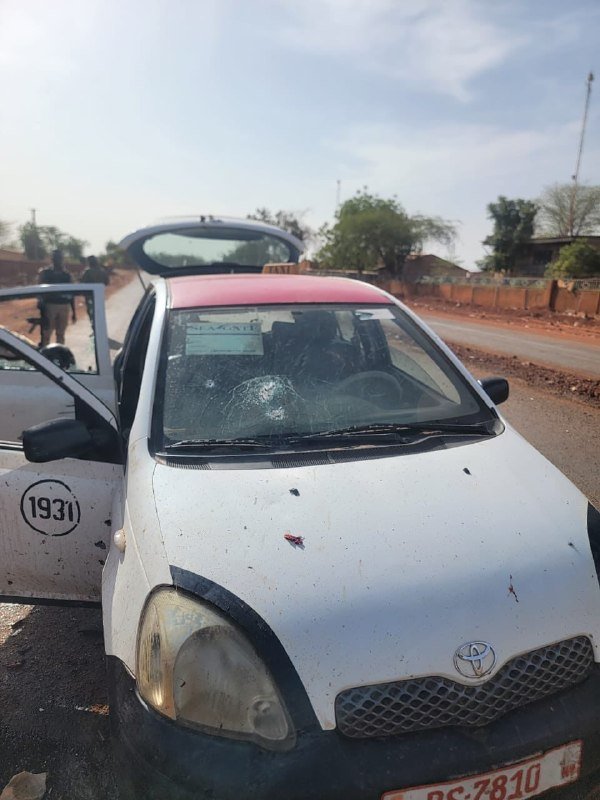
Explosions and sustained gunfire were heard before dawn on Thursday, 18 June 2026, at the airport serving Niamey, the capital of Niger, according to witnesses and security sources cited by Reuters and republished by Telegram channels monitoring the Sahel (07:20 UTC, 07:49 UTC). France 24 reported the same sequence of events from its own correspondent string at 07:46 UTC, describing the area as blocked off by security forces as residents said the firing continued. Iran's Tasnim, often used as a clearing-house for Reuters and AFP wire copy into Persian-language feeds, carried an identical account at 07:37 UTC.
The pattern matters more than the plume. Niamey has not seen open combat inside the capital since July 2023, when mutinying soldiers detained President Mohamed Bazoum and installed General Abdourahamane Tchiani at the head of the Conseil National pour la Sauvegarde de la Patrie. The junta has since aligned Niger with Burkina Faso and Mali inside the Alliance of Sahel States, expelled French and most Western military missions, and courted Russian and Turkish partners. An attack, or an attempted attack, on the country's principal international airport would test that arrangement in public.
What the wire says, and what it does not
Three of the four source items are explicit re-publications of a single Reuters bulletin: an al-Arabiya-affiliated channel broke the line at 07:20 UTC, the Tasnim mirror ran it at 07:37 UTC, and the @wfwitness feed, which tracks West African security incidents, carried it at 07:49 UTC. France 24, the only outlet that has so far filed its own dateline, corroborates the report without adding detail on a perpetrator, a target, or a casualty count. None of the available material names a group, claims responsibility, or identifies a specific facility within the airport complex. Until the junta's communications apparatus issues a statement — or an outside outlet files from the ground — the morning's events sit in that thin, dangerous zone between an event and its framing.
This matters because Sahel reporting has, since the 2023 coup, been a tale of two pipelines. The first is the Western wire, which travels through Reuters and AFP bureaus in Dakar and Accra and arrives with the discipline of attributed sourcing. The second is the state-aligned channel, dominated since the French expulsions by the CNSP's own press office and by Russian-language platforms with limited on-the-ground capacity in Niger. Both pipelines can be wrong; both can be late. A blast that produces a Reuters flash but no Reuters follow-up by mid-morning UTC is, at minimum, an under-corroborated event.
The structural frame: a junta under three pressures at once
Whatever the cause of the morning's blasts, they land on a government already absorbing pressure from three directions. First, the Economic Community of West African States, despite announcing a partial lifting of sanctions in 2024, has not restored Niger to its customary trade and financial rails, and Abuja in particular has kept the diplomatic temperature elevated over the Bazoum detention. Second, the Alliance of Sahel States itself is a strained construction. The three military governments continue to coordinate on a shared currency proposal and a regional defence posture, but the Burkinabè and Malian juntas face their own insurgencies, and the 2024 declaration of a Confederation has produced fewer deliverables than communiqués. Third, the Russian footprint — principally the Africa Corps formations that succeeded Wagner after Prigozhin's death — has not stabilised the security situation in any of the three capitals; insurgent attacks in northern Mali and eastern Burkina Faso have continued at roughly the same tempo through the first half of 2026.
Against that backdrop, an airport incident in Niamey reads less as a surprise than as a stress test. A country's main civilian airport is, in the language of the trade, soft infrastructure: a single perimeter, a known flight schedule, a limited guard force. It is the kind of target at which a small, well-motivated actor can produce outsized political signal.
Counter-narrative: a military drill, or a kinetic event?
The most plausible alternative read is that the morning's noise was a scheduled security exercise that observers mistook for a real incident. Sahel capitals have, since the coups, run frequent public-order drills around transport nodes; in October 2025, a Niamey garrison exercise produced several hours of confusion before the CNSP press office issued a clarifying statement. The sequencing of the early Telegram posts — all of them essentially restating the same Reuters line without independent attribution — is consistent with a flash that has not yet been confirmed. Counter-pattern, the harder read, is that a previously unknown cell of the Islamic State Sahel Province or Jama'at Nusrat al-Islam wal-Muslimin has crossed the line from rural theatre into the capital — an event that, if confirmed, would mark an escalation beyond the insurgent group's published 2026 operating tempo.
Until a Niamey datelined piece of reporting names a weapon, a crater, or a casualty, both readings remain live.
What is at stake
If the morning's events are confirmed as an attack, the Tchiani government will face an immediate demand to demonstrate control of the capital and to identify a culprit — a demand that has political cost whichever answer it gives. Naming a jihadist group would underline the failure of the Russian-aligned security model. Naming an internal rival would fracture the CNSP. Naming an external state would invite escalation. The Alliance of Sahel States partners, watching from Ouagadougou and Bamako, will read the response for what it tells them about Niamey's resilience.
For ECOWAS and for Western capitals, the incident reopens a question that had drifted to the margins of the Sahel file: whether the post-coup security architecture, with its pan-African solidarity framing and its Russian training footprint, can hold the line against the kind of insurgent pressure that has already cost Bamako and Ouagadougou territory. Investors with exposure to Nigerien uranium — the country's dominant export, and a chain in which France's Orano remains a key counterparty despite the political rupture — will be watching the press conferences, not the plumes.
What remains uncertain
The source material does not specify which facility inside the airport complex was struck, whether civilian aviation has been suspended, or whether any casualties have been reported. Reuters, France 24, and the Telegram mirrors agree on the core event; they are silent on motive, attribution, and damage. The CNSP has not, as of the latest available item, issued a statement, and no Niamey-based outlet has filed an independent account. This publication will update the wire if a domestic statement, a credible claim of responsibility, or a casualty figure emerges from a named source.
How Monexus framed this: the early wire supports an event, not yet a story. We have held the framing to what the four available items — three of them Reuters relays, one a France 24 corroboration — actually say, and flagged the absence of attribution, perpetrator, and target rather than papering over it with plausible-sounding conjecture.
Wire provenance
This editorial synthesis draws on the following public wire/social posts:
- https://t.me/wfwitness
- https://t.me/JahanTasnim
- https://t.me/alalamarabic